Statement by the Abroad Committee of the Communist Party of Iran on the Occasion of October 10
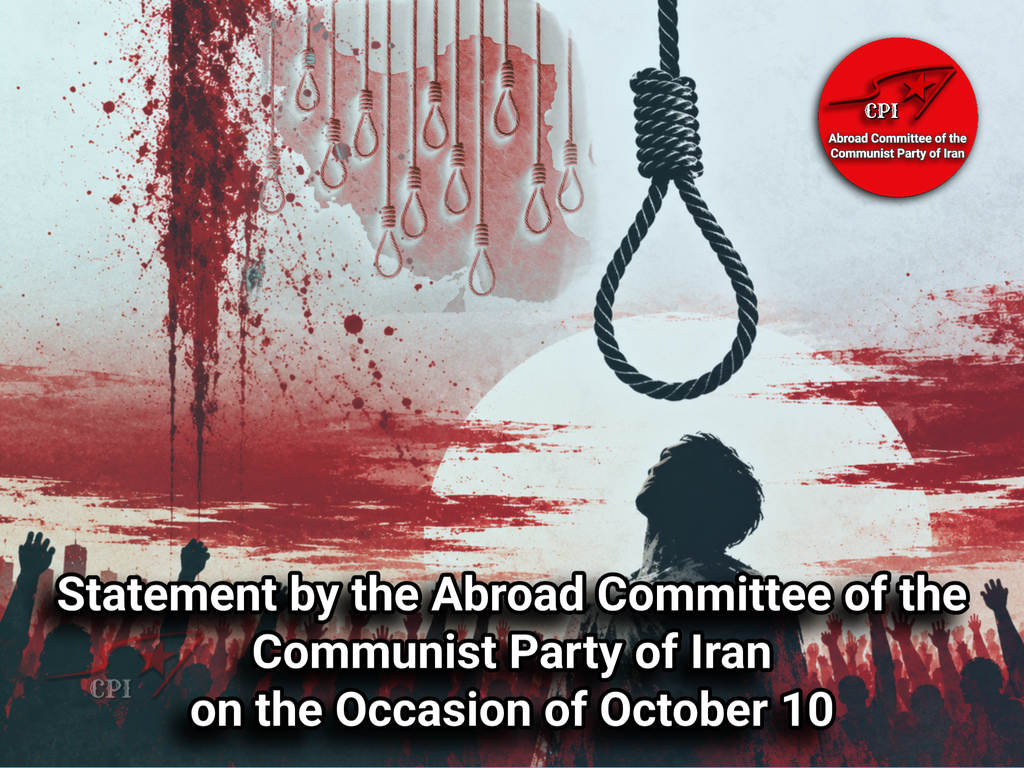
October 10, the World Day Against the Death Penalty, is not merely a day to protest against one form of punishment. At the same time, it is an opportunity to ask the fundamental question: who has the right to decide on behalf of society about the death of a human being, and in the service of what system is this right exercised?
The issue of execution cannot be separated from the structure of the state, class relations, and social inequalities. The state in a class society is not merely a neutral collection of institutions. Legal, judicial, and penal institutions also operate within existing relations of power and ownership. From this perspective, the death penalty is not only the end of an individual’s life, but also a stark display of the state’s coercive power and the system’s power over the human body and existence.
Execution does not eliminate violence; it reproduces it through the language of law. Where the system, in the form of punishment, turns killing a human being into a legal act, the boundary between permitted and prohibited violence becomes dependent on the decision of political power. Opponents of the death penalty, from various intellectual and political currents, have pointed to this fundamental aspect and called for its worldwide abolition.
But criticism of the death penalty must go one step further. The issue is not merely that the death penalty is inhumane. The question is what social conditions drive people toward crime, violence, and marginalization, and why the existing order so often responds by punishing the individual instead of changing these conditions?
Poverty, unemployment, discrimination, social deprivation, unequal access to education and healthcare, and social subordination cannot be resolved with a noose, an execution squad, or the gallows. A society that produces inequality and then views the victims of that inequality merely as criminals pushes the social causes of the problem to the margins.
From this perspective, opposition to the death penalty does not mean ignoring the suffering of victims of crime or denying the necessity of accountability for violence. On the contrary, the question is how justice can be separated from revenge. How can social security be connected with prevention, rehabilitation, accountability, and social justice, without the state reserving for itself the irreversible right to take human life in the name of achieving justice?
In many societies, the implementation of the death penalty is disproportionately linked to poverty, discrimination, and vulnerable social circumstances. This issue has also received attention in global campaigns against the death penalty.
Therefore, the struggle against the death penalty should not be reduced to a merely legal demand. Abolishing the death penalty is part of a broader struggle for a society in which human beings are neither tools of labor, nor numbers in crime statistics, nor objects of the exercise of state power, but possessors of the right to life and dignity.
Abolishing the death penalty alone does not create a just society, but a just society cannot be built upon a legal right to kill and deprive human beings of life.
The Islamic Republic came to power through repression, imprisonment, torture, and execution, and throughout the past forty seven years it has also ensured its survival by relying on these same tools. Today, after forty seven years, at a time when it is facing deep political, economic, social, and international crises, it has resorted to repression and execution more than ever and has increased the number of executions. It sends many protesters and opponents to the gallows in order to silence voices of protest and resistance in society by creating fear and terror. This is while global powers and countries that claim to defend democracy and human rights have turned a blind eye to all this repression, execution, and crime by the Islamic Republic, remained silent, and pursued their political and economic interests and relations with this regime.
We call on all freedom-loving, equality seeking people and awakened consciences to participate in the actions and programs on October 10 and be the voice of prisoners, those sentenced to death, and their families.
October 10 reminds us of this simple yet profound principle: life cannot be protected through death. Justice cannot be built through revenge. And the roots of violence cannot be eliminated without changing the social conditions that reproduce it.
The struggle against the death penalty is a struggle for the right to life, and the struggle for the right to life is part of the struggle to liberate humanity from social relations that reproduce poverty, subordination, and violence.
No to executions, no to repression and imprisonment
No to a law and system that regards death as a tool of punishment in order to preserve its order.
Abroad Committee of the Communist Party of Iran
October 7, 2026