Aban 98; An Uprising That Was Never Silenced
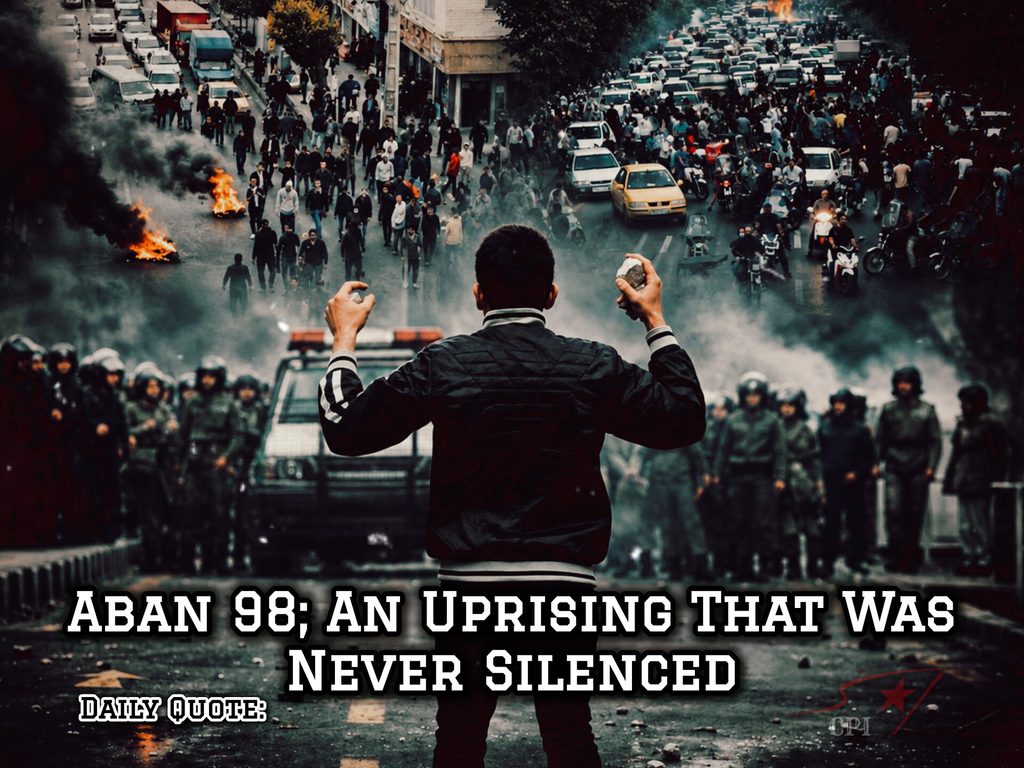
We are approaching the anniversary of the Aban 98 (Iranian Calendar) uprising, an event that has been etched into the collective memory of the people of Iran as “Bloody November.” The uprising began on November 15, 2019, following a sudden increase in gasoline prices, and became one of the largest and most widespread anti-government protests in the history of the Islamic Republic. Within a short period, the protests spread to nearly 200 cities and hundreds of locations across the country. The government responded with severe repression, a nationwide internet shutdown, and the mass killing of protesters. Since then, the memory of those who lost their lives in November has become a symbol of collective resistance and the continuity of freedom-seeking movements in Iran, a connection whose continuation could be clearly seen in the “Woman, Life, Freedom” uprising.
By simultaneously announcing and implementing the increase in gasoline prices, the Islamic Republic took the masses by surprise and, in practice, drove the urban poor and young people, who had been pushed to the brink by poverty and unemployment, into the streets. It appeared that the government had a prearranged plan to drown the uprising in blood within its very first hours and extinguish, in a single day, the flames of the oppressed people’s pent-up anger. But the revolt of these marginalized poor people and the astonishing speed with which it spread nationwide disrupted the government’s calculations and sent shockwaves through its ranks. Once again, this event demonstrated that a profound and historic transformation was taking shape in Iranian society.
The Aban uprising was neither sudden nor without precedent. The structural crisis of Iranian capitalism and the devastating consequences of neoliberal economic policies, combined with religious rule, corruption, and rent-seeking, had imposed unprecedented poverty and deprivation on the majority of the population. This situation had long been creating the objective conditions for social revolt. The reimposition and intensification of economic sanctions, the collapse of the rial’s value, and the sharp decline in the purchasing power of workers and disadvantaged sections of society further aggravated these conditions. Alongside this, the spread of workers’ strikes and protests, nationwide struggles by teachers and retirees, the renewed rise of the student movement, and the energetic participation of women in these struggles had made the outbreak of such an explosion almost inevitable.
The November 2019 uprising should be seen as a continuation of the December 2017–January 2018 uprising, with the difference that it had a broader scope and greater strength. The driving force behind this movement consisted of the urban poor, unemployed young people, and marginalized sections of society. Like any other powerful political movement, this nationwide uprising shifted the balance of forces in favor of the protest movement and created more favorable conditions for the expansion of economic and political struggles. Once again, November prepared the ground for the growth of workers’ struggles and other protest movements, demonstrating how such upsurges can become powerful catalysts for struggle and strengthen workers’ determination to resist.
The presence of young people, working people, and laborers in these protests, as well as their inspiring solidarity in confronting the repressive forces, showed that the fear the government had instilled in people’s hearts through its repressive apparatus had given way to anger, solidarity, and resistance. This movement also revealed how an energetic society engaged in struggle can produce new leaders and organizers and bring them to the forefront. Such a development has laid the groundwork for connections among these leaders, the establishment of local communication and struggle networks, and progress toward mass and council-based institutions in neighborhoods.
One of the most prominent features of the November uprising was that it mobilized poor people and young people simultaneously in both large and small cities. The cities of Kurdistan and Khuzestan, which had remained to some extent detached from the nationwide movement during the December 2017 uprising, played a prominent role in the protests from the very beginning this time. The working people of Kurdistan demonstrated that, contrary to the prescriptions offered to them by nationalist parties, they have no path to liberation from the Islamic Republic other than solidarity with the nationwide revolutionary movement.
One of the government’s main objectives in massacring protesters was to impose an atmosphere of terror and fear on society, particularly to intimidate generations born after the 1980s. But the government failed to achieve this objective. The people were not intimidated by this bloody repression; instead, through expressing their anger and protest, they brought the government itself into a state of fear. Immediately after these crimes, various workers’ organizations and institutions, retirees’ associations, teachers’ organizations, writers, and artists inside the country condemned them by issuing statements and declarations. Workers’ strikes and protests continued uninterrupted, and on December 7, the student movement, despite being surrounded by security forces, held impressive gatherings condemning the government’s crimes and declaring that the freedom movement in Iran had not been intimidated by this horrific massacre.
Nevertheless, like the December 2017–January 2018 uprising, the November uprising also subsided after approximately one week, despite the sacrifices and selflessness of those who had initiated it and its significant achievements. Once again, workers in factories and large industrial complexes, who through their successive struggles had helped create the conditions in people’s consciousness for this uprising, were not prepared to join the revolt of their fellow workers in the streets through coordinated, nationwide strikes at production centers. Such a connection could have paralyzed the repressive apparatus and paved the way for a general political strike. The absence of this link was one of the most significant shortcomings of this mass uprising. In reality, the November uprising had brought only part of its potential strength into the field and was not prepared for a final confrontation.
By killing more than 1,500 people, most of them young, and injuring, arresting, and imprisoning thousands of others, the government forced this movement into retreat. The leaders of the Islamic Republic believed that, with the help of the COVID-19 pandemic, they had managed to escape the pressure of the movement seeking justice for those killed in November. But the events of the following years, particularly the “Woman, Life, Freedom” uprising, demonstrated that a much greater force had been taking shape deep within society. November 2019 was not the end of a path, but one link in a chain that continues to this day.