Parliamentarianism: Achievements and LimitationsOn the Occasion of the International Day of Parliamentarism
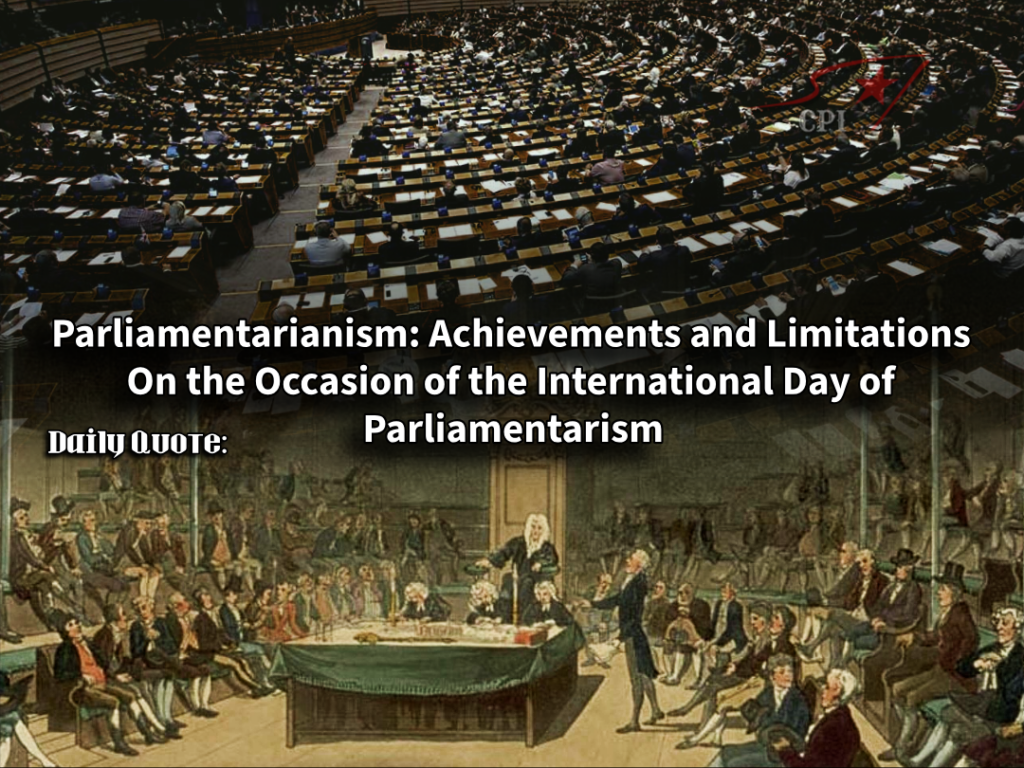
Over the past two centuries, the parliamentary system has been one of the most important institutions of bourgeois democracy, an institution intended to embody the “general will” through elected representatives and to provide an accountable intermediary between the state and society. Every year, the United Nations and the Inter-Parliamentary Union (IPU) observe 30 June as the International Day of Parliamentarism, highlighting the role of parliaments in safeguarding human rights and democracy.
At the same time, however, these institutions warn that public trust in political institutions has declined and that parliamentary democracy faces growing threats from populism, extreme nationalism, and the weakening of democratic institutions. This has led many to ask: Can parliament still serve as the principal pillar of democracy? The reality is that parliamentary systems, despite all their limitations, have produced significant achievements for humanity.
Parliaments originally emerged as instruments for limiting the power of monarchs and absolute governments. Requiring governments to be accountable to an elected legislature represented a fundamental step in the transition from personal despotism to the rule of law. Although such representation has always been incomplete and shaped by class interests, the establishment of electoral mechanisms created the possibility of the peaceful replacement of governments and the public articulation of social demands. Compared with the naked forms of dictatorship, this represented an undeniable historical advance.
Many civil and political rights, as well as a significant share of social and labour rights “including the minimum wage, social insurance, women’s rights, and more” were consolidated through parliamentary processes, particularly during the height of the welfare state in post-Second World War Europe.
As a forum for negotiation, debate, and compromise, parliament has also enabled many class and political conflicts to be managed through legal and public mechanisms rather than violent confrontation. These are achievements that even radical critics generally recognise as important historical accomplishments of parliamentary democracy, although they do not regard them as sufficient or final.
In recent decades, however, signs of a profound crisis have emerged within parliamentary systems—a crisis reflected both in political developments, such as declining electoral participation, increasing public distrust, and the growth of fascist parties, and in theoretical debates.
- Jürgen Habermas argues that parliaments have gradually lost their ability to shape the “general will”, because the most important decisions are increasingly made outside parliament, in financial markets, multinational corporations, and supranational institutions such as the European Union and the World Trade Organization. In his words, “popular sovereignty has been pushed to the margins.”
- Colin Crouch, in his book Post-Democracy, offers a clear formulation of this development: elections continue to take place, but politics increasingly becomes a competition between party brands, while real decision-making is concentrated in the hands of economic elites and powerful lobbying groups. Parliament assumes an increasingly ceremonial function.
- Chantal Mouffe approaches the issue from another perspective, arguing that the growing distance between traditional liberal and social democratic parties and the real demands of ordinary people has created a political vacuum that is increasingly filled by populist movements and leaders. These movements often portray parliament itself as an obstacle to the “true will of the people” and reject its legitimacy.
- Yascha Mounk and Jan-Werner Müller focus particularly on the dangers of illiberal democracy and authoritarian populism: governments that come to power through free elections but gradually undermine the independence of parliament, the media, and the judiciary, while branding every form of opposition as “anti-national.” Under such conditions, parliament may formally continue to exist, but in practice it is emptied of both power and independence.
Communist critics such as Wolfgang Streeck, on the other hand, locate the roots of this crisis in globalised capitalism. In his view, national governments and parliaments, under pressure from financial markets, credit-rating agencies, and international investors, have lost the ability to make genuine choices between alternative economic policies. Democracy retreats before the logic of capital accumulation, while elections become little more than a choice between different versions of the same economic programme.
From a communist perspective, the assessment of parliamentarianism has always been two-sided. On the one hand, communists do not reject participation in the parliaments of capitalist societies as a matter of principle. Depending on the balance of forces and the concrete conditions in each country, parliamentary participation can serve as a platform for exposing the nature of the existing system, advancing the demands of workers and the toiling masses, and defending democratic rights and freedoms. The decision to participate or to boycott is therefore a tactical question rather than a fixed ideological principle.
On the other hand, communists do not regard the bourgeois parliament as the highest or final form of democracy. They see it as inseparable from the structures of ownership and power under capitalism. For this reason, their strategic alternative is a council-based system of social administration, founded upon elected councils in workplaces and communities “factories, neighbourhoods, universities, and other social institutions” with representatives who are subject to immediate recall, whose salaries and privileges do not exceed the average standard of society, and who remain directly accountable to those who elected them. From this perspective, genuine democracy means far more than voting once every four years; it requires the continuous and organised participation of the majority in fundamental political and economic decision-making, something that the bourgeois parliament, even in its most advanced form, can provide only to a limited extent.
Despite all its weaknesses and contradictions, parliament remains one of the principal arenas of struggle for democratic rights and freedoms. Yet unless it is superseded by deeper forms of social and council democracy, it will become increasingly hollow under the pressures of capital, populism, and authoritarianism.