A Thousand Faces of Poverty in IranThe Body: The Last Asset of the Lower Classes
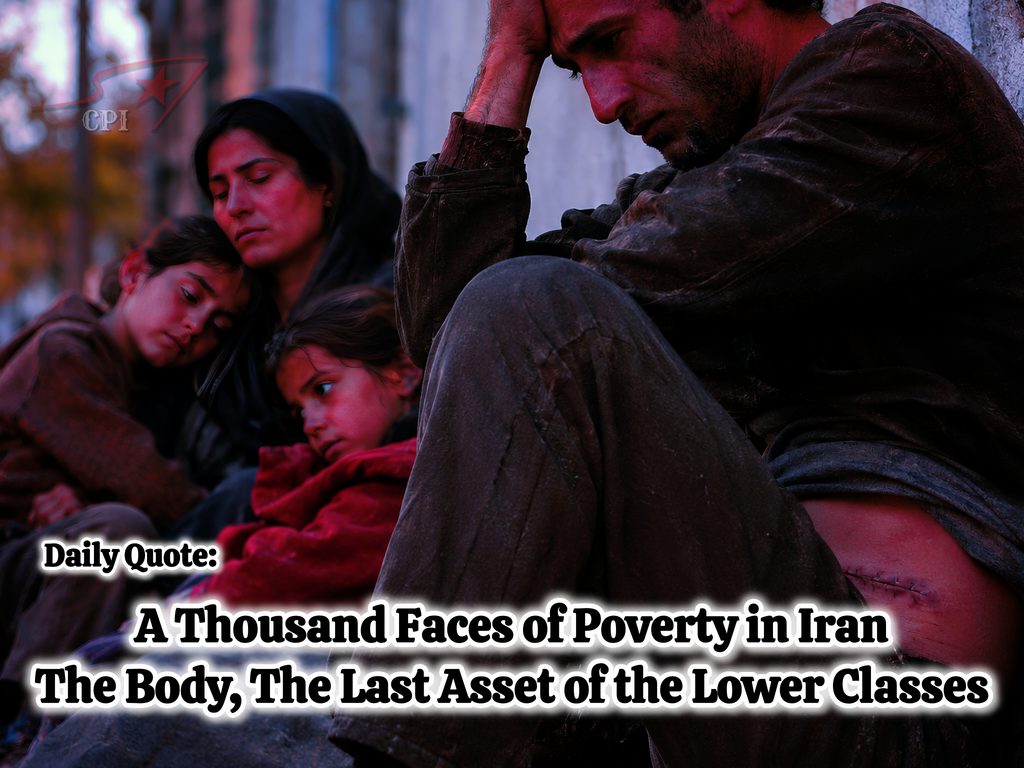
In most countries around the world, the buying and selling of human organs is prohibited for ethical, legal, and medical reasons. Iran, however, is one of the few countries where a legally established, state supervised system allows living unrelated donors to donate kidneys in exchange for financial compensation; an amount paid under the respectable-sounding title of a “gift of altruism.” Alongside this official structure, an informal market has emerged on social media, Telegram channels, and the walls surrounding hospitals, where kidneys, parts of the liver, bone marrow, corneas, and even eggs and sperm are bought and sold at prices determined by “mutual agreement.”
But an “agreement” between whom? On one side of this transaction stands a patient or family with the financial means to pay, and on the other, an unemployed young person, an indebted worker, or a father unable to pay the rent. What appears on the surface to be a free transaction between two individuals is, in reality, the transfer of health from the poor to the wealthy. When someone is forced to sell part of their own body in order to survive, it is no longer possible to speak of “free choice”; this is coercion disguised as a market transaction.
Selling a body organ is usually not the first, but the final link in a chain of hardships that has worn down a family’s life. The family breadwinner first exhausts every possible avenue to find work and cover the costs of medical treatment, food, and rent. Then the few possessions in the household are sold one by one: carpets and refrigerators, televisions and bicycles, and the little gold jewelry that was a wedding keepsake. After that comes borrowing: from the corner shopkeeper to friends and acquaintances. When there is nothing left to sell and borrowing is no longer an option, the only remaining asset is the body itself.
This path is a condensed account of the lives of the working class and the urban and rural poor. Someone who owns capital, property, or savings has a shield against crises; but someone who has nothing to sell except their labor power, when even that labor power finds no buyer, is forced to sell a part of their own body. Field reports indicate that most kidney sellers are young people between the ages of 20 and 35. Their advertisements cite reasons such as unemployment, bankruptcy, debt, illness affecting a family member, or the need to save their children from hunger. There have even been reports of 16-year-old teenagers offering their kidneys at lower prices out of desperation.
In this market, as in any other, the main profits go into the pockets of intermediaries. A network of brokers, intermediaries at medical centers, and sections of the medical profession concerned solely with profit benefit from this inhumane trade. With the collapse of the rial’s value, kidney prices in this market have reached several billion rials, and there have even been reports of organs being sold abroad.
To see the real face of poverty, one cannot rely solely on official statistics; a government that even manipulates figures on casualties from natural disasters has little incentive to publish the full picture of poverty. Nevertheless, even these official figures are revealing. In January 2026, the head of the State Welfare Organization announced that the population living below the absolute poverty line had increased over a decade from approximately 16 million to 34 million people, representing nearly 40 percent of the population, with the possibility of a further increase of up to 10 percentage points.
Poverty in Iran is not the natural result of a shortage of resources; its roots lie in the prevailing political and economic system. In the political sphere, through prolonging the eight-year Iran-Iraq War, intervening in regional crises, pursuing costly nuclear and missile programs, and allocating enormous resources to expanding religious institutions, the Islamic Republic has squandered national wealth and the fruits of the people’s labor and suffering. All of this has taken place against the backdrop of institutionalized corruption, in which patronage and access to political power determine wealth. Sanctions and military conflicts have also intensified the pressure, but the burden of these pressures has been placed on the shoulders of workers, wage earners, and the poor.
In the economic sphere, successive governments of the Islamic Republic, regardless of their factional affiliations, have followed a common path. Extensive privatization, which has often resulted in the transfer of public assets to those close to the centers of power, the gradual removal of subsidies, the reduction of social services, and widespread layoffs have all been components of this process. Workers have been dismissed without adequate unemployment insurance, benefits such as housing allowances and health insurance have been reduced, and temporary contracts have replaced job security. These policies, alongside chronic inflation and mass unemployment, have shifted the cost of the crisis from the top to the bottom of society.
The result of this process has been the widespread reproduction of the most severe social harms: prostitution, addiction, scavenging through garbage, homelessness, child labor, and suicide. Selling body organs is just one of the “thousand faces” of this poverty; perhaps more starkly than any other, it reveals just how far the existing order is willing to turn human life into a commodity.
Despotism and repression, inflation and soaring prices, mass unemployment, and the deep class divide have pushed the lives of the working masses to the breaking point. Workers and oppressed people, who have been struggling for nearly five decades to improve their working and living conditions, will continue this struggle. Selling a kidney to pay the rent is not an individual or moral issue that can be resolved through sermons or stricter laws; it is a structural and class issue. As long as society’s wealth remains concentrated in the hands of a minority and the burden of the crisis is placed on the majority, the bodies of the poor will continue to be put up for sale.
The way out of this hell lies in the independent organization and struggle of workers and the toiling masses. For fair wages, unemployment insurance and universal healthcare, decent housing, and the right to organize. Only through such a struggle, more resolute and determined than ever before and across every front, can we put an end to an order in which human beings are forced to sell a piece of their own bodies simply to stay alive.