World Teachers’ Day; A Reminder of Iranian Teachers’ Persistence in Pursuing Their Just Demands
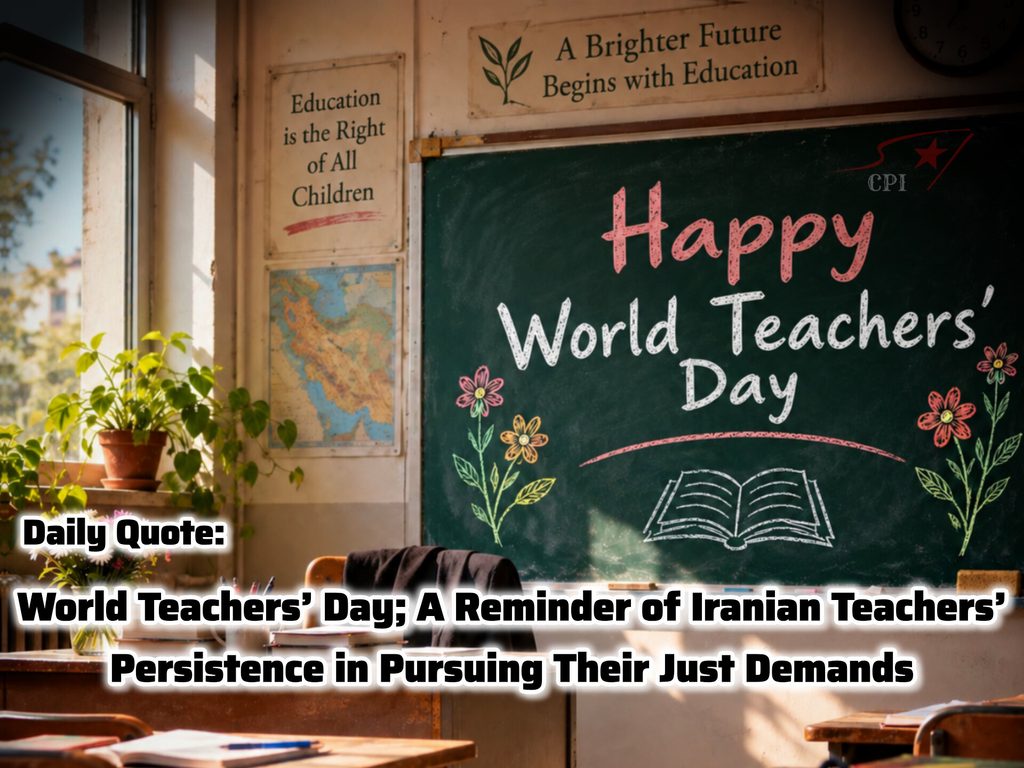
Monday, October 5, corresponding to October 5, is World Teachers’ Day. UNESCO and the International Labour Organization designated this day in 1994 as Teachers’ Day. The stated goal was “to honor teachers, express appreciation for them, and examine their problems around the world.” In Iran, however, this day is less an opportunity for appreciation than a reminder of the deep gap between the position teachers should have and the life imposed upon them.
According to UNESCO statistics, one-third of the world’s teachers live below the poverty line. In Iran, this proportion is considerably higher. Estimates indicate that more than three-quarters of teachers live below the poverty line. The remainder have only managed to keep themselves slightly above this line by taking second and third jobs or relying on their spouses’ income. A teacher who should be spending their time studying, updating their knowledge, and preparing lessons is forced to work after school in ride-hailing services, shops, workshops, or private classes in order to pay rent and living expenses.
The situation of retired teachers is even more dire. They spent their youth and middle age educating generations for meager wages. Now, in old age, instead of peace and comfort, they struggle with poverty, crippling medical expenses, and an ineffective insurance system. In a system where education has been turned into a commodity, private schools and university entrance exam institutes make huge profits. At the same time, public schools deteriorate and their teachers are driven into poverty. The commercialization of education impoverishes teachers while also depriving the children of working families of quality education.
The suffering of Iranian teachers is not limited to material poverty. They have been forced to promote an educational system deeply intertwined with superstition and reactionary ideas. The influence of religion in educational content and the school environment, as well as gender segregation, are examples of this trend. The presence of ideological and security forces in schools, tasked with implementing humiliating policies and monitoring teachers and students, is another example. Such an environment exhausts teachers physically and harms them psychologically. A teacher who wants to foster questioning and free thought among students faces censorship, fabrication of cases, and threats at every step.
Iranian teachers have repeatedly and loudly announced their demands: raising salaries to a level above the poverty line, access to effective health insurance, equalizing retirees’ pensions with those of active employees and ensuring their livelihood and dignity, free and quality education for all children, particularly in deprived areas, standardizing and making schools safe, the necessity of which has repeatedly been demonstrated by tragedies such as fires and classroom collapses, providing students with cultural and recreational facilities, ending the commercialization of education, and putting an end to case-building and the security treatment of teachers’ activities. These demands are not special privileges, but the minimum requirements for a dignified life and humane education. Instead of responding to these legitimate demands, the Islamic Republic has resorted to imprisonment, dismissal, exile, salary deductions, and professional deprivation. Hundreds of teachers have been arrested for these very demands for justice, and many of them have spent long years of their lives in prison.
Nevertheless, repression has failed to intimidate teachers. Every arrest has been met with statements, demonstrations, and solidarity campaigns. The struggle to achieve just demands and secure the release of imprisoned colleagues continues without interruption. The persistence of this movement in the face of such pressure is itself a sign of its deep roots in society. What distinguishes Iranian teachers from many other sections of society is their level of organization. Teachers are among the masses protesting the existing situation and, to this day, are considered the most organized section of the working people in this society. Teachers’ associations and organizations have established branches in various cities and provinces, and the Coordinating Council of Teachers’ Trade Associations has connected them with one another. These organizations are a powerful arm of the Iranian teachers’ demands movement. This level of organization has made it possible for teachers’ protests to go beyond scattered grievances. Coordinated nationwide demonstrations, sit-ins, and widespread strikes in recent years, from major cities to small towns, are examples of this. Teachers’ solidarity with workers, retirees, and protesting students, particularly during the “Woman, Life, Freedom” uprising, showed that the teachers’ movement is not merely a labor movement. This movement is part of the broader struggle of society for freedom and justice.
The first sparks of thinking are kindled at school. Today’s world needs specialized, secure, and confident teachers with a strong sense of human values more than ever. But this cannot be achieved unless teachers enjoy the minimum conditions of a dignified life and can carry out their educational mission without the burden of livelihood concerns and without fear of being subjected to security measures.
World Teachers’ Day is also a reminder to conscious workers and all working people of the deprivation of rights imposed upon society as a whole. This day is an opportunity to honor the struggles against these deprivations and to emphasize the necessity of defending teachers’ demands. We extend our greetings on this day to all the militant, hardworking, and dedicated teachers of Iran, particularly imprisoned and dismissed teachers. Iranian teachers are honorable people with just demands who deserve the broadest and most persistent support. We hope that the labor movement and the teachers’ movement in Iran, united in one front alongside all working people, the deprived, and the oppressed, will remove the reactionary and anti-people Islamic Republic from Iran’s political scene. Then it will be possible to reach a future in which teachers and students live and receive their education under conditions of freedom and justice.