Iran’s Girls: Trapped by Poverty, Patriarchy, and the Law
On the Occasion of October 11, International Day of the Girl Child
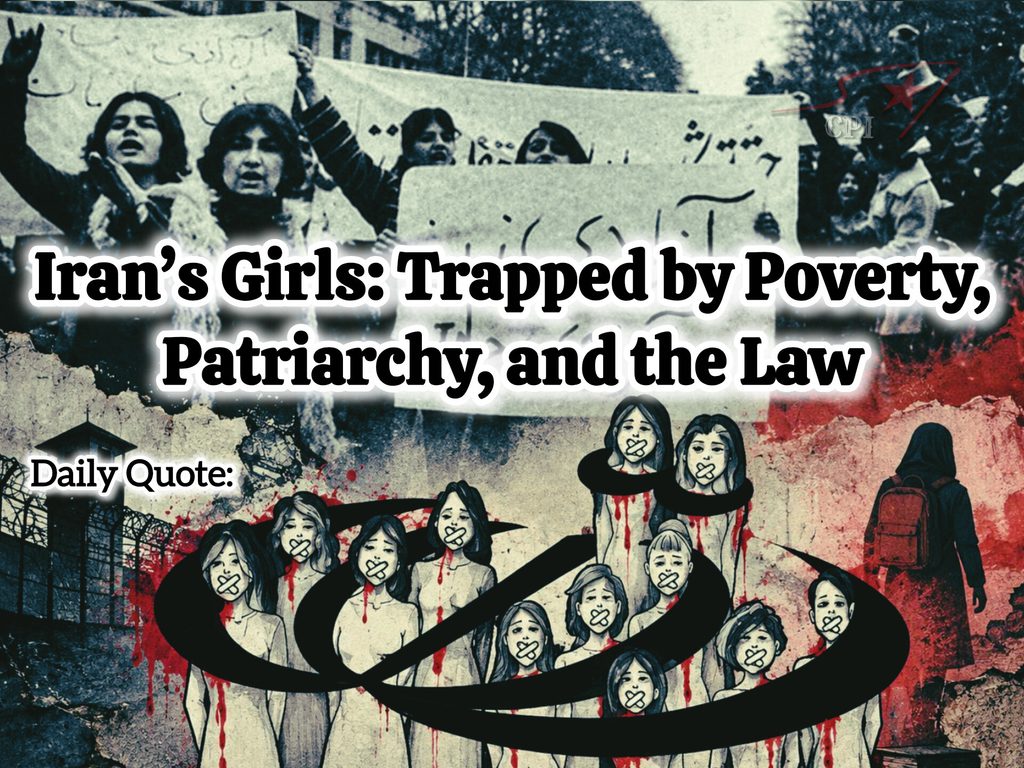
Today, October 11, is the International Day of the Girl Child. The United Nations has chosen “Ending Child Marriage and Investing in Girls’ Rights” as this year’s theme. Every year, more than twelve million girls around the world are married off before reaching adulthood, approximately one every three seconds. But for girls in Iran, this day is a reminder of a reality in which discrimination against girls stems not only from poverty and tradition, but also from the law itself and the government.
The struggle for girls’ rights in Iran dates back more than a century. During the Constitutional Revolution, pioneering women established girls’ schools and published journals in the face of social pressure and opposition from the clergy. The Islamic Republic, however, steered this process not toward equality, but toward control. The government did not stop girls from attending school, but turned schools into instruments for imposing ideology, compulsory hijab, and gender segregation. Nevertheless, the gap between legal rights and their actual enjoyment has persisted. When a family lives in poverty, the right to education remains on paper. This situation is more severe in deprived regions, from Sistan and Baluchestan to the villages of Kurdistan, where some girls do not even have birth certificates and are officially nonexistent.
In Iran, the legal age of marriage for girls is thirteen. Marriage is possible even below this age with the father’s permission and court approval. The age of criminal responsibility for girls is set at nine lunar years, meaning that a girl who is still a child is treated as an adult under the law. Every year, tens of thousands of marriages involving girls under fifteen are officially registered, while the number of unregistered marriages remains unknown.
Iran acceded to the Convention on the Rights of the Child in 1994, but with a broad reservation stipulating that its provisions would apply only insofar as they did not conflict with “Islamic standards.” This reservation rendered the spirit of the convention ineffective. A parliamentary bill to raise the minimum age of marriage for girls was shelved following opposition from lawmakers and religious institutions. The Law on the Protection of Children and Adolescents was passed in 2020, but without changes to the discriminatory foundations of civil and criminal law and without effective enforcement mechanisms, it has failed to transform girls’ lives. The government’s population policies, which encourage early marriage and childbearing, have also intensified the pressure on girls. Child marriage ends childhood before adulthood. It interrupts education, restricts social relationships, and leaves girls vulnerable to physical and psychological violence and harm.
Under conditions of poverty, girls are often the first victims within families. Boys are regarded as workers and future breadwinners; girls are seen as someone who will “go to another household.” From this perspective, the cost of educating a girl is not considered an investment, and early marriage becomes a way to reduce the family’s financial burden.
But the problem should not be attributed to the culture of a particular region or its people. Many families and mothers fight for their daughters’ education even under the harshest conditions. What reproduces discrimination is the combination of widespread poverty, inflation, the collapse of public services, and laws that legitimize patriarchy. Inheritance laws, the guardianship authority of fathers and paternal grandfathers, and inequality in blood money all tell girls that they are worth less. For this reason, confronting gender discrimination without confronting poverty is incomplete; and fighting poverty without challenging patriarchy and religious rule cannot achieve genuine equality.
Consider a girl who takes care of her younger siblings. Another sells goods on the street or works in a workshop. Yet another cleans the homes of wealthy families. The work of these girls often takes place behind closed doors and is not recorded in any official statistics.
The government’s response to child labor is to periodically remove children from the streets; not to address family poverty, provide free education, or offer social protection. The real question is this: how can we create conditions in which no child has to sacrifice their health and future to keep their family alive?
But Iran’s girls are not merely victims; they are fighters. During the “Woman, Life, Freedom” uprising, which began with the killing of Jina (Mahsa) Amini, high school girls took off their headscarves and chanted slogans in classrooms and on the streets. The price of this defiance was high: teenage girls such as Nika Shakarami and Sarina Esmailzadeh, along with dozens of others, lost their lives. In the aftermath, a wave of serial poisonings targeting girls’ schools brought fear into classrooms.
This uprising showed that a new generation of girls would no longer remain silent. But liberation cannot be achieved merely by opposing one form of coercion. A girl who stands against compulsory hijab may still be denied education, forced to work, or prevented from deciding whom and when to marry. The liberation of girls must begin in everyday life and requires linking the women’s movement with the movements of teachers, workers, retirees, and child rights advocates. A teacher fighting for free education and a worker demanding an adequate wage are both defending girls’ futures.
The struggle for girls’ rights in Iran has several clear demands: abolishing child marriage and raising the minimum age of marriage to eighteen, without any exceptions in the name of “the child’s best interests.” Providing free, high-quality education for all children, especially in villages and deprived regions, without ideological imposition or compulsory hijab. Providing adequate social protection for low-income families so that their livelihoods do not come at the expense of girls’ childhoods. Combating child labor and ensuring education, healthcare, and support for working children. Repealing discriminatory laws on inheritance, guardianship, and criminal responsibility. Publishing transparent statistics on school dropouts, child labor, child marriage, and violence against girls. Ensuring girls’ right to participate in decisions that shape their lives.
A society in which girls are deprived of education, children are forced into labor, and teenage girls are married off cannot speak of equality. But misogynistic governments can change. Patriarchal attitudes can be challenged. And girls can become not merely the objects of others’ protection, but conscious architects of their own lives.
A child is not a means of providing income for a family or carrying on a family name. A child is a human being with the right to learn, play, grow, and build a future. Why should a child’s fate depend on whether they were born a girl or a boy?
The struggle for girls’ liberation is a struggle for a society in which no child is deprived of their human rights because of their gender, poverty, or birthplace. This struggle is an inseparable part of the fight for freedom, equality, and liberation from oppression and exploitation.