Anniversary of the Fall of Berlin, Memorial to the Victims of the Struggle Against Fascism and a Lesson for Today
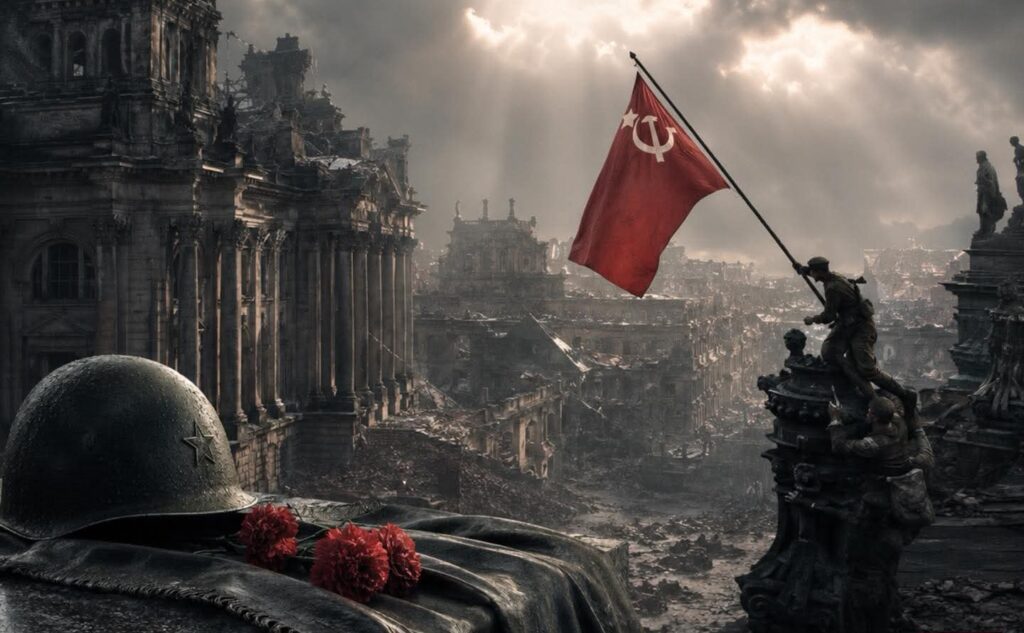
The United Nations has designated May 8 and 9 as the “Time of Remembrance and Reconciliation for Those Who Lost Their Lives during the Second World War”; a war in which tens of millions of people lost their lives, cities were reduced to rubble, and human civilization came close to the brink of complete destruction. Remembering the victims of this war is, at the same time, a warning about the structures that still reproduce war, destruction, and death.
The Second World War was not merely the result of the ambitions of a few mad politicians or diplomatic mistakes.
That war was the product of the deep crisis of global capitalism, the rivalry of imperialist powers, militarism, fascism, and efforts to redivide the world. Millions of people were sacrificed so that new power blocs could consolidate their markets, resources, and spheres of influence. Fascism, just as much as it was an ideology of racism and supremacy, was also a violent tool for defending the logic of capital and empire. War is a phenomenon rooted in the global economic and political structure. As long as profit takes precedence over human life, arms industries profit from war, and major powers view the world as an arena for military rivalry and division of influence, war will continue to reproduce itself in different forms.
Today, eighty-one years after the end of that catastrophe, the world is still not free from war. From Ukraine to the Gaza Strip, from Sudan to Iran and the Middle East, we once again see the same pattern: ordinary people become victims of geopolitical rivalries, the military economy, and the logic of power. Borders, energy resources, the arms market, and regional influence are still valued above human lives.
In today’s wars as well, just like during the Second World War, it is the lower classes who pay the highest price. Workers who lose their jobs and homes; women who carry the burden of poverty, displacement, and the collapse of families; children whose futures are buried beneath the rubble of war; and millions of people who are forced into migration, homelessness, and life under permanent insecurity.
For this reason, remembering the victims of the Second World War is, above all, a declaration of moral and political commitment toward the living people of today; a commitment to struggle against warmongering, opposition to fascism, racism, and militarism, defense of the right to life, housing, work, and security, and the effort for a world in which human beings and their needs take precedence over profit and domination.
If we honor the memory of the millions of victims of the Second World War, we cannot remain silent in the face of the victims of today’s wars. Historical memory only has meaning when it stands beside the suffering of contemporary humanity. Therefore, the anniversary of the defeat of fascism must not only remind us of the past, but also serve as a mirror for today; a memorial that calls on us to stand against new fascisms, new racisms, and the normalization of war. Only in this way does the blood of the millions of victims of Stalingrad, Auschwitz, Berlin, and Normandy become a living memory; a memory that guides us toward a more just, peaceful, and humane world.
The fall of Berlin was not only the military defeat of the Third Reich, but also the liberation of Europe: the Red Army freed vast parts of Eastern Europe from Nazi domination. For the capture of the last strongholds of fascism at the gates of Berlin alone, it suffered more than 80,000 casualties. This figure must be added to the 20 million other casualties the Red Army endured during six years of war, from Stalingrad to Berlin. Nevertheless, today many European governments describe the role of the Red Army as an “occupation” and destroy memorials to Soviet soldiers; as if history could be rewritten through political statements. The reality, however, is simple: without the Red Army, Europe would not have been a “democracy,” but a burned continent beneath the boots of fascism.
If we honor the millions of victims of the Second World War, we must also be the voice of the victims of today’s wars; because historical memory only has meaning when it stands beside the suffering of contemporary humanity. A memory that remains imprisoned only in museums and official ceremonies will sooner or later become a tool of the same powers that create war.
The memorial to the victims of the Second World War must simultaneously become a remembrance of today’s victims as well; victims who still live under the shadow of war, sanctions, poverty, and displacement and who demand a more just world. The anniversary of the fall of Berlin is a reminder of the fact that fascism was defeated through the sacrifice of a generation, millions of whom never returned home. Our duty is to ensure that this sacrifice remains alive in our everyday political and social practice.