Summary of the Speech of Fallen Worker Jamal Cheragh Veisi and a Remembrance of the Tradition of Holding International Workers’ Day in Kurdistan
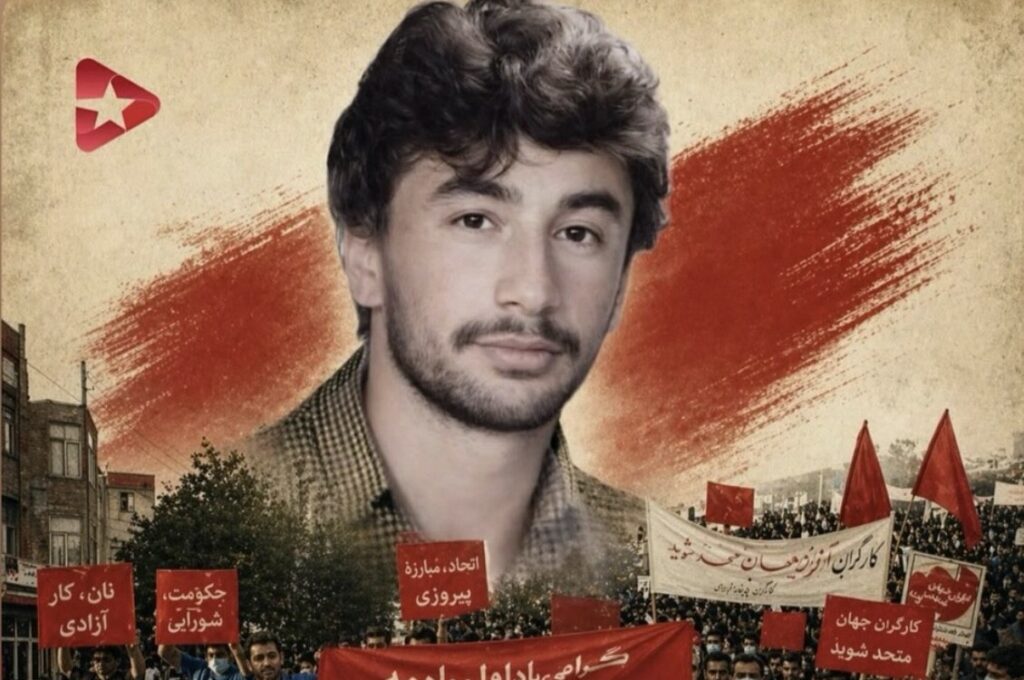
In the years 1988 and 1989, at a time when the Islamic Republic was brutally suppressing every voice of freedom and opposition, labor activists in Sanandaj, especially workers organized within the “Sanandaj Craftsmen’s Union,” stood at the forefront of organizing and holding International Workers’ Day and turned Sanandaj into one of the major centers of working-class struggle in Iran. The peak of this period was the May Day ceremony of 1989 held in Takhti Hall in Sanandaj and the passionate and radical speech delivered by comrade Jamal Cheragh Veisi; a revolutionary communist worker who, merely for speaking about the rights and demands of his class, was arrested by the Islamic Republic, subjected to months of the harshest torture, and ultimately executed.
After his arrest, Jamal endured more than nine months of torture, but he did not speak and, through his silence and resistance, saved the lives of dozens of labor activists and militants in Sanandaj. The regime intended through his execution to intimidate and disperse the workers, but the opposite occurred: his radical speech, his steadfastness in prison, and his execution for defending workers’ rights became a source of inspiration, awareness, and encouragement toward unity and organization.
Today, we approach May Day under conditions in which Iranian society is filled with crisis and at the same time pregnant with major transformations. The Islamic Republic is more isolated and hated than ever before, yet the absence of the working class at the level of organization and in the form of a conscious and organized alternative remains the major weakness of the current movement. On this basis, the memory of Jamal Cheragh Veisi and all the fallen of the labor and socialist movement reminds us of the necessity of continuing the same path: linking the everyday demands of workers, women, and the oppressed to the final horizon of class and socialist liberation.
Within this context, Jamal Cheragh Veisi’s speech at the May Day gathering of 1989 in Takhti Hall in Sanandaj provides a clear image of his perspective on the mass organization of workers and the practical tools for such organization.
Main Themes of Jamal Cheragh Veisi’s Speech
Jamal began his speech by welcoming his worker comrades and emphasizing that today is “International Workers’ Day and our own global celebration.” He stressed that this day should become a platform for raising workers’ demands and collective discussion among workers.
The central point of his discussion was the concept of the “workers’ general assembly.” He defined the general assembly simply, clearly, and profoundly: the gathering of a number of workers at a specific time and place to discuss a particular issue and make a shared and conscious decision. In his view, human beings are fundamentally social creatures, and workers can only address their common needs and hardships through unity, collective thought, and solidarity. For him, the general assembly was the “weapon and guarantee” for obtaining workers’ rights.
Jamal then referred to the specific demands of workers: wage increases, reduction of working hours, access to health and medical facilities, unemployment insurance, prevention of dismissals, and dozens of other unmet demands. He emphasized that achieving these demands was possible only through reliance on collective strength and the workers’ general assembly, not through individual and scattered appeals.
In his view, the historical experience of the working class had shown that whenever workers acted individually, they faced dismissal and repression, while whenever they acted united and organized, they had a chance of success. Therefore, the general assembly was not something strange or unattainable; this very Workers’ Day gathering, these discussions and expressions of demands, were themselves a general assembly.
He explained that workers already practically have small and elementary assemblies in workplaces, neighborhoods, and even families, but what gives the “general assembly” real credibility is its “order” and “continuity.” According to him, workers who labor together ten hours a day can dedicate a few hours each week or month regularly to discussing their problems and making collective decisions. It is this regularity that turns the general assembly into a serious and established tool for defending workers’ interests; otherwise, hasty and unprepared reactions usually remain ineffective.
Jamal focused particularly on the conditions of small private workshops in Sanandaj: from mechanics and welding shops to carpentry and bodywork workshops. In these workplaces, there were no fixed working hours, no fair wages, no safety, no insurance, and not even the superficial implementation of labor law. Here, “labor law” meant only the will of the employer. He saw the solution in workers of these units gathering together, expressing their shared problems, and creating organizations such as syndicates, unions, or any other form capable of genuinely responding to their issues.
He then moved from the workshop level to the neighborhood level and painted a clear picture of working-class neighborhoods in Sanandaj” from Abbasabad to Kanikozaleh, Hajiabad, and Zourabad “as symbols of deprivation and the lack of the most basic necessities of life: water shortages, lack of infrastructure, poverty, and hardship. In this context, he proposed the creation of collective funds, labor cooperatives, and consumer cooperatives: workers could pool small monthly contributions into a shared fund to support themselves and their comrades during unemployment, illness, accidents, or severe need, and even assist poor and indebted families in their neighborhoods.
He emphasized the widespread problem of unemployment and the constant fear of dismissal, a fear that forces workers to endure humiliation and oppression by employers. Once again, his practical solution was organization and the creation of collective funds and mutual aid so that workers would not be completely defenseless in moments of unemployment.
Another part of his speech was devoted to literacy and raising awareness. He regarded the illiteracy of some workers as a result of long working hours and harsh living conditions and proposed that workers themselves hold literacy classes for one another and consciously study so they could better understand conditions and find solutions.
Jamal also addressed the issue of unemployment insurance. Referring to official statistics from 1987–1988, he showed that only a very small number of unemployed people had managed to benefit from unemployment insurance because only workers employed in officially licensed workshops with insurance and “work identification” were included. Agricultural workers, seasonal laborers, construction workers, brick kiln workers, carpet weavers, and others were effectively deprived of this right, despite the fact that insurance payments were deducted monthly from employed workers’ wages while the government and insurance institutions essentially acted as banks collecting these funds.
His clear demand was that unemployment insurance must include all workers; everyone who sells their labor power in order to survive, regardless of their field, type of work, or contract. In addition to universal inclusion, he criticized the very low amount of unemployment insurance, saying it covered only a tiny fraction of basic necessities and could not sustain a working-class family. In his view, unemployment insurance should correspond to price levels and genuinely provide for the livelihood of a family of several members.
He also criticized the “goods coupon” system, which had supposedly been intended to improve workers’ living standards but had in practice been reduced to insignificant and irrelevant goods and irregular and insufficient payments. His demand was that the coupons be paid on time, added to wages, and genuinely help secure the basic necessities of workers’ lives instead of merely serving as a deceptive and ineffective form of “benefit.”
At the end, Jamal emphasized that the purpose of his speech was not simply to talk about and list problems, but to act and struggle to achieve these demands. If no organization exists, then workers must begin building one from today; if there is no collective fund, one must be created. In his view, the road to liberation lies in the conscious, organized, and collective self-organization of workers—the same path for whose defense he himself stood until his final breath.