26 June, International Day in Support of Victims of Torture
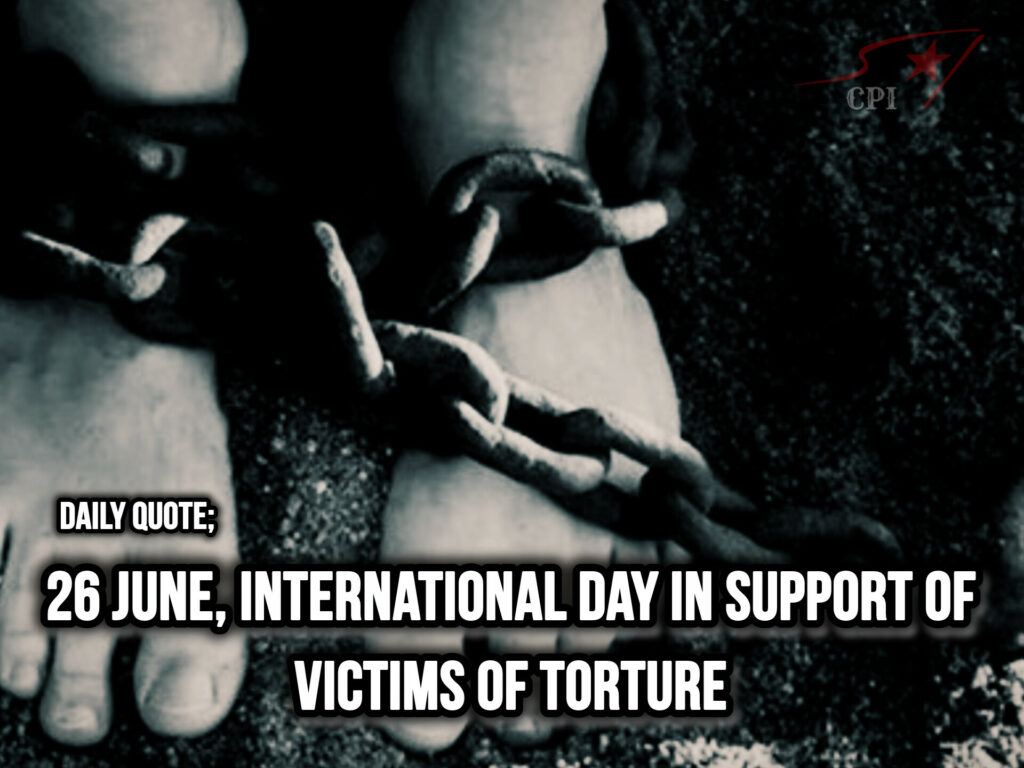
26 June is the International Day in Support of Victims of Torture. This day was recognized by the United Nations General Assembly in 1997 and was entered into the organization’s calendar. Out of the 192 member states of the United Nations, 50 countries, including the Islamic Republic of Iran, have not signed the Convention Against Torture.
The designation of such days by the United Nations General Assembly, which has no enforcement mechanism, does not create an obstacle for governments that practice torture. Nevertheless, the observance of this day provides an opportunity to condemn governments that carry out the inhumane practice of torture.
According to information from Amnesty International, torture is practiced in 111 countries around the world. This statistic is based on the same limited definition of torture employed by liberal currents; a definition that does not include systematic poverty, the killings and destruction caused by war, executions, violations of children’s rights, and violence against women. From a perspective that places the interests of the working class and the toiling masses at its center, the world that the capitalist system has created for humanity is full of every form of torture.
The expansion of torture on a global scale intensified, particularly after the events of 11 September 2001. The capitalist powers, led by the United States of America, not only used that criminal event as a pretext to invade Afghanistan and Iraq, but also officially placed torture on their political agenda. The government of George W. Bush, through Abu Ghraib Prison in Iraq, the Guantanamo Bay detention camp on occupied Cuban territory, and several other secret prisons, and with the assistance of governments that had practiced torture for years under U.S. support, subjected political prisoners to torture. The British government was also a partner in this process, and well-documented reports concerning these acts of torture have been widely published. Alongside these so-called democratic governments stand dictatorial regimes that openly and systematically employ torture. At the head of them all is the Islamic Republic of Iran.
Over the course of more than four decades, abundant documents and evidence have been published regarding the systematic and organized use of torture in the prisons of the Islamic Republic. However, what distinguishes the Islamic regime from many other dictatorships is that, in Iran, torture is recognized not only in practice but also in law.
Under its own laws, the Islamic Republic does not consider punishments such as religious discretionary punishment (ta’zir) “which includes flogging, retribution (qisas), and amputation” to be torture, but instead defines them as legal and religious punishments. This religious justification serves as a cover for institutionalizing torture within the judicial system. In reality, in Iran, the executioner wears the robe of a judge, and the sentence of flogging is issued by the very court that claims to administer Islamic justice.
The torture practiced by the Islamic government is not limited to prisons. What other name can be given to the actions of the Guidance Patrol (Morality Police) against women and girls in the streets, if not torture? Execution, and especially public execution, is nothing but a tool for promoting violence and public terror. The strengthening of patriarchal institutions and the legal permission to kill women under the pretext of “honor” is this not an encouragement of torture?
The imposition of absolute poverty on more than 20 million people and relative poverty on nearly 50 million others, depriving children of education and driving them into mines, brick kilns, and carpet-weaving workshops, and the sale of girls in the sex trade, all of these are forms of torture for which the Islamic regime bears direct responsibility.
The expansion of torture throughout the world and the efforts to roll back the democratic gains achieved through decades of struggle are rooted in the deepening crisis of the capitalist system. Nevertheless, fighters for freedom and human rights, in every arena, have struggled to limit the ability of capitalist governments, including the Islamic Republic, to carry out torture.
26 June is the day on which we renew this determination and resolve: not only to condemn the perpetrators of torture, but also to further organize the struggle whose goal is the eradication of every form of torture, whether in the prisons of the Islamic Republic or in any corner of this world.