The European Union’s New Inhumane Policy Toward Refugees
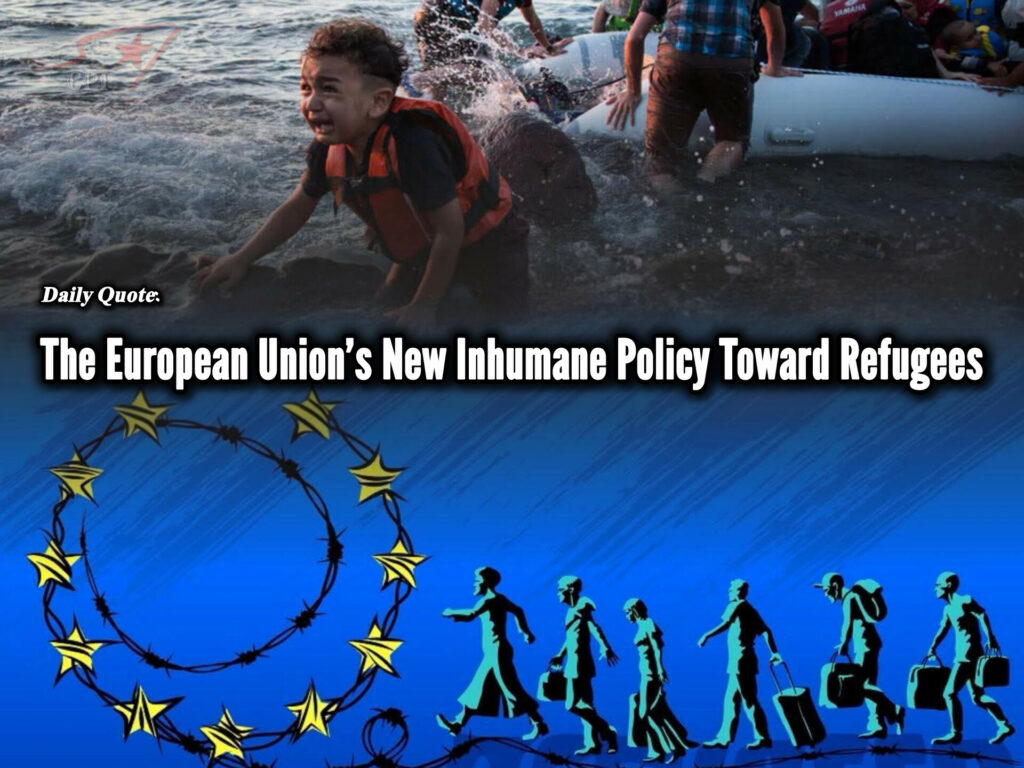
The right to asylum, one of the fundamental pillars of modern international law, was established in the aftermath of the tragedies of the Second World War to provide refuge for people driven from their homelands. For decades, Europe presented itself as the guardian of these values. However, recent developments and the adoption of increasingly restrictive policies indicate that this image is rapidly unraveling. Today, the European Union is turning its back on refugees and undermining some of the most fundamental principles of asylum rights. This clear shift has not only deepened a humanitarian crisis but has also called the Union’s moral credibility into question.
To understand the depth of this tragedy, one must first consider the scale of global displacement. According to statistics from the United Nations High Commissioner for Refugees (UNHCR), more than 200 million people worldwide are currently displaced. This represents the largest displacement crisis in human history. War, violence, persecution, political repression, environmental crises, and state collapse have forced this vast human population onto uncertain and often dangerous paths.
What makes this situation particularly troubling is that three-quarters of these displaced people are hosted by low-income countries neighboring the regions from which they have fled. Countries that themselves struggle with poverty, inflation, and domestic crises. Meanwhile, the European Union, composed of some of the wealthiest economies in the world and responsible for a significant share of global wealth production, carries only a small portion of this humanitarian responsibility and is now moving to reduce even that limited commitment.
Amid this crisis, the European Union implemented its “Migration and Asylum Pact” in June 2026. Although adopted in 2024, the pact became fully operational after a two-year transition period. The agreement represents, in the eyes of many critics, an official retreat from humanitarian commitments. Human rights organizations, from Amnesty International to the International Rescue Committee, have described the pact as “the most unprecedented attack on the right to asylum in Europe.”
One of the most controversial mechanisms of the pact is the expansion of the concept of the “safe third country.” Under the new rules, EU member states may reject asylum applications without conducting a substantive examination and transfer applicants to third countries, often poorer states outside Europe. This approach effectively shifts responsibility for refugee protection away from Europe and onto countries with fewer resources, weaker institutional capacities, and often lower human rights protections.
At the same time, the European Union has been finalizing new “Return Regulations” intended to replace previous deportation directives. These regulations, debated in the European Parliament in March 2026, include plans for the establishment of “return centers” outside EU borders. These centers “described by critics as a form of modern extraterritorial detention facility” would hold individuals whose asylum applications have been rejected. The International Rescue Committee has warned that the policy could have severe consequences for families and children and may effectively legitimize forms of detention beyond the direct oversight of European judicial systems.
A particularly concerning aspect of these developments is the weakening of appeal protections. Under previous European procedures, lodging an appeal against an asylum rejection generally suspended deportation until the appeal had been reviewed. Under the new framework, individuals may be removed before a court has examined their case. Critics argue that this creates the possibility of irreversible harm before judicial review can take place and undermines the right to a fair legal process.
This increasingly restrictive approach cannot be separated from the broader political climate across Europe. The rise of far-right movements throughout the continent has pushed many governments toward tougher anti-immigration policies. Populist parties have successfully mobilized public support through narratives centered on fear and xenophobia, while centrist parties have often adopted similar positions in an effort to maintain political relevance.
The portrayal of refugees as “security threats” or “economic burdens,” rather than as people in need of protection, has normalized a discourse that only a decade ago existed largely on the political fringe. This is despite numerous academic and economic studies suggesting that refugees often contribute positively to aging and shrinking economies over the long term, help address labor shortages, and enrich host societies culturally and socially.
The new asylum policies in Europe reflect a deeper crisis, an ethical crisis within institutions that claim to champion human values on the global stage. Refugees are people upon whom war has been imposed, not people who chose war. They are victims of geopolitical conflicts, structural poverty, and climate change, phenomena that are often linked, at least in part, to the political, military, and environmental policies of the very wealthy countries that are now closing their doors to them.
The right to asylum is both an international legal obligation and a human responsibility. On World Refugee Day and every other day of the year, it is the duty of civil society, human rights advocates, and all conscientious individuals to amplify the voices of refugees and insist on a simple truth: building walls against displaced people and confining them to offshore detention systems will neither make Europe safer nor improve the world. Such measures risk becoming a stain on the history of modern civilization. The time has come for the people of Europe to pressure their governments to build not higher walls, but stronger bridges of solidarity, human compassion, and protection.