The Struggle for the Right to Life Against State-Orchestrated Killing in Qezel Hesar Prison
At a time when the Islamic Republic is grappling with the consequences of war on one hand and deep economic and political crises on the other, it has once again turned to the only tool left in its arsenal of repression: expanding fear through executions. Statistics published by human rights organisations show that since the beginning of 2025, at least 1,128 people have been hanged in Iran, a figure that reflects an unprecedented acceleration in the issuance and implementation of death sentences. This wave of executions cannot be analysed separately from the atmosphere of protest within society; for the authorities, execution is less a tool for combating “crime” than an instrument for suppressing and intimidating social movements.
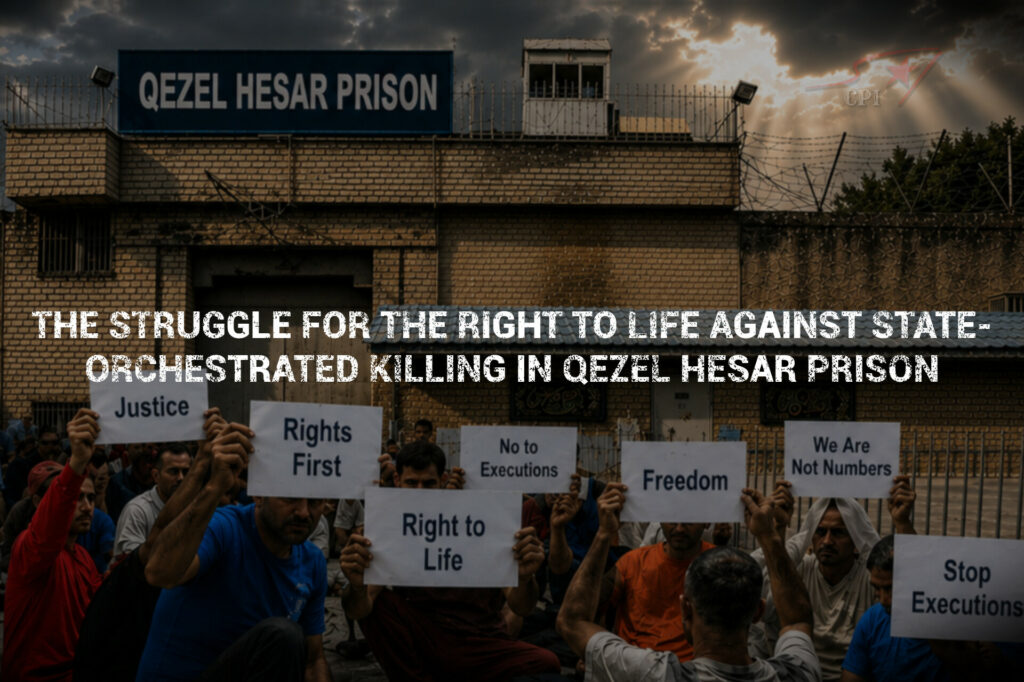
Since Monday, July 13, 2026, Unit 2 of Qezel Hesar Prison has become the scene of one of the largest prison protests in recent years. Following the transfer of five prisoners “Seyed Iman Heydari, Ayoub Asadi, Vahid Teymouri, Hamed Nazariani, and Amir Nazariani” to solitary confinement for the implementation of their death sentences, approximately 1,500 prisoners have launched a hunger strike and a widespread sit-in protest. A large number of these prisoners are themselves direct victims of the cycle of poverty, unemployment, and economic deprivation, people whom the judicial system of the Islamic Republic sends to the gallows instead of addressing the economic structures that produce poverty and addiction. The protesting prisoners have pointed to a fundamental contradiction: while low-level defendants in drug-related cases are swiftly sent to execution, organised trafficking networks linked to centres of power and the Islamic Revolutionary Guard Corps (IRGC) continue their activities with complete impunity. The protesters have declared that they will continue their strike until all executions are halted and unjust laws are reformed.
At dawn on Wednesday, July 15, 2026, as the strike in Qezel Hesar continued, the judiciary executed two more political protesters. Aref Khoshkar, one of those arrested during the nationwide 2022 uprising, had been forced into making a confession under brutal torture and threats of sexual assault against his younger brother. He was denied access to a lawyer of his own choosing and deprived of a fair trial, becoming another victim of the government’s blind vengeance. Mohammad Amini Dehaghani was also among those arrested during the January 2026 protests in Isfahan. Due to severe pressure placed on his family, his name was kept out of the public eye until the moment of his execution. The simultaneous execution of these two men sends a clear message from the authorities to society: every spark of protest must be extinguished before it can grow.
Meanwhile, reports from inside the prison indicate that the physical condition of the striking prisoners has become critical. At least one prisoner has died as a result of the deliberate neglect of prison officials, while several others have fallen into comas. This situation clearly demonstrates that a silent crime is unfolding in the corridors of Qezel Hesar Prison, a crime in which the denial of medical care and the application of psychological pressure are being used to silence this struggle for life. Yet the prisoners’ resistance has so far shown that the policy of intimidation no longer has the same power against collective determination.
Execution, in every form and for every charge, is state-organised killing, and no legal or moral justification can legitimise it. The policy of ruling through the gallows only deepens existing social divisions. All political and social prisoners have the right to independent legal counsel and to public, transparent judicial proceedings. Confessions extracted under torture are inadmissible under any credible legal standard. The concentration of capital punishment on the poor and the working classes, while the principal actors behind corruption and organised trafficking continue their activities in complete security, is a clear example of systematic class injustice.
The voices of the prisoners in Qezel Hesar must not remain trapped behind the prison’s high walls. It is the responsibility of every member of civil society, progressive forces, and international human rights organisations to increase the political cost of executions for the Islamic Republic by publicising these events, issuing statements, and engaging directly with international institutions. The families of prisoners sentenced to death must not be left alone during these difficult moments. Providing them with legal, psychological, and social support is an inseparable part of the struggle against the machinery of execution.
This hunger strike is a struggle for life and for class justice. Through their steadfastness, the prisoners of Qezel Hesar have declared that resistance is still alive. It is now our responsibility, outside the prison walls, to transform this message into a powerful cry against tyranny and in defence of freedom and the right to life.