Europe’s Youth Protests Today: A Cry for the Future
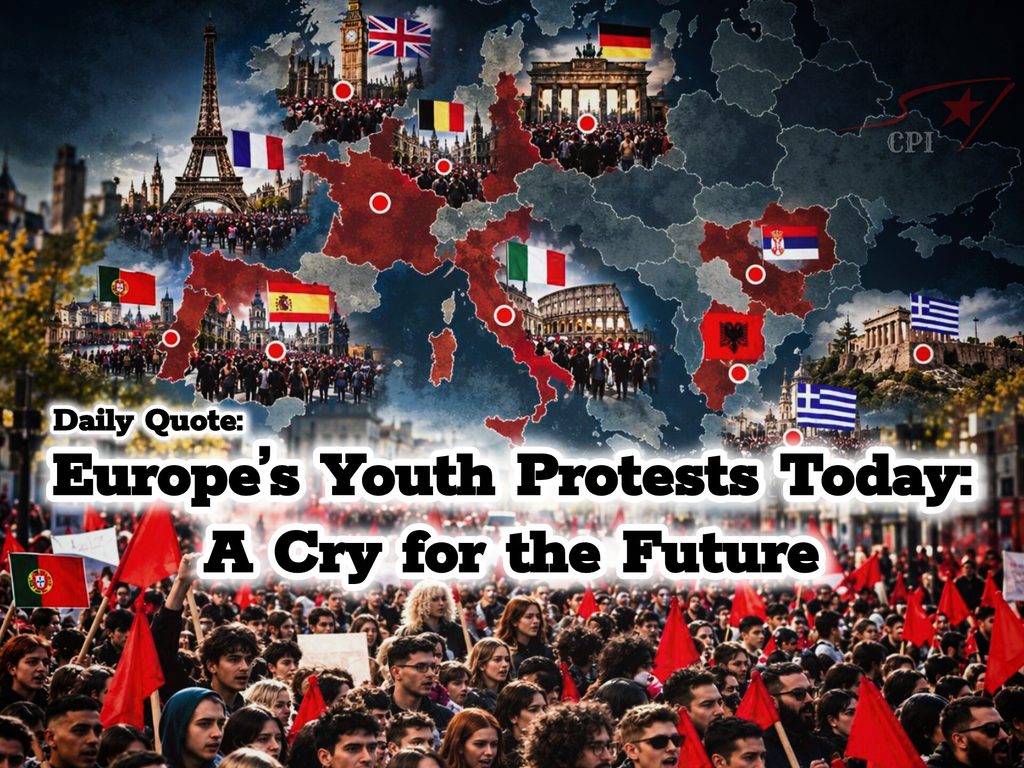
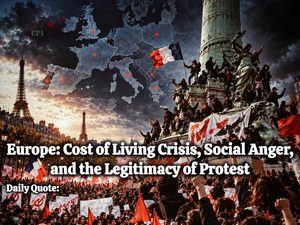
In the autumn of 2026, the streets of Europe are witnessing a wave of youth protests that fundamentally represent legitimate demands for basic rights. School pupils and university students want high quality education, decent housing, secure employment, and a future they can plan for. From Paris and Rome to Athens, Lisbon, Madrid, and Tirana, young people have taken to the streets. What began in mid-September with French high school students protesting teacher shortages has now evolved into a nationwide movement addressing inequality and the cost of living. The roots of this anger lie in two successive shocks: the COVID-19 pandemic and the war in Ukraine, the heavy burdens of which fell more heavily on the younger generation than on any other group. As a result, one of the fundamental promises of liberal democracy “that each generation will enjoy a better life than the one before it” is now crumbling.
The COVID-19 pandemic struck just as Europe was beginning to recover from the 2008 financial crisis and employment levels were returning to their pre-crisis levels for the first time. Young people paid the highest price because most worked in sectors such as restaurants, tourism, and retail, often under temporary or parttime contracts. According to a report by Eurofound, around 12 percent of young people aged 18 to 29 lost their jobs, while 12 percent of students also faced unemployment. The consequences were not merely economic. The same institution reported that approximately twothirds of young people were at risk of depression. In the spring of 2021, 43 percent of unemployed or economically inactive young people struggled to cover their living expenses, 39 percent had no savings, and 17 percent were dealing with housing insecurity. The closure of schools and universities also created an educational gap that is now reflected in overcrowded classrooms and teacher shortages, the very issues against which French and Italian students are protesting today.
An important point is that, according to Eurofound, most government support measures introduced during that period were temporary. The institution warned that, to build resilience against future crises, governments needed to prioritize long term measures, such as permanently improving access to employment and training and increasing job security. Today’s protesters are essentially repeating those recommendations in the language of the streets.
Before the wounds of COVID-19 had healed, Russia’s invasion of Ukraine in February 2022 delivered a second shock. Energy and food prices soared, as Ukraine had been the world’s fifth-largest wheat producer and largest producer of sunflower oil before the war. Eurozone inflation reached 8.1 percent in mid 2022 and shortly afterward hit a record 9.9 percent. The International Monetary Fund also warned that the energy crisis had severely reduced household purchasing power. Young people were the most vulnerable. In 2021, the 18 to 29 age group had the highest rate of people at risk of poverty, and young people, particularly young women, were hit hardest by the cost-of-living crisis. They have lower incomes and fewer savings, and a larger share of their earnings goes toward rent, food, and transportation.
The deepest layer of this wound, however, is the housing crisis. From 2015 to the third quarter of 2025, house prices in the European Union rose by 64.9 percent, while rents increased by 21.8 percent. In Portugal, house prices climbed by 180 percent, and this week Portuguese protesters pitched tents in Lisbon’s Rossio Square. Eurofound says that young people living independently spend a much larger share of their income on housing, and many cannot afford to live independently even when they are employed. In Spain, Italy, Greece, and Croatia, the average age at which young people leave their parental homes is around 30 or older. Eliza Pastore, a student who struggles to afford rent for a shared room in Rome with her brother, told a CNN reporter that she is forced to commute 120 kilometers every day. The energy shock has not yet run its course either, and today Italian truck drivers have blocked roads to protest soaring fuel prices following the war with Iran. The crises have piled up on top of one another.
The immediate trigger for the protests has differed from country to country, but protesters have drawn inspiration from one another, and student unions have been sharing their experiences. In France, everything began in September with high school students protesting teacher shortages. Their demands now include smaller classes, increased funding for teachers, essential infrastructure, and an end to police violence. In Italy, students at a high school in Rome occupied their school on October 7 under the slogan “Just Like France,” demanding safe schools, dignified work, public healthcare, and social justice. In Spain, the demand for affordable housing became so widespread that the government was forced to call an early election. The wave also reached Portugal, where protesters are demanding a cap on rent increases and the repeal of a law that has made evictions easier.
In Greece, students and teachers marched together in support of free public education, while in Belgium, young people demonstrated in Brussels and Liège against the cost of living. In Albania, plans to build a luxury development backed by Jared Kushner sparked protests that developed into a campaign against corruption and calls for the resignation of Edi Rama’s government. In Serbia, a student movement has been continuing its fight against corruption for two years. In Germany, a nationwide protest call has also been issued for October 31. The wave continues to grow. French and Spanish trade unions have announced nationwide strikes for November 5 and 11, while student unions in Britain and Italy have designated November 20 as a day of protest against education costs. The slogan of Greek protesters “From Greece to France, we demand free public education” aptly captures this solidarity.
What protesters are demanding are not privileges but recognized rights. Free, high-quality education, adequate housing, dignified work, and public healthcare are recognized in the Charter of Fundamental Rights of the European Union and the European Social Charter. Young people are asking for nothing more than their governments to honor their own commitments. Their demands are specific and achievable. The French want fewer students in each classroom and more funding for teachers, while the Portuguese are demanding a rent cap and the repeal of a specific law. These are policy proposals, not abstract slogans.
Generation Z experienced two major crises during its formative years without having played any role in causing either of them. Support measures introduced during the pandemic were temporary, while the costs of inflation triggered by the war in Ukraine fell disproportionately on low-income people. Now artificial intelligence is threatening lower level jobs, making the employment outlook even more uncertain. Governments have responded more with denial and repression than with dialogue. Italy’s education minister denied any similarity with France and blamed the problem on immigrants. In Lisbon, 55 people were arrested, while Emmanuel Macron has restricted protests taking place outside the framework of trade unions. When institutional channels are closed, the streets become the last available platform.
These movements have also extended beyond the younger generation. The housing crisis has brought older generations into the streets as well, and the demands of young people are, at their core, demands for social justice for everyone. The overwhelming majority of protests have been peaceful, although there is no doubt that violence has occurred, both on the part of some protesters and on the part of the police. The problem is not the condemnation of violence itself, but its selective application. The same accounts that describe every burnedout car in detail say nothing about the teenager who lost most of his teeth after being struck by a teargas grenade, or the fifteen years old boy whose hand was blown off by a police grenade. When violence against property is presented as the defining truth of a movement while violence against teenagers’ bodies is ignored, we are no longer dealing with a genuine condemnation of violence but with its instrumentalization. Almost every major mass mobilization, from the strikes of 1968 to the Yellow Vests movement, has had a violent fringe, yet no one reduces the meaning of those movements to broken windows.
Europe’s youth protests are the cry of a generation that, despite bearing no responsibility for the crises, has paid the price of two historic shocks through its employment, education, mental health, and ability to keep a roof over its head. COVID-19 disrupted this generation’s education and first steps into working life, while the war in Ukraine devoured its meager savings through rising energy and food prices, all against the backdrop of an already escalating housing crisis. Manageable class sizes, enough teachers, reasonable rents, and secure employment are neither radical nor unrealistic demands. They are precisely the promises that European governments themselves have made. Today’s generation has every right to distrust liberal democracy and the promises it has failed to fulfill.