Europe: Cost of Living Crisis, Social Anger, and the Legitimacy of Protest
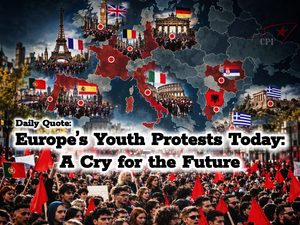
In recent months, Europe has witnessed waves of social, student, and workers’ protests spanning France to Portugal, Italy to Greece, and Belgium to Albania and Serbia. Hundreds of thousands of school students, university students, workers, teachers, pensioners, truck drivers, and farmers have taken to the streets. Despite their national differences, their demands converge on one fundamental issue: a life that can no longer be sustained on wages and pensions.
Mainstream media and many governments seek to portray these events through the lens of street disorder and isolated clashes, while some far-right groups blame immigrants and left-wing movements. Yet behind these protests lies a deep cost of living crisis, the erosion of public services, growing inequality, and the continued decline in the purchasing power of the working class and low income groups. Even observers with no sympathy for the labor movement have acknowledged that the central issues driving these protests are the cost of living and deteriorating public services, not immigration or religion.
From this perspective, the current movements should be understood first and foremost as a legitimate and understandable response by millions of European citizens to conditions whose heaviest burden has been placed on workers, pensioners, young people, and society’s most disadvantaged.
But today’s crisis did not emerge overnight. Over the past three decades, European governments have followed the logic of austerity, scaling back public services, restricting social spending, and transferring many welfare responsibilities to the market. Housing has been transformed from a social right into an investment commodity, schools and hospitals have faced chronic shortages of funding and staff, and wages in many countries have fallen behind the rising cost of living.
Since 2020, a series of successive shocks has accelerated this process. The COVID-19 pandemic made millions of jobs insecure and increased government debt. Then, the war in Ukraine and turmoil in energy markets drove gas, electricity, fuel, and food prices to unprecedented levels, while the European Union experienced the highest inflation rate in its statistical history.
But the burden of inflation was not distributed equally. Energy and food account for a much larger share of a working class family’s spending than that of an affluent household. Consequently, rising prices had an entirely different meaning for disadvantaged people. Research by European institutions themselves confirms that low-income households suffered the greatest harm and that government assistance compensated for only part of their losses. Much of this assistance was distributed broadly rather than being specifically targeted at those most in need.
Today, a new phase of the same cycle is underway. Governments facing budget deficits and high borrowing costs are once again putting cuts to social services and pension reform on the agenda. In other words, the bill for crises that workers played no part in creating is once again being handed to them.
The war in Ukraine has affected Europeans’ lives through more than rising energy prices alone. Alongside the cost of living crisis, European governments have entered a period of extensive rearmament, and NATO member states have committed to sharply increasing their defense and security spending in the coming years.
For millions of citizens, the question is simple and fundamental: Why is there always money for war and weapons, but never enough for schools, hospitals, social housing, and pensions? This question is now being heard in the slogans chanted in the streets. Italian students have explicitly demanded more spending on education and less on weapons. In Germany, fears of the return of compulsory military service have sparked a wave of school strikes supported by trade unions and peace organizations.
European citizens are therefore paying not only the direct cost of inflation but also the price of militaristic policies that redirect public resources away from everyday needs and toward the arms industry. Under these conditions, defending workers’ interests cannot be separated from defending peace and prioritizing social needs.
One of the most striking features of this wave of protests is the leading role played by school students, university students, and young people. In France, protests began with demands related to education. Teacher shortages, overcrowded classrooms, and deteriorating school buildings provided the initial spark. But when trade unions, public sector employees, protesters against rising fuel prices, and social movements joined the students, educational protests quickly developed into a nationwide movement against the government’s economic policies. The same pattern has been repeated in Italy, Belgium, Greece, Austria, and Albania.
This connection is no coincidence. The education crisis, housing crisis, rising energy costs, and declining purchasing power are different manifestations of a single social crisis. A teenager studying today in an overcrowded classroom in a dilapidated building will face an insecure labor market, inadequate wages, and crippling rents tomorrow.
Perhaps no issue illustrates the connection between young people’s anger and the economic system more clearly than housing. In Spain, renting a small home for a young person wishing to live independently consumes almost their entire wage, and a large proportion of young people are forced to remain in their parental homes until the age of thirty. In Portugal, housing prices and rents have doubled in less than a decade, and the slogan “We can no longer live like this” has become a common rallying cry among protesters in Lisbon and Porto. It succinctly captures the situation of a generation that, despite working and studying, has lost the ability to build an independent life.
There is no doubt that attacks on public property, looting shops, or setting buildings on fire are not solutions to social problems. Such actions do nothing to advance popular demands and instead provide governments and the far right with the pretext they need to suppress protests, introduce harsher security laws, and discredit the entire movement.
But we must not make the mistake of judging an entire movement by the behavior of small groups. When hundreds of thousands of workers, teachers, students, pensioners, and low-income families take to the streets, the defining characteristics of the movement are not violence but its broad social reach, mass character, and the legitimacy of its demands. The vast majority of these demonstrations have been peaceful, with millions of people simply demanding that their voices be heard.
A fair assessment also requires examining the conduct of security forces. In France, thousands of people, including large numbers of teenagers, were arrested, and disturbing reports emerged of students being injured by rubber bullets and stun grenades. In Belgium and Albania, protesters faced tear gas and riot-control equipment. In Portugal, protest camps were forcibly dismantled, while in Italy, the deployment of soldiers in major cities and the tightening of penalties reflected the government’s security-oriented approach to social protest.
Therefore, if violence by some protesters is condemned, state violence must be criticized with equal clarity. Injuring children who have taken to the streets to demand better schools cannot be called the preservation of public order. Democracy has meaning only when citizens can express their grievances without fear of repression and when their voices can lead to changes in policy.
The most significant political outcome of this protest climate has so far been seen in Serbia. The country’s student movement emerged after the 2024 disaster in which the canopy at the Novi Sad railway station collapsed, an incident that became a symbol of corruption and government irresponsibility. What began as a demand for accountability developed over nearly two years into a nationwide movement against corruption and for improvements in people’s lives.
The movement succeeded in turning the power of the streets into political power. In the October 2026 parliamentary elections, the “Student List,” amid record voter participation, won a majority of the votes and seats, and Aleksandar Vucic conceded defeat after more than a decade of dominance. A defining feature of the movement was its deliberate rejection of individual leadership and its reliance on collective organization, bringing together students, professors, doctors, and workers.
Resolving Serbia’s structural problems will take time, but this experience offers a clear lesson for Europe as a whole. If social movements maintain their organization, popular support, and independence, they can bring the demands of the streets into the formal political arena.
What is happening in Europe’s streets today is not a collection of isolated disturbances but a sign of deep social divisions that have accumulated across the continent over many years. Workers and low-income groups have borne more than any other section of society the costs of inflation, rising energy prices, stagnation, and cuts to public services, while the benefits of economic growth and public resources have been distributed unequally and an ever-greater share has been diverted toward military budgets.
For this reason, demands for fair wages that keep pace with inflation, affordable housing, free and high quality education, accessible public healthcare, decent pensions, and the prioritization of social needs over military spending are not extremist demands. They are legitimate and democratic claims. Their legitimacy cannot be denied by pointing to a few smashed shop windows.
Europe’s central problem today is not the security of its streets but the economic security of millions of people who are increasingly burdened by economic crisis and inequality. What Europe is hearing today is the cry of millions demanding dignity, social justice, and the right to a decent life, a cry that will continue to echo through the streets of the continent until its economic and social roots are addressed.