Extreme Poverty and the Necessity of Social Solidarity in Iran
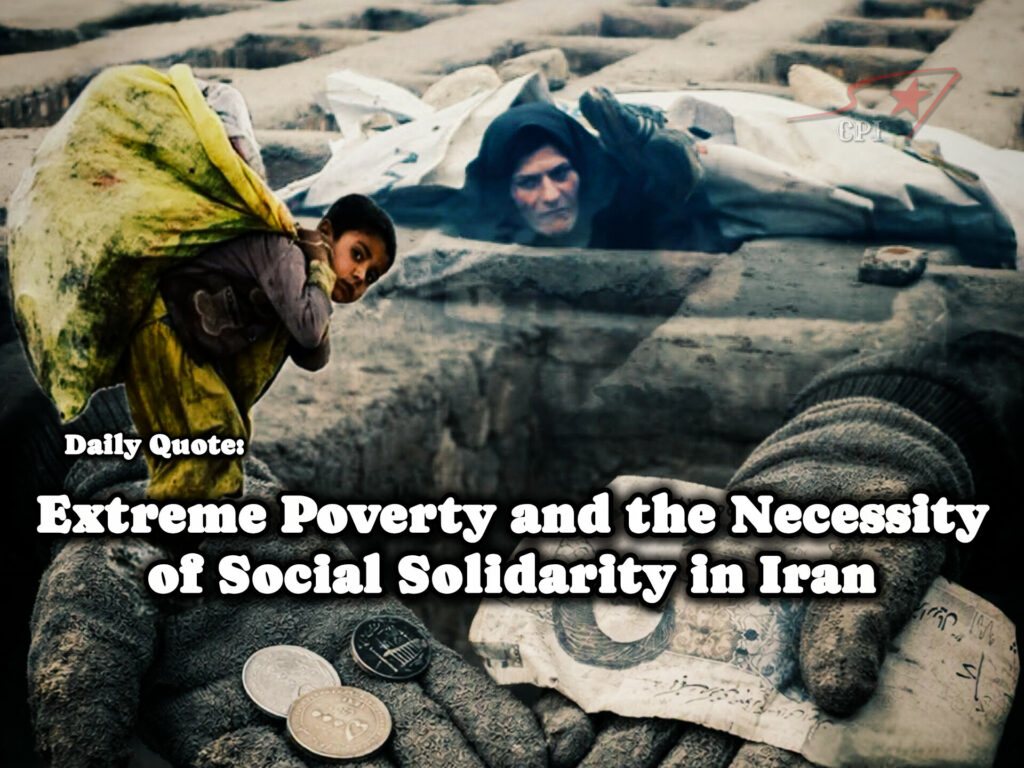
Extreme poverty has tightened its grip on a large part of Iranian society. The lives of workers, wage earners, retirees, the unemployed, and other disadvantaged groups are increasingly approaching the threshold of absolute poverty, and meeting even the most basic necessities of life has become an exhausting struggle for millions of households. Today’s crisis is not limited to declining purchasing power; it is also threatening food security, health, children’s education, job security, and even hope for the future.
A report published by the ILNA news agency on inflation and living costs in Tir 1405 presents a shocking picture of the depth of this crisis. According to official data, point-to-point inflation for food products has reached 128.1 percent; meaning that the price of a specific basket of food and beverages has increased by more than two and a half times compared with the same period last year. Meat, chicken, eggs, rice, legumes, dairy products, oil, fruit, vegetables, and even bread, which were once the basic components of people’s tables, have now become difficult or inaccessible commodities for a large proportion of households.
The crisis becomes even clearer when the gap between wages and the actual cost of living is examined. Independent estimates indicate that the minimum cost of living for a 3.3-person working-class family has reached approximately 90 million tomans per month. In contrast, the monthly income of a married worker with one child, even including benefits, is around 24.9 million tomans. Thus, a worker’s wage covers only about 27.5 percent of essential living expenses; meaning that their monthly income is sufficient for roughly eight days of the month, while the family must get through the remaining twenty-plus days by borrowing, eliminating basic needs, selling assets, or working more.
These figures show that the deepening gap between income and expenses has brought workers’ lives to an emergency situation. When the wage of a full-time worker cannot even cover one-third of basic expenses, employment can no longer guarantee a dignified life. Under such circumstances, being employed does not mean escaping poverty, and many workers, despite working long hours, remain among the poor.
The effects of this crisis are visible on household tables. Ordinary forms of saving are no longer effective, because many families had already reduced their consumption to the absolute minimum. Removing meat and fish from the diet, reducing consumption of dairy products, fruit, and vegetables, replacing food with cheaper and less nutritious alternatives, and lowering the quality of nutrition have become part of the daily reality of low-income groups. When buying a tray of eggs, a package of pasta, or even a limited amount of meat and chicken becomes difficult for families, this should be recognized as a serious livelihood and public-health crisis.
Food insecurity, particularly for children, has consequences extending far beyond daily hunger. Children experiencing hidden malnutrition and deficiencies in protein, vitamins, and minerals may suffer from physical weakness, reduced concentration, declining learning ability, and long-term health problems. This means that today’s poverty reproduces tomorrow’s poverty as well. A society unable to provide healthy food, adequate education, and accessible healthcare for its children is effectively placing its own future at risk.
Economic pressure has pushed families toward individual and often exhausting solutions: overtime work, taking multiple jobs, migration, borrowing money, selling household possessions, taking on heavy loans, and drastically cutting essential expenses. But these methods are generally unsustainable and, in many cases, merely transfer the crisis into the future. A worker holding several jobs faces physical and psychological exhaustion; a family that sells its assets loses its safety net; and repeated borrowing consumes an increasing share of future income.
Alongside inflation, another fundamental issue is people’s lack of protection against inflation. A worker has limited bargaining power against employers, landlords, banks, the market, and economic decision-making structures. In a society where independent labor organizations face restrictions and formal, contract, project-based, and informal workers remain fragmented, the burden of the crisis falls even more heavily on disadvantaged groups.
For this reason, independent organizing, the right to protest, and the right to strike have become vital necessities for defending people’s livelihoods. Organized workers can build greater bargaining power around demands for wages corresponding to real inflation, timely payment of salaries, full insurance coverage, job security, protection against arbitrary dismissal, unemployment insurance, rent controls, and access to quality healthcare and education.
The first step on this path is overcoming fragmentation. Workers in factories, workshops, service centers, hospitals, schools, neighborhoods, and different workplaces can establish networks of communication and solidarity. These networks do not necessarily have to be large from the beginning; small, conscious, and persistent groups can create the foundations for trust, the exchange of experiences, and the development of broader organizations.
Establishing local and occupational mutual-aid funds can also be an important measure. Many workers suddenly need immediate support because of illness, unemployment, dismissal, or unexpected crises. Solidarity funds, even if limited in scope, can reduce part of the pressure and strengthen human and collective bonds. Such experiences also teach people that they are not alone in the face of crisis and that they can rely on their collective strength.
Demands should also be clear, public, and accessible: wages corresponding to the real cost of living, provision of essential goods, universal insurance, support for the unemployed, job security, free and high-quality education and healthcare, the right to independent organization, and the right to protest. These demands can connect formal and informal workers, women and men, retirees, teachers, nurses, drivers, service workers, and the unemployed.
The current crisis has shown that waiting, passivity, and individual solutions cannot address widespread poverty. Only through unity, solidarity, independent organization, and collective struggle can people resist the continuous decline in living standards. The issue today is not merely high prices; it is people’s lack of protection against those prices. Building collective power is a necessity for defending the livelihoods, health, dignity, and future of millions of people.