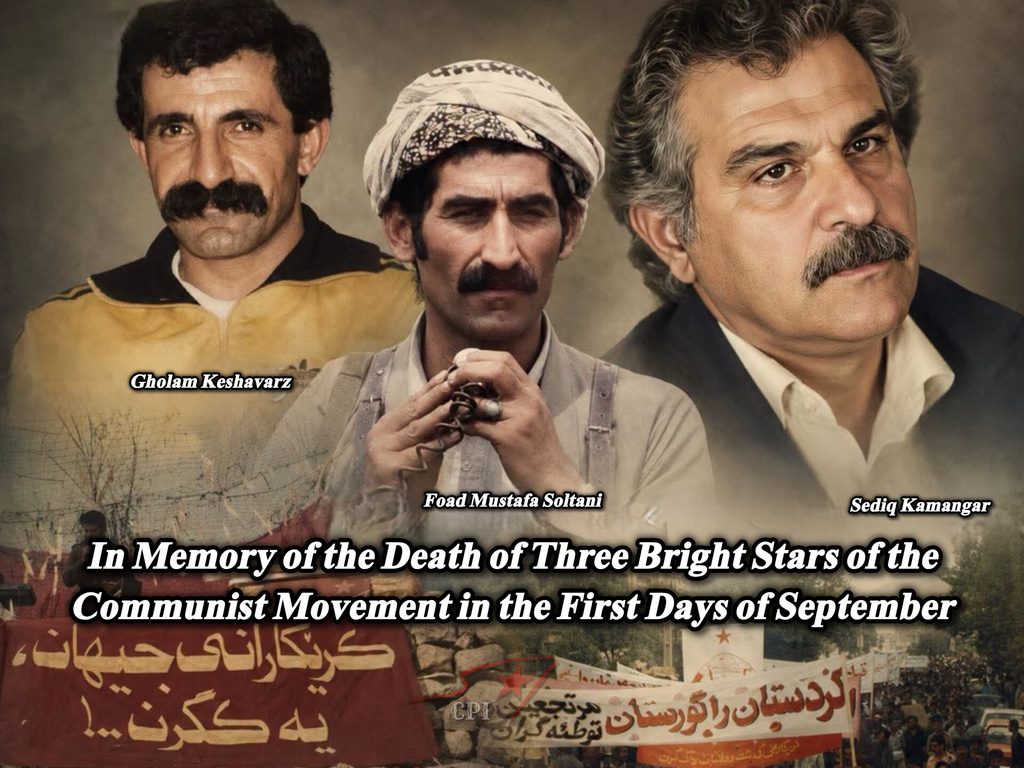
In Memory of the Death of Three Bright Stars of the Communist Movement in the First Days of September
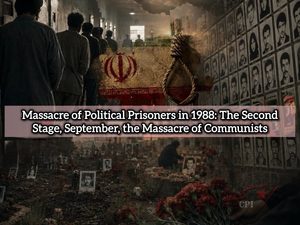
The first half of September recalls bloody days in the history of Iran’s communist movement and the revolutionary movement of the people of Kurdistan. It was during such days that the mass killing of communists in the prisons of the Islamic Republic began. The massacre of political prisoners, which had begun in July 1988 with the mass executions of members and supporters of the People’s Mojahedin Organization of Iran, continued in the first days of September with the killing of leftist and communist prisoners. The “Death Commission,” after reporting on the criminal mission it had carried out in the prisons in July to Khomeini, also obtained his religious decree for the killing of communists and turned against free human beings whose hearts were filled with love for the noble ideal of liberating exploited and oppressed humanity. In the dark days of the first half of September, thousands of militant and steadfast prisoners kissed the gallows, but did not turn their backs on their human ideals and, by answering no to the reactionary questions put to them, proved the superiority of their will over the power and force of the enemy.
In the first days of September 1979, the reactionary and bloodthirsty Khalkhali, acting on Khomeini’s command and religious decree, driven by his deep hatred of the resistance of the people of Kurdistan against Islamic reaction, turned against the revolutionary and dignified people of Kurdistan. The execution grounds in the cities of Paveh, Sanandaj, Marivan, Saqqez and Mahabad were stained with the blood of those who had refused to bow their heads before the reaction that had seized power.
But even this is not the end of these bitter memories, nor the end of recounting the heroism and self-sacrifice of those who gave their lives. The fourth, ninth and thirteenth days of September recall three important events in the political life of Komala and the Communist Party of Iran. On these days, our movement lost three of its prominent leaders, Foad Mustafa Soltani, Sediq Kamangar and Gholam Keshavarz. Their political role, alongside nearly two thousand five hundred people who lost their lives in the ranks of our movement, has made their political biographies part of the history of this society. Let us briefly review parts of the lives of these three leading figures of the caravan of those who gave their lives, in memory of all the other beloved fallen:
⸻
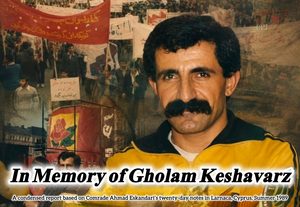
On the night of September 4, 1989, Comrade Bahman Javadi, known as Gholam Keshavarz, one of the prominent and well-known figures of Iran’s communist movement, who had traveled to Cyprus to visit his relatives, was targeted in the city of Larnaca by agents of the Islamic Republic and died in hospital hours later.
The year 1989 was a year of great upheaval in the world. Khomeini had “drunk the poisoned chalice” and the eight-year Iran-Iraq War had ended; the executions of thousands of political prisoners were underway; the genocide operation against the Kurdish people in Iraqi Kurdistan known as Anfal, in which 180,000 defenseless people were massacred in the deserts of southern Iraq, was entering its final stages; the Soviet army left Afghanistan and another dark period in the life of the suffering people of that country began; the Berlin Wall fell and the Soviet-aligned governments of Eastern Europe were taking their last breaths. Yes, it was in such circumstances that our party lost Gholam Keshavarz, one of its prominent leaders.
Comrade Gholam Keshavarz, whose real name was Bahman Javadi, was born in 1955 into a poor family in the village of Narek, one of the villages of Gachsaran County in Kohgiluyeh and Boyer-Ahmad Province. In 1973, he formed a group called “Revolutionary Action Against the Existing Situation.” In 1975, he entered the Faculty of Agriculture in Karaj. In May 1978, he was arrested by SAVAK for organizing a student strike. In the autumn of 1978, he was released from prison during the release of political prisoners. In early winter 1979, he joined the Union of Communist Militants.
Comrade Gholam Keshavarz was among the pioneers of the communist struggle in Iran. Through years of revolutionary struggle, resistance in the dungeons of the Pahlavi regime, and at the cost of exhausting his spirit and body, he moved at the forefront of Iran’s communist struggle through his work among workers. He was a well-known figure of resistance in the prisons of the Shah’s regime and one of the founders of the Communist Party of Iran. During his activity in the party, he held numerous responsibilities, including membership in the Central Committee.
Comrade Gholam had entered political struggle in the years before the February 1979 Revolution and then participated passionately and actively in all struggles during the February uprising and against the Islamic Republic. Throughout the turbulent political life of the Communist Party of Iran, until his death, Gholam Keshavarz was one of the party’s prominent thinkers and political figures.
By taking responsibility for the party’s main organs, including membership in the Organizing Committee for the Party’s City Organizations, the party’s Foreign Committee, editorship of the Resaneh publication, the committee of the Radio Voice of the Communist Party of Iran, responsibility for organizing the Federation of Councils of Iranian Refugees abroad, and membership in the Central Committee of the party, he played a prominent and important role, drawing on extensive theoretical, political and organizational abilities and experience. Throughout his political life, he was a sincere and persistent fighter against the system of oppression and exploitation under capitalism and for the liberation of the working class, and he gave his life on this path.
⸻
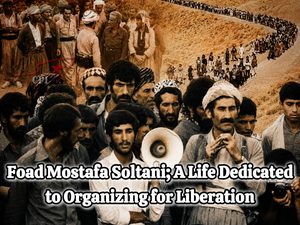
On September 9, 1979, Comrade Foad Mustafa Soltani, one of the leaders and founders of Komala, a well-known and beloved figure of Iran’s communist movement and a beloved leader of the workers and laboring people of Kurdistan, was killed following an unequal confrontation with a large number of Islamic Republic forces in the village of Bastam, along the Saqqez–Marivan road.
Comrade Foad was born in 1949 in the village of Almaneh in the Marivan area. He spent his childhood and adolescence and received his education in the city of Sanandaj, and completed his higher education in Tehran with a degree in electrical engineering. In 1969, together with a group of his comrades, he founded an organization that later became known as Komala. Foad’s social activity began with leading protests by political prisoners in the prisons of the Shah’s regime. If before that he had been a leader and organizer of underground struggles, from that point onward his talents and abilities in the field of social struggles flourished one after another.
Komala, the communist organization that Comrade Foad had founded with a group of his comrades nine years earlier, publicly declared its existence alongside the uprising of the Iranian people against the Shah’s regime. This marked the beginning of the fruitful organizational activity of an organization that, throughout the years of authoritarian rule and repression by the Islamic Republic, became intertwined with the name of workers and communism and with determined struggle against the Islamic Republic.
The name of Foad Mustafa Soltani and Komala shone in leading the struggles during the 1978 uprising, the mass movement in Sanandaj and the formation of city councils in various cities of Kurdistan, the protest exodus of the people of Marivan, organizing peasant unions, the massive mass march from Sanandaj to Marivan, forming the first Komala Peshmerga units, establishing democratic associations in almost all cities of Kurdistan, and finally organizing the mass armed resistance against the regime’s assault on Kurdistan. Following the Islamic Republic’s military campaign against Kurdistan in August 1979, Foad Mustafa Soltani was engaged in organizing the revolutionary resistance of the people of Kurdistan and was killed in battle with the occupying forces of the Islamic Republic on September 9 of that year.
Foad was a passionate communist who tirelessly struggled for the liberation of the working class and oppressed masses. His death in an unequal battle with the mercenaries of capital did not allow him to see the fruits of his own efforts and those of his comrades in the formation of the Communist Party of Iran, for whose preparation and establishment he had struggled for years and which had been one of his political objectives.
⸻
At 2 a.m. on September 13, 1989, Comrade Sediq Kamangar, a member of the Central Committee of the Communist Party of Iran and a member of the Central Committee of Komala, was assassinated in a criminal attack carried out by a traitor and agent of the Islamic Republic.
Comrade Sediq Kamangar was born in 1947 in the village of Afriyan in Kamiyaran County. In 1965, he entered the University of Tehran and studied law at the Faculty of Law and Political Science. In 1971, he graduated from the university with a master’s degree and began working as a lawyer in Sanandaj.
Sediq Kamangar, a brilliant figure and veteran fighter of the communist movement, was one of the most prominent and popular leaders of the masses and the revolutionary movement of Kurdistan, a distinguished mass agitator and orator, and one of the founding cadres of the Communist Party of Iran.
For more than four decades, he had made the ideal of communism and the struggle for the liberation of the working class the goal of his life, and from then on his energetic life became intertwined with communist and revolutionary struggle.
Beginning organized struggle in the underground Komala organization from the first months of its establishment; emerging as a leader of the mass movement during the revolution against the Shah’s regime; issuing statements as spokesperson for the Iranian Bar Association; becoming the leader and spokesperson of the radical and revolutionary wing of the revolutionary movement against local and religious reaction in southern Kurdistan; standing at the head of the masses rising up in the city of Sanandaj; then shining as the articulate and fiery voice of the people who had risen against the newly established Islamic regime during the Bloody Nowruz of Sanandaj and at the head of the revolutionary council of that city; becoming associated with the demands and rights movements of the deprived and laboring people of the cities and villages of Kurdistan; participating in directing the revolutionary war in Kurdistan as a military commander; overseeing and running Radio Voice of the Iranian Revolution, Komala’s radio, of which he was one of the prominent writers and speakers; and participating in diverse political and organizational activities as a member of the Central Committee of the Communist Party of Iran and Komala, all formed part of the rich political record of Comrade Sediq Kamangar.
With a renewed pledge and loyalty to the communist and liberatory ideals of these beloved comrades, we commemorate the memory of those who gave their lives in September and all those who gave their lives on the path toward liberating working and laboring people from the exploitation and oppression of the capitalist system. We hope for the day when the criminal leaders of the Islamic Republic are brought before the courts of the suffering people of Iran, when the sealed secrets of the countless crimes they have committed are further exposed, and when they receive the punishment they deserve.