Message from the Central Committee of the Communist Party of Iran on the Occasion of the Beginning of the New Academic Year
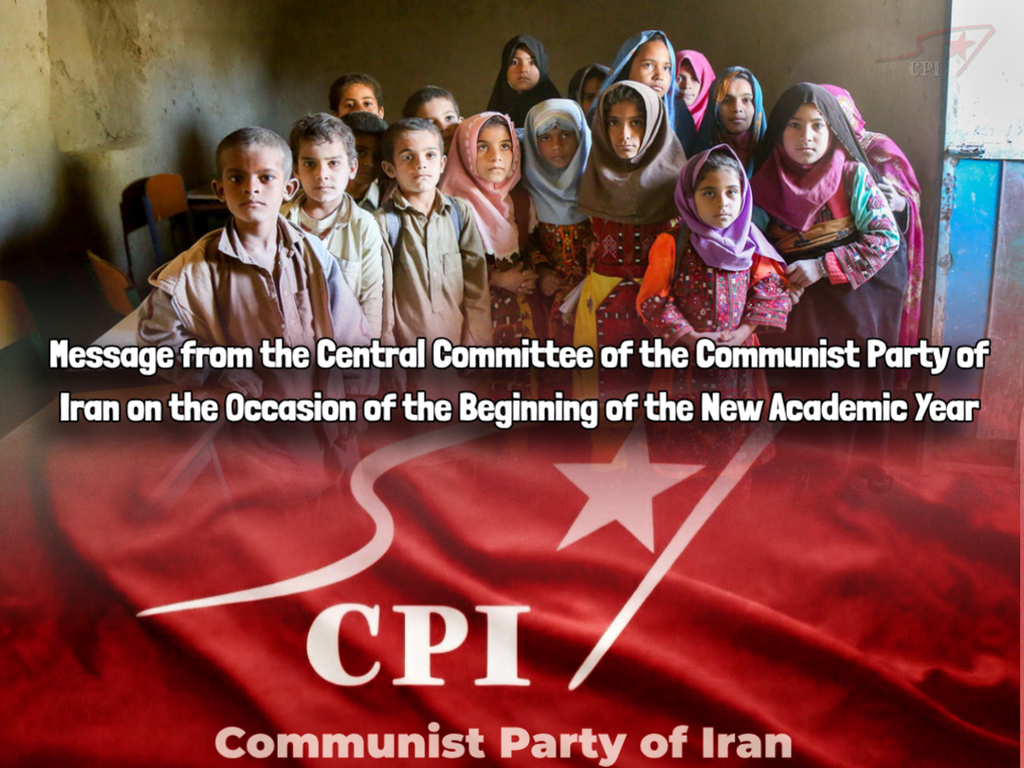
On Wednesday, September 23, 2026, the new school year officially begins in Iran. These days, more than 16 million schoolchildren and adolescents, more than 4 million university students, nearly 2 million teachers, and thousands of university professors will once again make their way to classrooms. The school bell is a sign for millions of families of the beginning of a season of effort, hope, and dreams for their children’s future.
But alongside this picture, there is a bitter and undeniable reality: statistics show that more than 3 million school-age children have been deprived of attending school due to their families’ poverty. This figure represents the lives of millions of children who, at an age when they should be holding a pen, have instead been forced to work in workshops, on streets, in fields, and at intersections to contribute to providing food for their families.
The deprivation of millions of children and adolescents of their right to education troubles every awakened conscience. Child laborers and street children constitute part of the country’s school-age population; children whom poverty, their parents’ unemployment, the hidden and overt costs of education, and the lack of social support have thrown from the classroom into the labor market. For these children, education is not a guaranteed right, but a commodity they cannot afford.
The Afghan immigrant children must also be added to the number of these children; children who, because of lacking residency documents, administrative barriers, and discriminatory policies, are deprived of access to formal education. A child who lives in Iran, regardless of their place of birth or their parents’ nationality, has the right to learn.
Iran’s education system has, over the past four decades, become an arena for the injection of religious ideology. Textbooks, educational programs, and the school environment have served more to instill official beliefs and train obedient citizens than to foster critical thinking and scientific knowledge. This system has fallen far behind the scientific advances and modern educational methods used around the world.
Nevertheless, the regime’s ideological projects in education have failed. A prominent symbol of this failure is the widespread turning away of young people from official religion and the transformation that has taken place at the social level. The generation raised in these very schools became one of the main forces of protest during the “Woman, Life, Freedom” uprising, challenged imposed values, and expressed its demand for freedom and equality in its own language and manner.
While astronomical and unaccountable sums are spent every year on expanding weapons of war, adventurous military projects in the region, and strengthening the machinery of repression against people’s protests, education is in a disastrous state in terms of its budget. The priorities of the authorities are clear: missiles are preferred over teachers, barracks over schools, and repression over education.
The result of this policy can be seen in every classroom. Educational aids, which can both help students learn and reduce teachers’ heavy workload, are scarce and worn out. Classrooms accommodate at least twice their standard capacity of students. A large number of schools in villages and impoverished neighborhoods have damp classrooms, cracked rooms, cold spaces without fuel, and insufficient lighting.
In addition to the lack of resources, educational environments have been transformed into police and security spaces. The regime has made these environments unsafe by recruiting members of the Basij and cultivating informants in schools and universities. A number of dedicated and protesting teachers have been arrested and are being held in prison. Those who have not been arrested are periodically summoned and threatened by security agencies. Collective protests and teachers’ gatherings are met with police raids and arrests. A system that sends its teachers to prison openly demonstrates that it fears awareness-raising education.
This year, the school and university bells will ring with empty seats. The seats of students and university students are empty because they lost their lives at the hands of the Islamic Republic’s repressive forces during the “Woman, Life, Freedom” uprising and the protests of previous years, in the streets, in schoolyards, and on university campuses; teenagers who had not yet reached the age of twenty and whose only “crime” was shouting for freedom and equality. Their names are engraved on the walls of this society’s memory and constitute an indictment against a government that, instead of responding to the demands of the younger generation, chose bullets.
And there are the empty seats of the students of Minab School; children who, in an anti-people war, were torn apart when a missile fired by the U.S. military struck their school, killing more than one hundred of them. This tragedy showed that in wars between governments, the first victims are children and defenseless people. Those who stockpile missiles at the expense of the people’s tables and those who rain fire on cities from thousands of kilometers away share one thing: disregarding the lives of ordinary human beings. A school that should have been a safe haven for children became a mass grave for students. The memory of these children, along with the memory of those who lost their lives in the streets, will not be forgotten, nor will responsibility for it be subject to a statute of limitations.
For students, moving up to a higher grade and seeing their friends and playmates brings excitement and joy. But for teachers, the beginning of the academic year marks the beginning of another year of hardship; a year of struggling with the problems that confront them this year and every year.
Low teachers’ salaries in the face of rising inflation and ever-increasing prices have pushed the lives of the teaching masses below the poverty line. Many of them are forced to take on a second job after finishing their work at school in order to provide for their families. Exhausting working hours not only leave them no opportunity to enjoy time with their families, but also directly reduce the quality of their teaching.
The inconsistent system of salary payments has effectively turned teachers into second-class citizens compared with other government employees. The teaching profession is not only unappreciated, but is also subjected to discrimination and humiliation. Thousands of contract teachers, working under temporary contracts and receiving the lowest wages, have been working for years in the most remote parts of the country without even having health insurance coverage. A large proportion of them spend the summer months doing manual labor and the hardest jobs and begin the new academic year with exhausted bodies.
Despite all these difficulties, what gives hope is the fact that Iran’s teachers have not surrendered. Nationwide gatherings, strikes, statements by teachers’ professional organizations, and teachers’ presence alongside workers, retirees, and families seeking justice have consistently been part of the living movement of society in recent years.
In the free Iran of tomorrow, with the separation of religion from the state and the separation of education from religion, all of students’ abilities will be directed toward scientific education, critical thinking, and life skills instead of superstitious ideas. In that society, no child will be deprived of education because of poverty, nationality, language, gender, or place of residence. Free and universal education will be the guaranteed right of every child, and schools in villages and cities will have access to the advanced facilities of the modern age. Children will learn in their mother tongue, and teachers will enjoy social status, a dignified livelihood, and job security.
Under such conditions, talents will flourish, and this country’s immense human capital, instead of being wasted in the cycle of poverty, war, and repression, will be put to work for the development, freedom, and advancement of society.
The Communist Party of Iran warmly congratulates students, university students, teachers, professors, and all employees of Iran’s schools and universities on the beginning of the new academic year. We honor the memory of the students and university students who lost their lives in the streets, the children of Minab School, and imprisoned teachers, and call for the immediate release of all imprisoned teachers and university students.
With the hope that in the new academic year, Iran’s educational institutions throughout the country will continue to be at the forefront of the people’s protests and struggles for their rights; that schools and universities will remain bastions of awareness, solidarity, and the pursuit of freedom; and that the new generation will lead the effort to build a free, equal, and humane society.
Central Committee of the Communist Party of Iran September 17, 2026