The Collapse of the Formal Labor Market in Iran
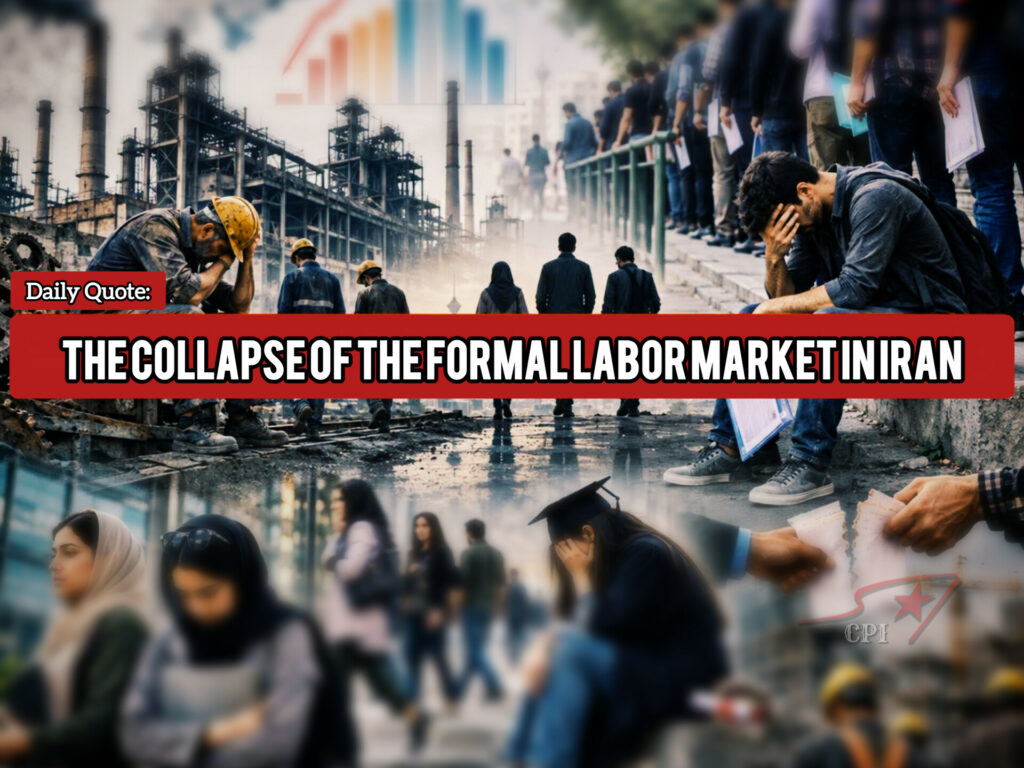
ILNA, the Islamic Republic’s labor news agency, published a report yesterday titled “One Million Workers Exit the Formal Labor Market,” lifting the veil on the real unemployment crisis and the fabricated statistics of the Statistical Center of Iran. The Statistical Center of Iran has announced a fabricated rate of 7% as the unemployment rate in Iran. This is while the same center, in keeping with the saying “a liar has a poor memory,” had announced that in just the first quarter of the current year, 630,000 industrial jobs had been lost; a figure that indicates the deep recession in large and medium-sized industries. At the same time, reports from the Social Security Organization indicate a decline of around one million insured contributors over the course of one year. This massive exit has a clear meaning: even if some of these people have re-entered the labor market, their new jobs lack the quality and job security of their previous employment and are mostly in informal, part-time, and unproductive service sectors.
Iran’s labor market has faced shocks in recent years whose dimensions go far beyond official statistics. The sharp decline in industrial employment, the mass withdrawal of women from the labor market, and the expansion of informal employment paint a picture of the future of Iran’s workforce that differs from what the Statistical Center of Iran presents.
While the government puts the unemployment rate at around 7%, a senior member of the Chamber of Commerce has emphasized in an interview with ILNA that the real unemployment rate is five times the official figure. This enormous discrepancy can only be explained by looking at economic participation indicators: the sharp decline in women’s participation from 16% to 11%, and the direct unemployment of more than 450,000 people as a result of the war. These figures show that a large portion of the working-age population has stopped looking for work due to despair over finding employment and therefore is not counted as “unemployed” in official statistics.
Historical comparisons show that today’s official rates do not correspond with the realities of the labor market. In the 1970s, the unemployment rate was around 15%, and in 2000 it was recorded at 14%. Despite the fact that today’s economic conditions are considerably more difficult, the official unemployment rate is reported to be lower.
According to the domestic standard, a person who works at least one hour per week is considered employed; whereas international criteria require a minimum of 14 hours of work per week to be considered employed. This difference in definitions causes a large portion of underemployment and part-time employment to be recorded as full employment in official statistics.
Unemployment in Iran has targeted young people more than any other group. According to official statistics, the unemployment rate among young people aged 15 to 24 reached more than 20% in the summer of 2025; that is, more than twice the general rate. Reports indicate that around 70% of all unemployed people in the country are between the ages of 18 and 35. The consequences of this situation include the loss of opportunities to acquire skills, increased depression, lack of purpose and a sense of failure, and increased migration among young people.
One of the shocking dimensions of unemployment in Iran is the deep gender gap. The unemployment rate among women was reported at around 30% last year, compared with 13.5% for men. This twofold gap exists despite the fact that Iranian women have had a widespread presence in universities over the past two decades and their level of education has increased significantly. Despite this progress, suitable employment opportunities matching their education have not been provided, and a large proportion of educated women have been left among the unemployed.
Studies show that university graduates account for 42.4% of all unemployed people in the country. This figure indicates the deep gap between the higher education system and the actual needs of the labor market. Heavy investment by families and the government in education has ultimately failed to translate into stable employment, leaving a large part of the country’s skilled workforce unused.
But unemployment in Iran is not merely an economic issue; it is a full-scale social crisis. Its consequences include, among other things, job insecurity, the spread of absolute poverty, an increase in psychological disorders, depression and loss of identity, the growth of addiction, prostitution, suicide and other social harms, and the disintegration of working-class families.
More than 80% of workers in Iran have temporary, blank-signed, or subcontracted contracts. This situation means that on the first day of unemployment, a working-class family can fall into the depths of poverty, with no effective support system available.
The increasing closure of factories and crisis-ridden production centers, mass layoffs of workers, and the expansion of informal employment indicate a trend that, if it continues, could completely exhaust Iran’s productive structure. Even the lifting of sanctions does not create a clear short-term outlook for improving the employment situation.
Under conditions in which government policies are unable to contain the crisis, the burden of the struggle against unemployment falls on workers and activists of the labor movement. Individual visits to employment centers, waiting for government promises, or pinning hopes on future economic growth are not solutions.
The key demands of workers are job security, adequate unemployment insurance, the elimination of temporary and blank-signed contracts, an end to mass layoffs, and the creation of independent workers’ organizations. The vast mass of unemployed people, particularly educated young people, has enormous potential for the formation of a mass movement. Awareness of the social consequences of unemployment and the lived experience of millions of workers provide the basis for unity and solidarity.