The Islamic Republic and the United States; How Have the Two Sides of a Conflict Driven the People into Hunger?
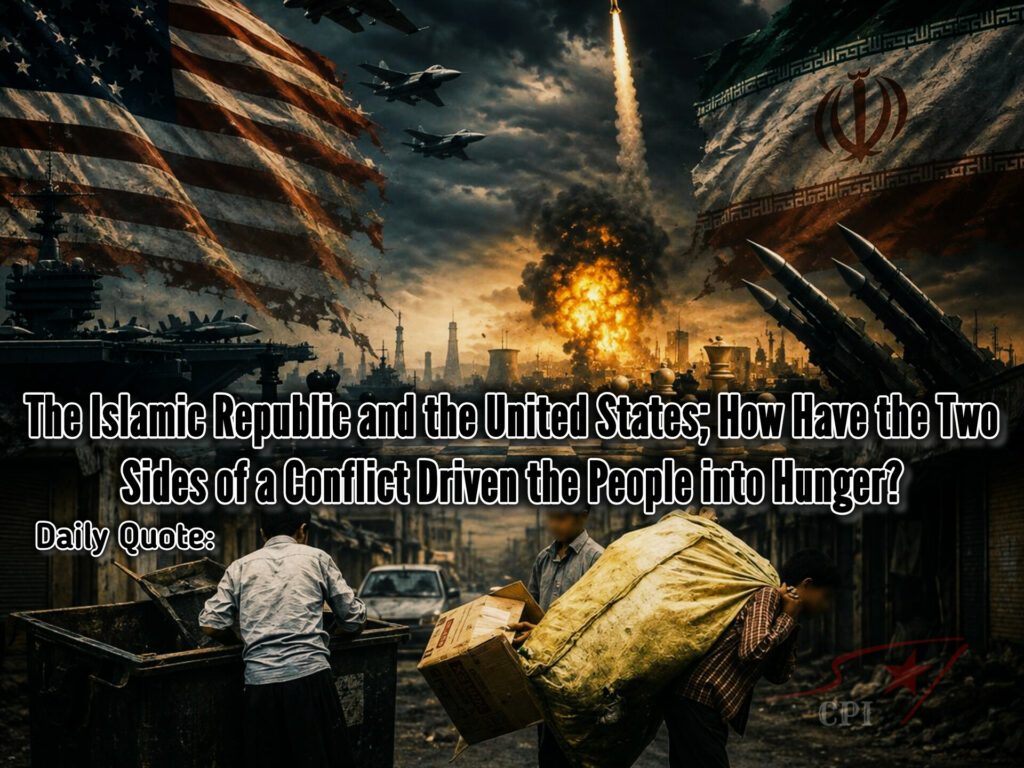
In the protracted and long-standing conflict between the Islamic Republic and the United States, while political actors on both sides beat the drums of confrontation and engage in displays of power, the real and deadly costs of this confrontation are imposed directly on the shoulders of the deprived classes and working masses of society. The brutal tools of geopolitics, from economic and banking blockades to the obstruction of trade arteries, do not deliver their first and most devastating blows to the foundations of the Islamic Republic’s rule, but rather to the health and food security of ordinary people.
The bitter reality today is that millions of Iranian citizens are being crushed between the hammer of external pressures and the anvil of domestic incompetence and corruption.
The maritime blockade of Iran’s ports and coasts, and the United States’ efforts to reduce oil exports to zero and cut the country’s access to global financial and trade mechanisms, represent one of the most ruthless forms of pressure in the current conflict. Oil, as the backbone of the country’s foreign-exchange revenues, has effectively been lost, and the entry of goods has become a costly, complex, and exhausting process. On paper, these pressures are described as “targeting the regime,” but in practice, their most direct consequences are manifested in shortages of goods and uncontrolled surges in prices.
The tangible impact of this blockade can be seen in changes to routes and transit costs. A driver who has spent years transporting imported goods from the borders and southern ports to central cities describes the reality of this situation as follows:
“It used to be a direct route. Now we have to take detours, pass through several countries, and be inspected repeatedly. Fuel costs, tolls, insurance… everything has multiplied several times over.”
This wandering along long routes and circumventing sanctions-related obstacles ultimately becomes a cost added to the final price of goods; a cost ultimately paid by workers and poor families who encounter astronomical price tags in neighborhood stores.
Government officials continually attempt to attribute all dimensions of the collapse in people’s livelihoods to external variables. In his recent remarks, President Masoud Pezeshkian attributed rising prices directly to increased import costs, declining oil revenues, and damage to some industries and factories. Although the destructive impact of sanctions and the blockade cannot be denied, reducing the entire crisis to American pressure is a form of evading responsibility.
Iran’s economy has suffered for years from chronic mismanagement, rent-seeking, systemic corruption, and the allocation of huge budgets to religious institutions that promote superstition. Instead of creating protective measures and strengthening the resilience of disadvantaged classes, the authorities have shifted the burden of the budget deficit onto society through unbacked money printing, increased indirect taxes, and manipulation of the exchange rate. Meanwhile, a large portion of the country’s resources is devoted to the Islamic Revolutionary Guard Corps and the further militarization of Iran, while welfare, public health, medical care, and education budgets become thinner year after year.
When these two factors combine, their consequences rapidly move beyond macroeconomic indicators and enter the deepest dimensions of household life. In one of the neighborhoods of southern Tehran, a mother describes her family’s situation as follows:
“We used to buy milk and yogurt every week. Now the children only drink milk at school. Prices have risen so much that it seems dairy products have become luxury goods. My husband is a construction worker, and his income does not keep pace with inflation at all. Every day something becomes more expensive; we just watch and there is nothing we can do.”
This is not an isolated account; it reflects the situation of millions of working-class and laboring families who have been forced to remove meat, chicken, dairy products, fruit, and even basic food items from their diets. Numerous reports indicate that malnutrition in disadvantaged and marginalized areas is becoming a generational crisis. Children deprived of basic food because of poverty are the first victims of a war that, without firing a missile, has targeted their lives and futures.
In this unequal equation, ordinary people are not one side of the dispute, but have become instruments of pressure and bargaining chips in power politics. On the one hand, policymakers in Washington, by imposing comprehensive blockades, drive the masses toward extreme poverty in order to turn public discontent into a political lever. On the other hand, the Islamic Republic uses the existence of sanctions as a shield to conceal its own inefficiencies, suppress legitimate livelihood demands, and justify everyday price increases; while ruling classes and power-connected profiteers amass enormous wealth from this very environment of isolation and sanctions.
Ultimately, workers, the deprived, women who are heads of households, and the children of Iran have become trapped between two millstones: the sanctions and economic blockade policies of the United States, which block vital channels, and the anti-people policies of the Islamic Republic, which place no value on people’s right to life and welfare. Both sides, through different language and different tools but with a shared function, have turned hunger into an everyday reality in the lives of Iran’s most deprived people.