The Strait That Was Closed to Iran Before Anyone Else
In these days when the name “Strait of Hormuz” is once again dominating news headlines and threats by the Islamic Republic to “close the strait” are being repeated, an important reality has remained hidden beneath the dust of political uproar: if the Strait of Hormuz is closed, it is the Islamic Republic of Iran itself that will be hit first; a blow heavier, deeper, and more devastating than that suffered by any other country in the region.
This conclusion may seem strange at first glance. For years, the Islamic Republic has presented the “Hormuz lever” as its trump card against the United States and the Arab countries; a tool that was supposed to hold the global economy hostage at a moment of crisis. But the reality in the region today shows that this lever not only no longer has the effectiveness it once did, but has instead become a tool against Iran itself; a tool that, whenever deployed, pushes Iran’s economy closer than anyone else’s to the brink of bankruptcy.
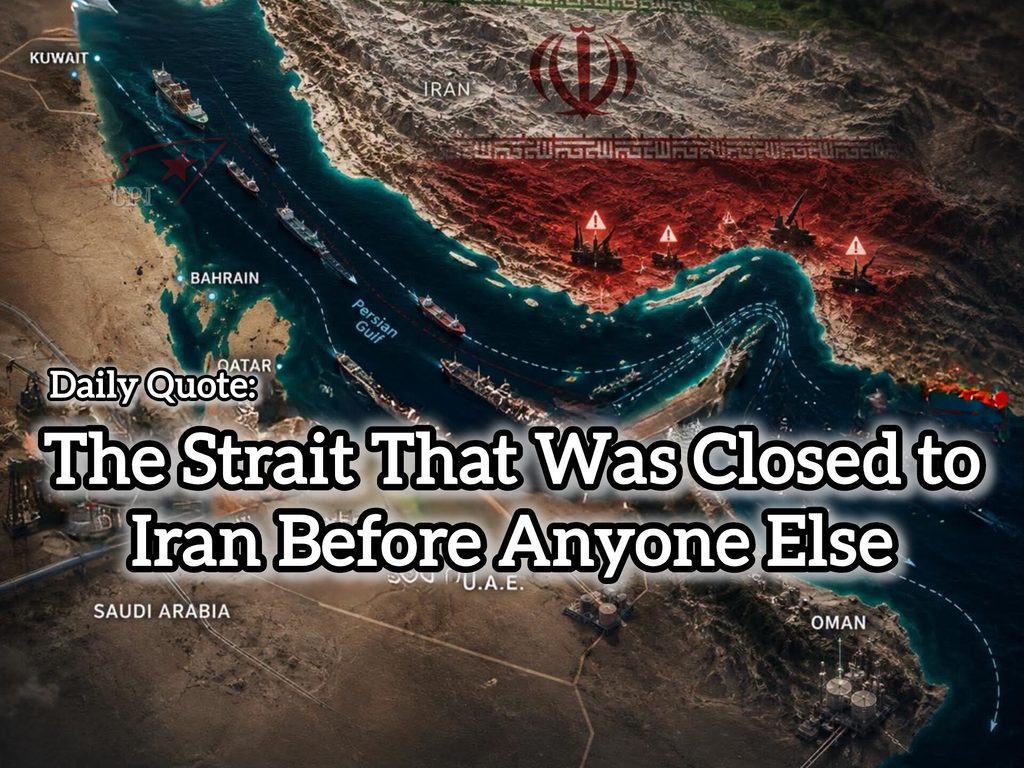
On Friday night, according to Axios, 40 oil tankers passed through the southern route of the Strait of Hormuz, a deep and secure route used by ships without approaching Iranian waters. That same night, 16 million barrels of oil passed through this route. This means that the Strait of Hormuz, contrary to the claims of Iranian military commanders, has not been closed to the world. The flow of energy continues, the global market continues to breathe, and no country in the region has suffered an export paralysis.
At the same time, however, the president of Iran announced that Iran’s oil exports had fallen to zero. The reason is clear: Iranian ports are under a U.S. naval blockade, and Iranian oil tankers are unable to leave. The Goreh–Jask project, which was supposed to provide Iran with an alternative route, has not only failed to become fully operational, but even if completed, would effectively remain unusable because of the naval blockade. Put simply: the Strait of Hormuz is closed to Iran, not to others.
While Iran remains dependent on Kharg Island and the Persian Gulf, regional countries have rapidly reduced their dependence on the Strait of Hormuz. Saudi Arabia has the enormous “Petroline” pipeline, which transports 5 million barrels of oil per day to Yanbu on the Red Sea. The UAE has built the Habshan–Fujairah pipeline, which transports oil directly to the Gulf of Oman and has made Fujairah one of the most important energy terminals outside Hormuz. Oman, with the ports of Duqm, Sohar, and Salalah, is essentially outside the danger zone and, even during periods of crisis, serves as a secure route for regional trade. Iraq, through routes via Turkey and Syria, as well as coordination with Iran for its tankers to pass along the Iranian side of the strait, has effectively remained protected from a Hormuz blockade. Qatar suffers losses in liquefied natural gas exports, but not to an extent that threatens the structure of its economy. Kuwait has no alternative route, but its enormous storage capacity makes short-term shocks manageable.
In this situation, Iran is the only country completely trapped behind the strait. It has no operational alternative route; its main export infrastructure is located on Kharg Island and inside the Persian Gulf; its ports are blockaded; and its exports have fallen to zero during the crisis. In reality, Iran is the only country that would be completely cut off from global markets by the closure of Hormuz.
The United States understands better than anyone that Iran’s threat to “close the strait” is more of a political display than a genuine instrument of pressure. The global oil market has alternative routes; Saudi Arabia and the UAE have made a significant portion of their exports independent of Hormuz; Oman is essentially outside the strait; Iraq has multiple routes; and the only country that would be paralyzed by the closure of the strait is Iran. For this reason, Washington knows that the threat has no long-term effectiveness. The Hormuz lever, which was once Tehran’s trump card, has now become a lever of pressure against Iran itself.
If the Strait of Hormuz were ever genuinely closed, the global economy would suffer, but the impact would remain manageable. Regional countries have built alternative routes, developed new infrastructure, and reduced their dependence. Iran, however, remains trapped behind the strait; under a naval blockade, without an alternative route, without extensive storage capacity, and with an economy more dependent than ever on oil exports. For this reason, it can be said that the Iranian regime has, before anyone else, closed the Strait of Hormuz to its own economy. And this is precisely the reality that the United States understands better than anyone.