Iran in the Post-War Period

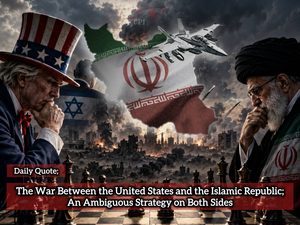
Most likely, the Islamabad negotiations between the Islamic Republic of Iran and the United States, after the failure of the first round, will be resumed once again. In this round, and perhaps in one or two subsequent rounds, the Iranian regime will effectively face three main scenarios: first, reaching an agreement that can be presented in Iran as a “dignified” deal and in the United States as a sign of “political success”; second, a return to war, with consequences whose scope and depth cannot be easily predicted; and third, the continuation of the exhausting “no war, no peace” situation, along with ongoing political and economic pressures and the continuation of Trump’s maximum pressure sanctions policy.
However, the political future of Iran cannot be understood solely within the framework of these negotiations. The main issue is what transformations are taking shape within society and within the power structure of Iran, regardless of the outcome of the talks. Post-war Iran will be the result of two simultaneous processes: the reconfiguration of power at the top of the ruling system and the reconstruction of social capacity from below.
Regarding the first process, an article by “Menachem Merhavy,” a professor at the University of Jerusalem, published in Foreign Policy on April 16, 2026, contains important points about the reconfiguration of power at the top of the ruling system. In this article, the author argues that Iran is transitioning from a system centered on the clergy to one centered on a security-military structure. According to him, this transformation is not merely the result of recent wars, but the outcome of a decades-long process shaped by war, the suppression of protests, the containment of reforms, and the gradual expansion of the influence of the Islamic Revolutionary Guard Corps in political, security, and economic spheres.
Merhavy considers Mohammad Bagher Zolghadr as a symbol of this change; a figure who has risen not through electoral competition nor through conventional political activity, but from within the IRGC, intelligence institutions, and the hard mechanisms of power behind the scenes. From this perspective, while the IRGC once merely defined the boundaries of political power, it has now itself become one of the main centers of governance. The clergy still maintains a presence at the symbolic, linguistic, and ideological level, but its real role in decision-making has diminished, and the center of gravity of power has shifted to security networks.
This assessment broadly aligns with the trends of recent years. Today, in the Islamic Republic, although the official language remains one of religious legitimacy, the practical logic of governing the country is increasingly driven by security considerations, social control, crisis management, and the effort to survive. In clearer terms, while the clergy may still be the spokesperson of the formal order, in practice it is the security institutions that play the decisive role in determining the real trajectory of the Islamic Republic.
Of course, this picture should not be viewed in an absolute or simplistic way. The power structure in Iran still consists of multiple layers, internal rivalries, and fragile balances among the clergy, bureaucracy, military forces, appointed institutions, and limited electoral mechanisms. Nevertheless, the general direction of transformation, especially under conditions of crisis, clearly tends toward greater concentration of power in the hands of security structures.
One of the important points in the Foreign Policy article is that increasing external pressure does not necessarily lead to internal reforms. On the contrary, in many cases, external threats strengthen those very institutions that define their interests and existence in terms of broader coercive control. The experience of past decades has also shown that whenever external pressure has intensified, the hands of security institutions to further consolidate control have been strengthened.
Accordingly, if the Islamabad negotiations fail and the current suspended situation continues, the most likely political outcome will be the further consolidation of the security bloc’s position. Even if an agreement is reached, according to the author of the article, at best the form of exercising power may become softer, harsher, or more complex, but the fundamental security-centered nature of power will not easily change.
Nevertheless, the future of Iran cannot be explained solely from the perspective of developments within the ruling system. The experience of social and political struggles over recent decades clearly shows that Iranian society from below is neither passive nor easily subject to top-down designs. No plan formulated at the highest levels of power, by new commanders, security managers, or crisis bureaucrats, can be imposed without social friction and without cost to society.
Iranian society has in practice learned that neither external pressure opens the path to freedom nor do internal divisions within the government, by themselves, lead to liberation. If there is a prospect for change, it depends above all on the reconstruction of social capacity, organization from below, and the reconnection of fragmented demands into a clearer and more comprehensive framework.
The end of war, or even the reduction of fear and anxiety caused by the possibility of its resumption, can provide such an opportunity. A society that has been forced to suspend part of its demands under the shadow of war will, in the post-war period, have the chance to breathe, reassess its experiences, and prepare for a new phase of social and political movement. In this context, demands such as bread, work, and freedom can once again become central to the formation of social movements.
The crisis of livelihood, job insecurity, poverty, the erosion of the middle class, structural discrimination, environmental crisis, generational discontent, and the issue of civil rights and freedoms will not disappear with the end of war. On the contrary, what has been temporarily pushed to the margins during wartime and emergency conditions will return with greater intensity in the post-war period.
The post-war period is also a time for redefining the political credibility of different forces. At historical turning points, society gradually moves beyond general slogans and reaches more concrete judgments about parties and political actors. Questions will arise about who, during the war, saw the suffering of the people and who became trapped in power calculations, political ambitions, or their own illusions. Which forces accepted the continuation of war and the deepening of destruction, and which forces tried to place the salvation of society and the interests of the majority at the center of attention. From this perspective, the end of war is also a decisive moment for assessing political legitimacy. Those currents that, without the slightest attention to the human, social, and economic consequences of war, welcomed it or remained silent in the face of the destruction of society will inevitably face an erosion of their credibility. In contrast, forces that have been able to draw a line both against war and against the order that produces war, while at the same time speaking of rebuilding social life, reducing public suffering, and restoring collective hope, will have greater capacity to influence the future.
Accordingly, in the post-war period, Iran will likely face two contradictory yet simultaneous processes: on the one hand, a deepening tendency toward the concentration of security power at the top; and on the other hand, the gradual return of society to the arena of demands, protest, and organization from below. If an agreement between Iran and the United States is reached, this contradiction will manifest itself in a milder form but with greater depth; and if no agreement is reached, this same gap, in the context of economic pressure and social erosion, may lead to new crises.