Slow Death in the Prisons of the Islamic Republic
At a time when the political atmosphere in Iran and the region is overshadowed by war, negotiations, military threats, the Strait of Hormuz, and international tensions, a major danger is taking shape: the forgetting of political prisoners. The Islamic Republic has always used moments of crisis, war, and foreign pressure to conceal internal repression. Under such circumstances, political, ideological, civil, labor, student, and protesting women prisoners are more than ever exposed to isolation, defenselessness, and silent death.
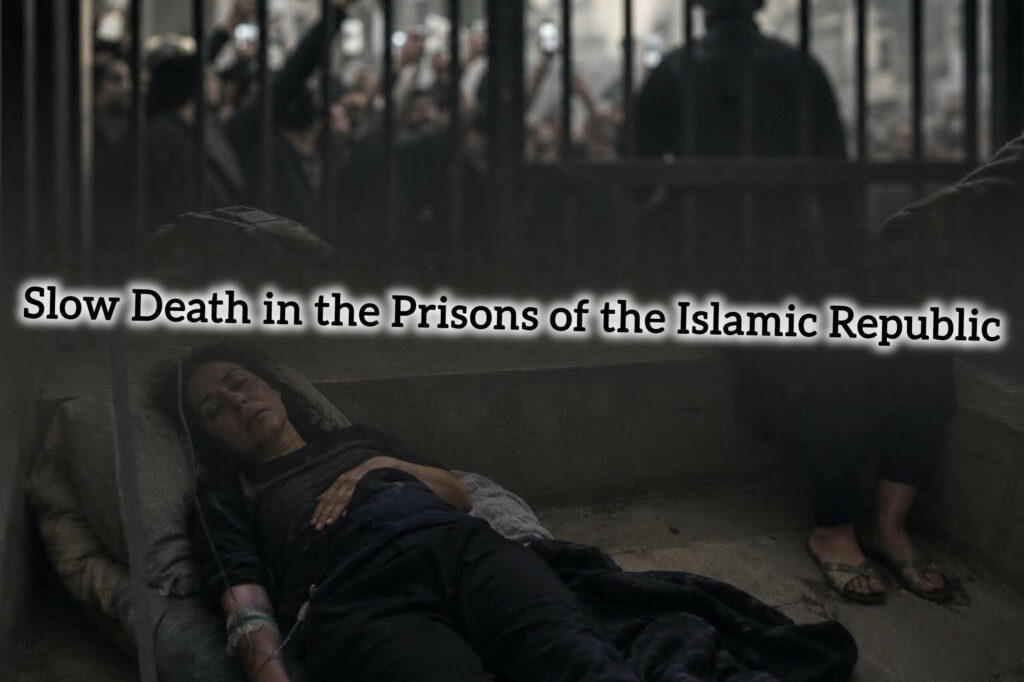
Recent reports regarding the worsening physical condition of Narges Mohammadi, Nobel Peace Prize laureate, following repeated fainting spells and heart problems, have once again sounded the alarm. At the same time, worrying news has emerged regarding the severe physical condition of Fatemeh Sepehri in Mashhad prison. These are well-known names; yet behind them stand dozens and hundreds of lesser-known prisoners who silently endure pain, illness, exhaustion, and deprivation of medical treatment. The issue is not merely medical negligence or administrative disorder. Depriving prisoners of treatment has become a policy in the prisons of the Islamic Republic; a policy that can be described as “silent execution.”
In the cases of Mahvash Sabet, Matin Ahmadian, Arash Sadeghi, Mohammad Ali Taheri, and Nasrin Javadi, a common pattern can be seen: serious illness, warnings from family members and lawyers, indifference from prison authorities, delays in transfer, interference by security institutions, and finally the worsening of the prisoner’s condition. This pattern has been repeated again and again. Its victims are not one or two individuals, but dozens of prisoners. In many cases, the government has prevented the transfer of prisoners to hospitals or the granting of medical leave until the very last moment, retreating only when the patient’s condition has reached a dangerous or irreversible stage.
The case of Baktash Abtin, the imprisoned poet and filmmaker, is one of the clearest signs of this crime. He died after delays in treatment and a late transfer to the hospital. His death was the result of a chain of irresponsibility, delay, and cruelty. Khaled Pirzadeh, a bodybuilding champion, lost forty kilograms in prison and, after severe physical and psychological pressure, became confined to a wheelchair. Raheleh Rahimipour, a seventy-three-year-old woman with a brain tumor, spent years behind prison bars. Zeinab Jalalian has remained imprisoned for years without even a single day of leave. Somayeh Rashidi died after months of medical deprivation in Evin and Qarchak prisons. These are only a few names from a long list.
There are many more names: Hoda Saber, Sasan Niknafs, Vahid Sayadi Nasiri, Mohsen Doghmehchi, and Akbar Mohammadi. The list is long, but the pattern is the same: warning, denial, delay, deterioration, death. It is precisely this pattern that human rights activists describe as “white torture” and “silent execution.” Perhaps this description is more accurate than many legal definitions, because it describes the reality without disguise. They do not directly kill the prisoner, but they create conditions in which the body slowly collapses. They do not hang the prisoner, but they deny treatment until the illness finishes its work.
In some cases, even the government’s official account of the cause of death has been met with serious doubt by families and human rights organizations. The cases of Behnam Mahjoubi, Behnoud Ramazanifar, Shahin Naseri, and Sina Ghanbari are among these examples. Regarding Behnam Mahjoubi, an eyewitness stated: “Behnam had practically died in prison; they brought him to the hospital and attached an IV to his corpse so they could claim he was under treatment.” This horrifying sentence paints a picture of the logic governing the prisons of the Islamic Republic.
One of the most dangerous tools of this system is the label of “malingering.” A sick prisoner, before being regarded as ill, is treated as an accused person. They must prove that their pain is real, that their illness is not fabricated, and that they are not trying to exploit the situation. Leila Hosseinzadeh, former political prisoner and student activist, described this experience as follows: “Being ill in prison is the closest experience to death; especially in provincial prisons that are less under the scrutiny of the media.” According to her, the first reaction of some medical staff or prison guards toward a sick prisoner is the accusation of pretending. The prisoner must prove again and again that they are truly in pain. This process becomes so exhausting that some prisoners prefer to endure the pain rather than enter the treatment process again.
The structure of medical care in prisons is also deliberately designed to be complex, exhausting, and dependent on the decisions of multiple institutions. For a sick prisoner to be transferred to the central infirmary or hospital, approval may be required from the prison guard, prosecutor’s representative, security institution, prosecutor’s office, and prison authorities. Opposition from any one of them can cancel the transfer. In such a structure, the life of the prisoner is not in the hands of a doctor, but in the hands of a security officer. Leila Hosseinzadeh has said that in the women’s ward of Evin prison she repeatedly witnessed prisoners’ conditions becoming so severe because of these delays that they ultimately had to be transferred by ambulance.
Another dimension of this repression is the use of medication as a tool of control. In some prisons, psychiatric and sedative drugs are used not for treatment, but for forced calming, numbing, sedating, or controlling prisoners. Hosseinzadeh spoke of high doses of psychiatric medication in Adelabad prison that were given to prisoners at the slightest tension; medications that caused severe hand tremors in some prisoners and put others to sleep for more than sixteen hours a day. This is no longer treatment; it is a form of chemical repression.
She also stated regarding Narges Mohammadi that she personally witnessed her medical transfers being repeatedly delayed, to the point that these delays caused blockage of a heart artery. The importance of this testimony lies in the fact that Narges Mohammadi is a globally recognized figure whose name appears in international media and who has received the Nobel Peace Prize. If such treatment is inflicted upon a prisoner of this prominence, one can imagine how much worse the conditions are for unknown prisoners, provincial prisoners, and those whose stories receive less attention.
But the prison crisis does not always end with release; sometimes it truly begins afterward. Kiana Kasiri, physician and one of the founders of the Human Rights Healers Network of Iran, has emphasized the hidden dimension of this crisis: the psychological and physical consequences that emerge after release from prison. According to her, in some security wards prisoners are given large quantities of sedatives and psychiatric drugs; medications that are not always administered under specialist supervision and serve more of a controlling function than a therapeutic one. When the prisoner is released, these medications are suddenly cut off without any treatment process or psychiatric care. The combination of security pressure, long-term drug use, and sudden withdrawal can push a person into severe psychological crisis; from insomnia to nervous breakdown and even suicide.
The condition of political prisoners is a human, social, and political issue. The government seeks to separate prisoners from society, silence their voices, deny their illnesses, and portray their deaths as natural. Today, more than ever, it is necessary for people, families, civil and political activists, workers, students, women, teachers, doctors, lawyers, and journalists not to allow news about political prisoners to be buried beneath the noise of war, negotiations, the Strait of Hormuz, foreign threats, and everyday crises. The names of sick prisoners must be repeated, their conditions publicized, evidence and documentation collected and preserved, reports delivered to international institutions, and global pressure created. Gathering in front of prisons, following prisoners’ conditions through their families, continuously demanding the release of political prisoners, requesting medical leave, and exposing those responsible for deprivation of treatment are among the actions that can save human lives.