The 1988 Mass Execution of Political Prisoners: A Crime Committed in the Shadow of War
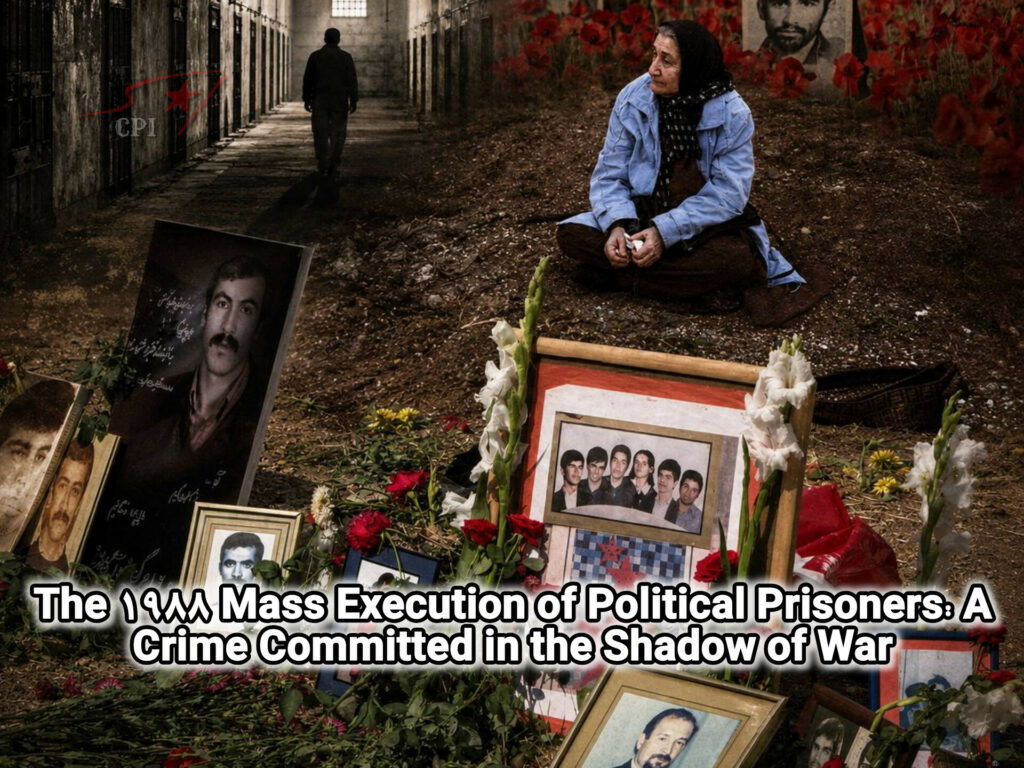
The summer, particularly August and September 1988, marks one of the darkest chapters in the history of the Islamic Republic of Iran. During this period, thousands of political prisoners were secretly executed, many of whom had already completed their prison sentences or had not even been formally charged. The massacre took place after Iran accepted the ceasefire ending the eight-year Iran–Iraq War, a conflict that inflicted enormous human and economic losses on both countries. After years of promising victory, the Islamic Republic ultimately accepted the ceasefire, which Ayatollah Khomeini famously described as “drinking the poisoned chalice.”
For a society that had endured years of bombardment, poverty, death, and repression, the end of the war could have marked the beginning of a new era. People hoped that ordinary life would resume and that their political, social, and economic demands would no longer be suppressed under the pretext of wartime conditions. However, the public’s sense of relief and hope following the end of the war was viewed by the authorities (who feared growing public dissatisfaction and unrest) as a serious threat. Rather than responding to the people’s demands, the government chose a path of intimidation and the elimination of political opponents.
Following Khomeini’s decree, a committee consisting of Hossein-Ali Nayyeri, Morteza Eshraghi, Ebrahim Raisi, and Mostafa Pourmohammadi (later known as the “Death Committee”) was tasked with determining the fate of political prisoners. Communication between major prisons and the outside world was cut off, and prisoners were subjected to brief, opaque proceedings in which they were questioned not on the basis of fair judicial standards, but according to their political and religious beliefs. In August 1988, the executions of members and supporters of the People’s Mojahedin Organization of Iran (MEK) began. In September, the wave of executions expanded to include communist prisoners and other political dissidents.
Prisoners were questioned about their religious beliefs, whether they prayed, their belief in God, and their views toward the Islamic Republic. Answers deemed incompatible with the standards of the Death Committee could result in execution. Many of those executed were serving legally imposed prison sentences under the Islamic Republic’s own laws, while others were nearing release. For this reason, these events were not merely a series of executions, but an organized massacre and a crime against the most fundamental principles of justice and human rights.
The Iranian authorities have never officially disclosed the exact number of victims. Various reports estimate that several thousand prisoners were executed, with some estimates ranging between 6,000 and 10,000 people. Their bodies were buried secretly at night in mass graves or cemeteries in Tehran, Shiraz, Isfahan, Kurdistan, and other cities. Khavaran Cemetery and other burial sites have since become enduring symbols of remembrance and the pursuit of justice, despite years of official intimidation and pressure. Families were denied the right to mourn publicly, hold memorial ceremonies, or even receive clear information about the burial places of their loved ones.
One of the defining aspects of the massacre was the government’s effort to conceal it and erase its traces. Nevertheless, the testimonies of survivors, the accounts of victims’ families, published documents, and independent investigations have gradually revealed significant parts of the truth. The Hamid Nouri trial in Sweden also demonstrated that pursuing accountability for crimes committed during the 1980s remains possible even decades later. The case underscored the importance of documenting testimony, preserving evidence, and supporting efforts aimed at truth and justice.
The continuation of this pattern of violence must be understood within a political system in which impunity for those responsible for repression has long been part of the state’s mechanism of survival. Some officials who held positions within the judicial and security apparatus during the 1980s later rose to the highest levels of government. This continuity suggests that the 1988 mass executions were not an isolated event detached from broader state policy, but rather one link in a long chain of executions, torture, repression, and denial.
Remembering this crime carries particular significance today, as the Islamic Republic continues to face widespread social protests alongside deep economic and political crises. Inflation, the devaluation of the national currency, unemployment, poverty, corruption, water and electricity shortages, and environmental degradation have made life increasingly difficult for millions of people. In this context, public protests have been met not with dialogue, but with arrests, violence, and deadly force. Reports of the violent suppression of the January 2026 protests demonstrate that, nearly four decades later, the logic of repression remains unchanged. The killing of demonstrators demanding a better life, freedom, and justice echoes the same policy that was carried out inside Iranian prisons in 1988.
Alongside domestic repression, the government’s costly military policies and regional interventions have imposed a heavy burden on Iranian society. By directing public resources toward military programs and cross-border interventions, the authorities have exposed the country to sanctions, international isolation, and the risk of further wars. These conflicts primarily harm ordinary people, diverting resources that could otherwise be invested in welfare, education, healthcare, and rebuilding the country toward destruction and violence. The experience of the Iran–Iraq War and its aftermath “including the 1988 mass executions” serves as a stark reminder of how military adventurism and domestic repression can reinforce one another.
Seeking justice for the victims of the 1988 mass executions is not merely an emotional demand or a matter confined to the past. It is inseparable from today’s struggle for freedom, justice, the abolition of the death penalty, and the right to organize. A society that fails to document and confront the truth about past atrocities remains vulnerable to their repetition. The victims of the 1988 massacre, along with all those who have lost their lives to repression, remain alive in the collective memory of the people. Truth, however long delayed, ultimately finds its way forward, and one day those responsible for ordering and carrying out these crimes must be held accountable before a public and fair court.