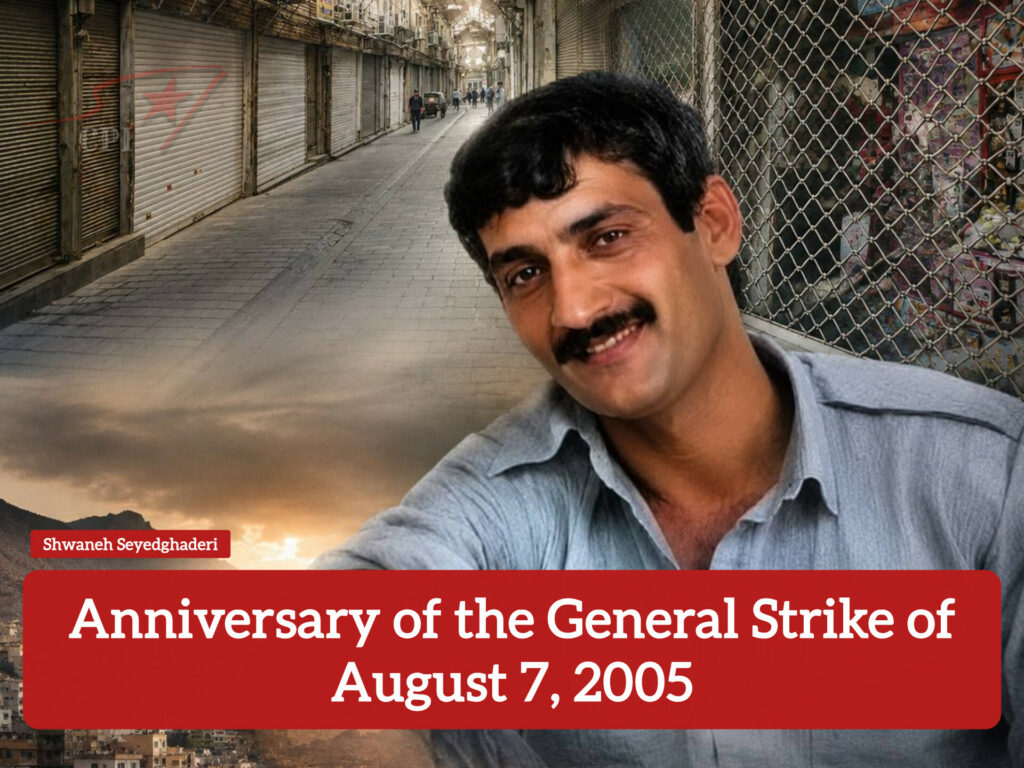
Anniversary of the General Strike of August 7, 2005
August 7; A Reminder of the People’s Power and the Necessity of a General Political Strike;
August 7, 2005 is one of the enduring days in the history of the struggles of the people of Iranian Kurdistan; a day when cities and large parts of Kurdistan came to a halt in protest against the crimes and repression of the Islamic Republic and, through a political and general strike, demonstrated the power of their unity and solidarity. On that day, the empty streets, closed shops, and shuttered workplaces spoke louder than any shout. The people’s message was clear: Kurdistan will not surrender to repression, and its movement for freedom and equality is alive.
August 7 is a living and instructive experience for today’s struggles; an experience that showed how scattered anger can be transformed into a collective will, how the casualties among the people can be reduced, how the apparatus of repression can be deprived of its ability to maintain normal control over society, and how the balance of power can be shifted in favor of the protest movement.
From the Killing of Shwaneh Seyedghaderi to the General Strike;
The background to the August 7 strike goes back to the crime committed by the forces of the Islamic Republic in Mahabad. On the evening of July 9, 2005, government agents pursued Shwaneh Seyedghaderi, a young activist from Mahabad. After failing to arrest him, they opened fire on him and wounded him. The agents then tortured the wounded young man, killed him, and returned his mutilated body to his family in a degrading manner.
The government intended to spread fear among the people through this crime, but the result was the opposite. As soon as the people of Mahabad learned of the incident, they gathered in front of Shwaneh’s home, expressed sympathy with his family, and demonstrated their outrage against the government. On July 10 and 11, young women and men took to the streets chanting protest slogans. On July 12, the protests expanded further, and the assault by the repressive forces was met with resistance from the people.
The protests did not remain confined to Mahabad and spread to other cities in Kurdistan. Instead of responding to the people’s demands, the government sent more forces to the region. In Saqqez, armed agents opened fire on demonstrators; several people were killed and many more were injured. Despite the courage of the people, the street protests remained scattered, and direct confrontation with the government’s armed forces resulted in heavy casualties.
Under such circumstances, the need for a coordinated, broad, and organized action was felt more strongly than ever; an action that would demonstrate the people’s power without placing them in the battlefield chosen by the repressive forces. Komala, the Kurdistan Organization of the Communist Party of Iran, declared August 7 as the day of a general strike throughout Kurdistan, and its call was published on August 2.
Labor activists, women, and progressive youth began preparing for the strike. The people of Mahabad, Saqqez, Bukan, Sanandaj, Oshnavieh, Piranshahr, Baneh, Sardasht, Rabat, Marivan, Kamyaran, Divandarreh, and a number of other cities and rural areas joined the strike. Parts of the population in Naqadeh and Urmia also participated. This broad participation turned August 7 into a historic day.
The success of the strike was not the result of issuing a call alone; it was backed by decades of struggle and sacrifice by the people of Kurdistan, one month of persistent resistance in Mahabad and other cities, and the activities of a network of activists and social leaders. The differences and narrow-minded obstruction by some Kurdish political organizations also failed to weaken the people’s shared determination.
Strike; A Deep-Rooted Tradition in Kurdistan;
August 7 is one link in the long chain of political strikes in Kurdistan. The strikes of June 5, 1982, May 13, 2010, September 12, 2018, and the nationwide strikes during the “Woman, Life, Freedom” uprising are among the examples of this tradition of struggle.
When the state killing of Jina Amini turned her funeral in Saqqez into the beginning of a historic uprising, the successive strikes in the cities of Kurdistan helped sustain the movement. The strikes showed that protest is not limited to street demonstrations alone. Society can express its opposition in a broad and visible way by bringing normal activities to a halt.
A general political strike is, above all, the collective withdrawal of the people from the order imposed by the government. Governments do not survive solely through military force; the daily work of millions of people, transportation networks, education, services, markets, and economic centers also keep society functioning. When people collectively refuse to continue their normal activities, they reveal a power that is less visible in ordinary times.
Why Is a Strike Important Under the Current Conditions?
Today, the Islamic Republic relies more than ever on prisons, executions, bullets, and a security atmosphere in the face of demands for bread, freedom, equality, and human dignity. Poverty, unemployment, inflation, discrimination, the oppression of women, national oppression, and the absence of a clear future have placed the lives of millions under immense pressure. In Kurdistan, this general pressure is accompanied by institutionalized discrimination, the militarization of the region, widespread unemployment, and intensified repression.
The people have no choice but to resist, but resistance does not mean repeating the same form of struggle forever. A government that uses live ammunition to disperse gatherings seeks to drag the people into a confrontation in which it has military superiority. The responsible response is to diversify the methods of struggle and choose tactics that expand public participation while reducing the possibility of mass killings.
A general political strike can stand alongside labor activities, justice campaigns, the women’s struggle, student protests, and other forms of resistance. A strike is not a substitute for all these forms; it is a means of connecting and strengthening them.
On the day of the strike, the repressive forces may still be present in the streets, but they are confronted with empty public spaces and a society practicing civil disobedience. They cannot easily surround and target large crowds gathered in limited locations. The coordinated closure of workplaces and social activities also deprives the government of its ability to portray the situation as normal. In this sense, a strike can politically paralyze the machinery of repression.
The Possibility of Broader Public Participation;
One of the greatest advantages of a general strike is that it opens the way for participation by those who cannot attend street protests. Elderly people, those with illnesses or physical limitations, parents responsible for caring for children, workers under pressure from employers, and those concerned about arrest or street violence can all demonstrate their solidarity through a strike.
A large demonstration may gather thousands of people, but a successful strike can involve hundreds of thousands or even millions. The widespread closure of markets, the suspension of work, and the shutdown of universities and educational institutions provide a picture of the true scale of public dissatisfaction that the government cannot dismiss as the actions of “a small group.”
A strike does not send people home so that the struggle ends; rather, it transforms homes, workplaces, schools, universities, and markets into arenas of civil disobedience. A successful strike demonstrates that the boundaries of struggle are not limited to the streets and that the people’s power can flow throughout society.
A Strike Must Be Organized Responsibly;
A general strike is not a magical solution and should not be called without considering the real conditions of the people. The economic pressure on working-class families, daily wage earners, and low-income shopkeepers is a serious reality. Kurdistan is predominantly a service- and trade-based region with relatively few major industrial centers; therefore, prolonged and repeated strikes may place the greatest burden on the very people who already suffer from poverty and unemployment.
For this reason, a call for a strike must be timely, carefully considered, limited in scope, and supported by society. The interval between strikes, a clear political objective, the real capacity of society, and the situation of vulnerable groups must all be taken into account. Essential services such as emergency care, medical treatment, and the basic needs of the people must also be safeguarded. Solidarity with low-income families and striking workers is an inseparable part of the movement’s collective responsibility.
A strike succeeds when people regard it as their own, not as an order imposed from above. Discussion in workplaces and communities, the participation of independent organizations, mutual trust, and collective decision-making are the foundations of such a movement. Hasty and unsupported calls can weaken public trust; by contrast, social preparation and broad cooperation turn a strike into a genuine source of power.
A School of Unity and Organization;
The importance of a strike is not limited to the day it takes place. The process of preparing, organizing, and evaluating a strike expands networks of solidarity, develops new social leaders, and increases experience in collective action. Every successful strike shows people that they are not alone and that they can overcome fear.
When workers, teachers, nurses, retirees, students, women, young people, and shopkeepers participate in a shared movement, they come to understand that their problems are not separate from one another. Low wages, unemployment, gender discrimination, political repression, national oppression, and the lack of public services are all different manifestations of the same underlying structure. A strike can elevate this understanding from an individual awareness to a collective and political consciousness.
The government, too, does not remain idle in the face of such unity. Threats, rumor-mongering, and the incitement of national, religious, generational, and class divisions are among its constant tools. The movement’s response must be to strengthen trust and solidarity, respect the diversity of society, and connect the demands of Kurdistan with the struggles of people across Iran. The freedom of Kurdistan is inseparable from the freedom of workers, women, and the people of other parts of Iran, just as the liberation of Iran will not be possible without ending oppression and discrimination in Kurdistan.
August 7 Remains Alive;
Remembering August 7 is a renewal of the commitment to the force that united the cities of Kurdistan on that day. That strike proved that the government, despite all its weapons and security forces, is vulnerable before a united and conscious people.
Today as well, a general political strike can be one of the most effective tools in the peaceful struggle of the people of Kurdistan and Iran; a tool for reducing the possibility of mass killings, expanding participation, politically paralyzing the machinery of repression, and demonstrating the power of society. However, its success depends on organization from below, responsible leadership, broad unity, and attention to the lives and safety of the people.
Honor the memory of August 7; the day when Kurdistan stood firm, united, and demonstrated that true power lies not in the gallows or the gun, but in the organized will of the people.