Sukhtbari and Kolbari: Bread in Exchange for Life on the Margins of Iran
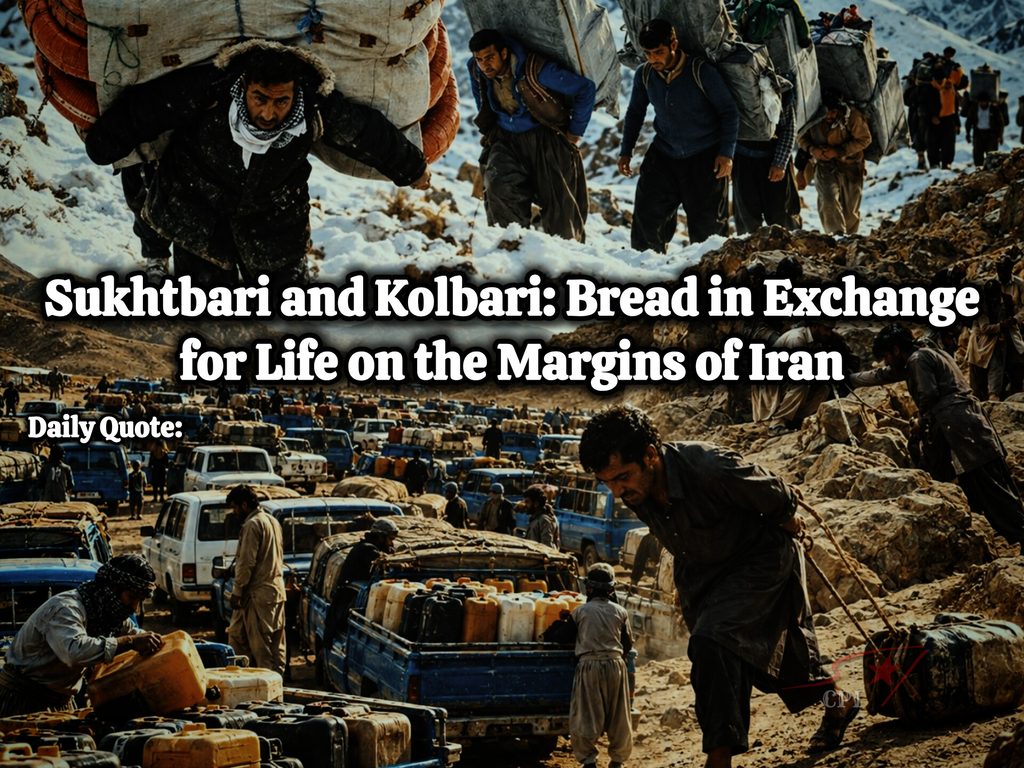
On two opposite sides of Iran’s geography, in the southeast and the west of the country, two terms have become symbols of life on the margins: Sukhtbari and kolbari. Both refer to forms of work that have no place in any official occupational classification, are backed by neither insurance nor contracts, and carry the risk of death every day. Nevertheless, for a large part of the population of Balochistan and Kurdistan, these activities are no longer a choice but the only remaining means of securing a bare minimum of subsistence. While kolbari has gained some public attention in recent years through disturbing images of kolbars dying under heavy loads in snowy mountain ranges, Sukhtbari remains a less familiar and less documented phenomenon.
To understand Sukhtbari, we must begin with the employment situation in Sistan and Balochistan Province. The province faces a deep and structural crisis in employment and livelihoods. A large part of the population depends on cash subsidies and food vouchers to make ends meet, while the lack of stable employment opportunities has driven people toward dangerous activities. If Sukhtbars are also counted as unemployed, approximately half of the province’s population lacks stable employment. These figures clearly show that Sukhtbari is not a “job” in the conventional sense, but a form of disguised unemployment that has acquired the name of work through the acceptance of the risk of death.
The absence of industry, severe drought in the northern part of the province, and the limited concentration of economic activity in the south, particularly in Chabahar, have reduced employment opportunities to a minimum. Zahedan, the provincial capital, also lacks a favorable industrial environment, and a significant part of the province is effectively deprived of productive infrastructure. Drought, which has devastated traditional agriculture and livestock farming in the region, has deprived rural residents of their only historical source of income and pushed them toward the border.
Even the capacities that could have provided alternatives to the border economy have deteriorated in recent years. Activity at Chabahar Port has declined sharply, and freight companies, loading and unloading operations, and businesses connected to maritime trade are operating at only 10 to 15 percent of their previous capacity because of sanctions and restrictions on commercial exchanges. Some have shut down, while others have turned to limited operations along the Pakistani border. At the same time, small manufacturing units are struggling with serious problems, and the energy crisis, along with electricity and gas cuts, could force even the remaining units to lay off workers. Wage arrears, particularly in municipalities and construction projects, continue to weigh heavily on workers’ lives.
Against this backdrop, the enormous difference between fuel prices in Iran and those in neighboring countries, particularly Pakistan and Afghanistan, has become the only economic “opportunity” available. Sukhtbars load diesel and gasoline into plastic jerrycans in dilapidated vehicles, often small pickup trucks, and drive toward the border along dirt roads and through desert terrain. Vehicles carrying loads several times their capacity and traveling at high speeds effectively become moving bombs; even the slightest collision or rollover can cause a fire and burn those inside.
The danger, however, is not limited to road accidents. Gunfire from military and law enforcement forces targeting Sukhtbari vehicles, particularly near the border strip, has repeatedly resulted in fuel carriers being killed or injured. Reports by Baloch human rights organizations, including Halvash, have documented numerous such cases over the years.
More tragically, Sukhtbari is no longer an activity undertaken exclusively by adult men. According to labor activists in the province, children have also turned to this work. Instead of sitting in classrooms, these children are seen behind the wheel or beside fuel jerrycans on border roads. Their lives are constantly at risk.
On the other side of the country, in the border mountains of Kurdistan, Kermanshah, and West Azerbaijan, kolbars play the same role as Sukhtbars in Balochistan. They carry goods such as household appliances, clothing, and tobacco on their backs from the Kurdistan Region of Iraq and Turkey, crossing difficult and treacherous mountain passes. Falls from heights, hypothermia, avalanches, landmines left over from the war, and direct gunfire by border forces have turned kolbari into one of Iran’s deadliest informal occupations. Kurdish human rights organizations document dozens of cases of kolbars being killed or injured every year.
The roots of kolbari are the same as those of Sukhtbari: a lack of industry, limited investment, widespread unemployment, and discriminatory development policies that have kept these regions on the margins for decades. Kolbars include university graduates, teenagers, and even women.
Sukhtbari and kolbari are two faces of a single policy: a development model that prioritizes the center over the periphery and security considerations over people’s livelihoods. Balochistan and Kurdistan, both regions with populations predominantly belonging to non-Persian nationalities and religious minorities, have been deprived of industrial and infrastructural investment for years, while the authorities have viewed them primarily through a security lens.
Even where resources and wealth exist within these regions themselves, local people receive little benefit from them. Recent protests by residents living around the Taftan gold mine over recruitment practices at the mine and its affiliated companies are a clear example of this situation. Residents expect local workers to be given priority in recruitment and local businesses to be used to supply machinery and services. People who bear the environmental consequences of mining naturally want to benefit from its economic returns as well. However, there is still a long way to go before this situation becomes a reality.
As long as this model remains unchanged, Sukhtbars and kolbars will continue to risk their lives for a morsel of bread. As long as the system of exploitation and repression remains in power in Iran, the dirt roads of Balochistan and the snowy mountain passes of Kurdistan will continue to serve as burial grounds for people whose only “crime” is trying to stay alive.