Poverty and Hunger: Products of the Social Order, Not Human Destiny
On the occasion of October 16 and 17, World Food Day and the International Day for the Eradication of Poverty
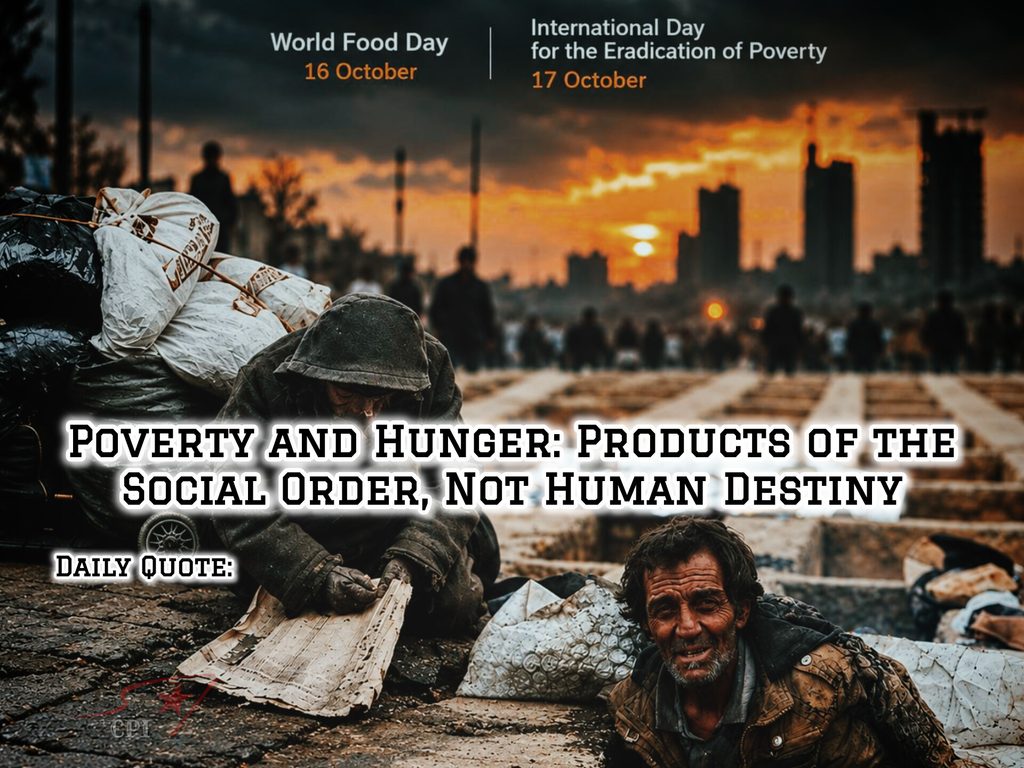
Two consecutive days on the global calendar are dedicated to one of humanity’s oldest wounds. October 16 is World Food Day and the day for combating hunger, while October 17 is the International Day for the Eradication of Poverty. These two occasions cannot be separated. Hunger is the most extreme face of poverty, and poverty is the condition that reproduces hunger. Every year around these dates, shocking statistics are published, governments and international institutions make new promises, and a few weeks later everything returns to business as usual. Yet the fundamental question remains: How is it possible that, in a world whose capacity to produce wealth, knowledge, and technology is greater than ever before, millions of people go to bed hungry and billions are deprived of adequate housing, healthcare, education, and economic security?
The origins of the International Day for the Eradication of Poverty date back to October 17, 1987. On that day, more than one hundred thousand people gathered at the Trocadéro in Paris to commemorate the victims of poverty, hunger, and violence and to affirm every human being’s right to live with dignity. Five years later, in 1992, the United Nations General Assembly officially recognized the day. Since then, countless meetings have been held. At the height of the 2008 food crisis, countries pledged to halve the number of people suffering from hunger worldwide by 2015 and to end hunger by 2030. Yet in 2016, the Food and Agriculture Organization of the United Nations (FAO) announced that approximately 815 million people still lacked sufficient food. The gap between promises and reality has never been clearer.
The scale of this catastrophe can be seen in a few simple facts. Hundreds of millions of people still experience chronic hunger. Tens of millions of children under the age of five suffer stunted growth due to malnutrition, and a significant proportion of child deaths worldwide are related to nutritional deficiencies. Environmental destruction and the climate crisis can also push millions more into poverty by reducing agricultural production. Meanwhile, reports by organizations such as Oxfam show that the wealth of a small number of the world’s richest individuals is equivalent to the combined wealth of half of humanity. The World Food Programme has estimated that a tiny fraction of this wealth would be enough to provide one nutritious meal for hungry schoolchildren.
Of course, poverty statistics depend on the method of calculation and the poverty line selected, and different measures should not be conflated. To understand this crisis in real terms, we must consider not only income but also housing costs, access to safe water, healthcare and education, job security, and social protection.
The reality is that poverty cannot be reduced to laziness, individual choices, or a lack of resources. It must be understood in relation to the structure of the economy, property relations, the distribution of power, and the way production is organized. Under capitalism, wealth is produced through the collective labor of millions of people, yet ownership of the means of production and economic resources is concentrated in the hands of a minority. Workers are forced to sell their labor power to make a living, while fundamental decisions about investment, production, employment, and the distribution of wealth are made beyond their control.
When a worker works full-time but their wages are insufficient to cover housing, food, and their family’s needs, responsibility cannot be placed on that worker. We must ask why labor productivity has increased while the economic security of employed people remains fragile. We must ask why housing costs have exceeded the means of a large part of the population and why the fruits of technological progress do not reach those whose labor creates this wealth.
This does not mean that all capitalist societies are alike. Labor struggles, tax policies, public services, and social security systems have significantly reduced the extent of poverty in many countries. These differences demonstrate that poverty is not an immutable destiny but a historical and social phenomenon.
Poverty is not merely a lack of income; it hollows out human life from within. A family that spends a large share of its income on rent and falls into debt to pay for healthcare and its children’s education is vulnerable to employers, landlords, and institutions of power. In working-class and impoverished families, everyone from children to adults works, yet they still struggle to secure even a bare subsistence. Leisure becomes a dream, while family and individual stability remain constantly under threat. Under such conditions, developing political and class consciousness, organizing alongside one’s fellow workers, and struggling for democratic rights become more difficult. When no way out can be seen in this world, some turn to religious escapism and seek justice in the afterlife. This is precisely what capital owners and their governments want. Without a minimum level of material security, political freedom becomes a merely formal right for many people.
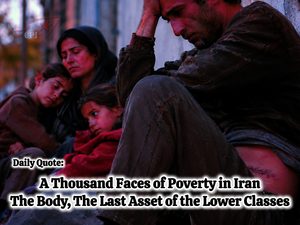
Iran is a clear example of this reality. Even official statistics, which are themselves questionable, indicate that society has lost at least one-third of its purchasing power over the past decade. The consequences are visible in the streets: child labor, scavenging through garbage, sleeping rough, addiction, forced prostitution, and suicide. These are direct consequences of the economic policies of the Islamic Republic and its rent-seeking and repressive structure. Under such conditions, the struggle to free society from the Islamic Republic cannot be separated from the struggle to free millions of people from poverty, unemployment, homelessness, and soaring prices.
In the twenty-first century, this contradiction has taken on new dimensions. Artificial intelligence and automation could reduce arduous labor and expand public services. But if their benefits are subordinated to private profit, they will lead to job losses, the expansion of precarious work, and an even greater concentration of wealth. Housing, too, should not be a commodity for speculation; it is a fundamental condition for human health and security.
The fight against poverty must go beyond alleviating its consequences and transform the conditions that reproduce it. Adequate wages, the right to organize and strike, secure employment contracts, universal healthcare and education, social housing, comprehensive social security, and fair taxation are interconnected components of such a struggle. At the same time, historical experience has shown that without democracy, direct public participation, and oversight from below, the concentration of power will be reproduced in other forms. Workers, teachers, nurses, tenants, and unemployed people are not passive recipients of assistance. Through independent organizations, councils, and unions, they can play a leading role in determining society’s future.
Poverty and hunger are neither signs of any inherent human incapacity nor eternal realities. Fighting them means struggling for a society in which food, housing, healthcare, education, and economic security are not privileges reserved for the wealthy but rights belonging to everyone. The path toward such a society lies through solidarity, independent organization, and the expansion of democracy. The goal is not to distribute deprivation more fairly, but to build a world in which every human being can live freely and with dignity.