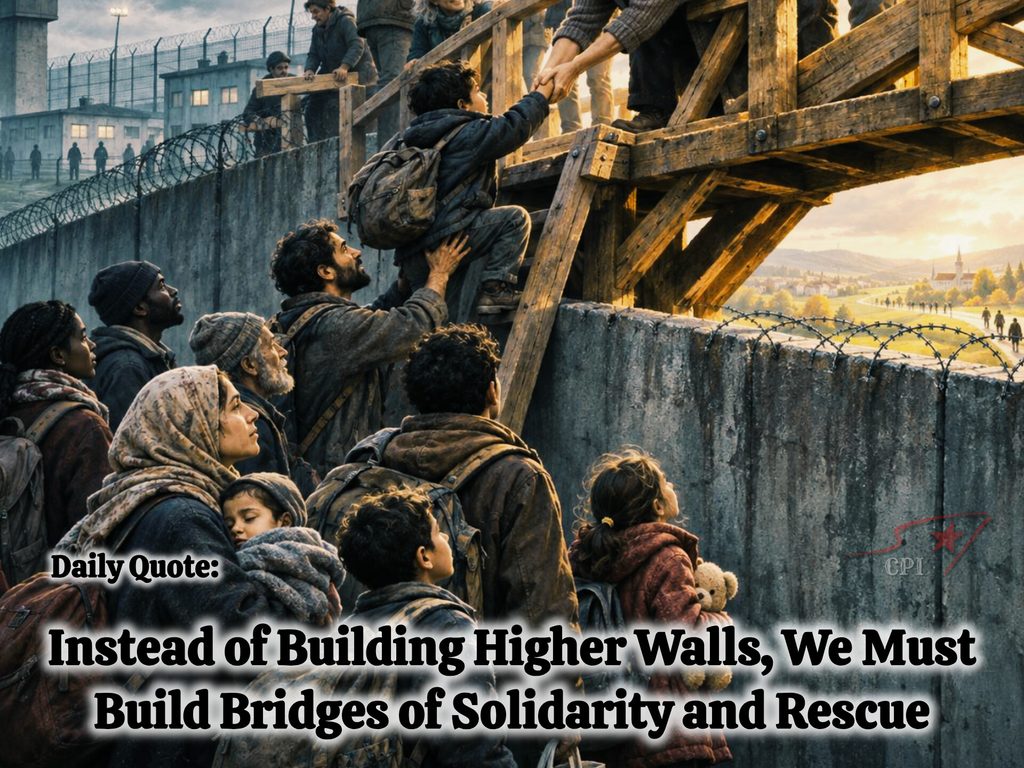
Instead of Building Higher Walls, We Must Build Bridges of Solidarity and Rescue
The right to asylum, as one of the main pillars of modern international law, was established in the aftermath of the disasters of the Second World War to provide shelter for people driven from their homelands. For years, Europe presented itself as the birthplace and guardian of these values. However, recent developments and the adoption of new restrictive policies show that this image is rapidly collapsing. Today, the European Union is turning its back on refugees and violating the most fundamental principles of the right to asylum. This obvious shift has not only deepened a humanitarian crisis but has also called the Union’s moral credibility into question.
According to statistics from the United Nations High Commissioner for Refugees (UNHCR), more than 200 million people are currently displaced worldwide. This is the largest wave of displacement in human history. War, violence, persecution and political tyranny, environmental crises, and the collapse of states have driven this vast human population into displacement and a life of uncertainty.
The painful reality is that three-quarters of these refugees come from countries that are themselves struggling with poverty, inflation, and internal crises. Meanwhile, the European Union, made up of some of the wealthiest economies in the world and holding the largest share of global wealth production, bears only a very small portion of this humanitarian responsibility. Now, it is seeking to bring even that small share close to zero.
In June 2026, the European Union brought its “Pact on Migration and Asylum” into force. This pact, which had been adopted in 2024, became fully applicable after a two-year transitional period. It represents the European Union’s official retreat from its humanitarian commitments. Human rights organizations, from Amnesty International to the International Rescue Committee, have described the pact as “the most unprecedented attack on the right to asylum in Europe.”
One of the most dangerous mechanisms of this pact is the expansion of the concept of a “safe third country.” Under the new rules, EU member states can reject asylum applications without conducting a substantive examination and send applicants to a third country, often poor countries in Central Africa. This approach explicitly shifts responsibility for protecting refugees away from Europe and transfers it to countries with fewer resources, facilities, and human rights obligations.
The first concrete example of these centres is now also taking shape. Five EU member states “Germany, Austria, Denmark, Greece, and the Netherlands” are considering a plan under which asylum seekers whose applications have been rejected, and whose return to their countries of origin is impossible for various reasons, would be transferred to Rwanda. Under this programme, the first “joint return centre” outside EU territory would be established in Rwanda. The stated aim of the plan is to increase the number of returns of migrants who have not been granted the right to remain in Europe. In practice, however, this means sending people to a country with which they have no prior connection and abandoning them in an uncertain situation that makes access to legal protection and assistance extremely difficult. It remains unclear how long these individuals will stay in Rwanda, what rights they will have, and what future awaits them if returning to their countries of origin continues to be impossible.
The choice of Rwanda is itself questionable. International organizations have repeatedly criticized restrictions on freedom of expression, pressure on political opponents, and limitations on the activities of civil society organizations in the country. Human rights organizations and some institutions affiliated with European churches have warned that implementing this plan could lead to prolonged detention, forced deportations, and violations of migrants’ fundamental rights. The greater danger is that those transferred could become trapped in a dead end, with no way to return to their own countries and no opportunity to begin a new life in Rwanda.
This is not a new experience for Europe. In 2022, the United Kingdom signed a similar agreement with Rwanda. However, in 2023, the UK Supreme Court declared the programme unlawful due to concerns about violations of asylum seekers’ rights, and the British government eventually abandoned it. The plan, which cost approximately 800 million euros, produced virtually no results. The fact that five European governments are now pursuing the same failed approach demonstrates that the purpose of these policies is not effectiveness, but rather keeping asylum seekers away from European territory at any cost.
One particularly inhumane aspect of these developments is the removal of the right to appeal. Under Europe’s previous laws, filing an appeal against an asylum rejection decision suspended the person’s immediate deportation until the appeal was examined by a court, ensuring that no one’s rights were violated. Under the new rules, however, individuals can be deported to another country before a court has examined their cases. This means irreversible harm can occur before any judicial ruling is issued. A policy that effectively destroys the right to a fair hearing.
This aggressive and restrictive approach by the European Union cannot be separated from the broader political climate currently prevailing across the continent. The wave of far-right politics sweeping across Europe has pushed numerous governments towards anti immigration policies. Populist parties have attracted public support by exploiting fear and xenophobia, while centrist parties, seeking to preserve their political survival, have also adopted the same extremist policies.
Europe’s new asylum policies reveal a deeper crisis: a moral crisis within institutions that claim to lead the world in upholding human values. Refugees are people upon whom war has been imposed, not people who have chosen war. They are victims of geopolitical crises, structural poverty, and climate change, which often have roots in the colonial, military, and environmental policies of the very wealthy countries that are now closing their doors to those who have suffered as a result.
The right to asylum is an international legal obligation and a humanitarian duty. It is the responsibility of civil society, human rights activists, and all conscious people to be the voice of refugees. Building walls against displaced people and resorting to offshore prisons will neither make Europe safer nor make the world a better place. These measures only wound humanity’s conscience and leave another stain on the history of capitalism. The time has come for the people of Europe to put pressure on their governments to build bridges of empathy, human solidarity, and rescue instead of constructing ever-higher walls.