Twelve Names, Twelve Lives; In Memory of the Workers Who Lost Their Lives at the Dehloran Gas Refinery
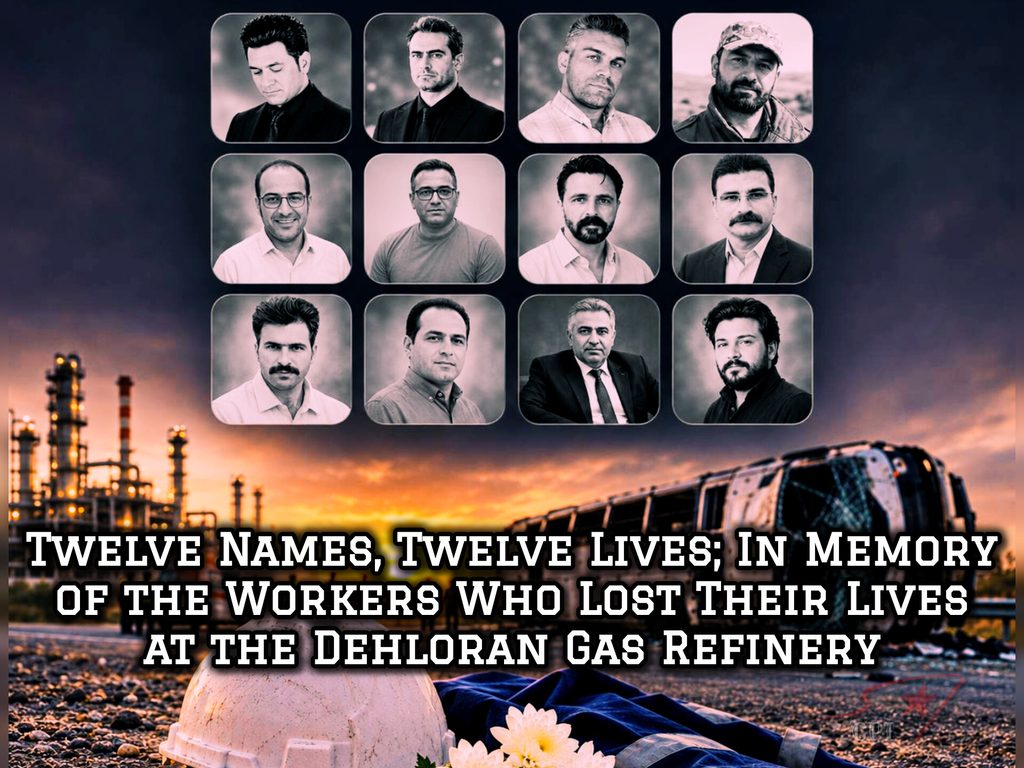
On the evening of Saturday, November 14, 2026, on the Abdanan highway, a bus carrying workers from the Dehloran Gas Refinery home overturned. At least twelve workers lost their lives and sixteen others were injured. These workers were on their way home after a hard and exhausting day of work. Their families were waiting for them, a meal had been prepared, and children were waiting for their fathers. But for twelve of them, that journey became the final trip of their lives.
We repeat their names with respect and anger because we do not want them reduced to a number in a brief news report. Those who lost their lives in this tragedy were Amin Mohammadvali, Mohammadreza Mohammadi, Saeed Gholami, Lotfollah Moradi, Ruhollah Alijani, Fariborz Hadizadeh, Sajjad Nasrollahi, Bahram Tahmasbi, Mohammad Rahimi, Mousa Rahimi, Ahmad Taghizadeh, and Ayoub Hasanvand. Each of these names represents a life. Behind each one stands a father, mother, spouse, or child who, from today onward, will have to live with the absence of a loved one. These twelve workers, like thousands of other workers in the oil and gas industry, produced wealth that is recorded in budgets and balance sheets. But their share of that wealth was an aging bus and an unsafe road.
Those injured in this tragedy are still struggling with pain and anxiety in hospital beds. Tavakol Khostavaneh, Mehdi Karimzadeh, Mehdi Nazarzadeh, Omid Hajizadeh, and Mohammad Poursaedi are hospitalized at Rasoul Akram Hospital in Abdanan. Saman Hemmati, Esmail Mohtashamian, Issa Karami, Kamran Norouzi, Naeem Mohammadvali, Mehdi Dardaneh, Ehsan Daniali, Morad Akbarizad, Nourmohammad Saffar, Ali Daniali, Arash Babaei, Hossein Mohammadi Arshad, and Majid Fili have been transferred to Ganjavian Hospital in Dezful. According to reports, Naeem Mohammadvali and Majid Fili are in intensive care due to the severity of their injuries. We stand alongside them and their families and wish them a full recovery. At the same time, we will be their voice so that this suffering is not forgotten in silence.
Officials and employers call this tragedy a “traffic accident.” They deliberately choose this term because an “accident” implies fate, bad luck, and that no one is responsible. But workers and their families know very well that these deaths were not accidental. Oil, gas, and petrochemical workers, particularly contract workers, have for years been forced to travel in worn-out vehicles on unsafe roads. For years, after long and backbreaking shifts, they have set out on daily and weekly journeys while exhausted and drained. For years, their protests have gone unheard. When all of this was known and nothing was done, it is no longer possible to speak of an “accident.” This is the direct result of deliberate disregard for workers’ lives.
It must be stated plainly that this tragedy is the product of a system of logic that places profit above human life. In many industrial projects, employers and major companies have outsourced transportation services to low-cost contractors in order to reduce expenses. The contractor, in turn, uses the cheapest buses and most dilapidated fleet to maximize profits. At every link in this chain, someone takes their share, while it is only the worker who pays the price with their life. The government, whose duty is to supervise, has either turned a blind eye or is itself part of this same chain. Where were the supervisory bodies? Where were the technical inspectors? Why did no one ask what kind of vehicles and under what conditions the workers who extract this country’s wealth from beneath the ground were using to return home?
The safety of workers’ transportation is an inseparable part of workplace safety. The employer’s responsibility does not end at the refinery gate. From the moment a worker sets out for the workplace until the moment they return home safely, they are still engaged in work. Any employer who ignores this simple truth is complicit in the deaths of their workers.
The Dehloran tragedy has once again highlighted the urgent and fundamental demands of workers. We declare these demands loudly and clearly.
First, an independent, transparent, and public investigation must be conducted into every aspect of this tragedy. It must be established what technical condition the bus was in, who the transportation contractor was and what obligations they had, how many hours the driver had worked, and what condition the road was in. It must also be established why supervisory mechanisms failed to prevent this tragedy. This investigation must not be conducted behind closed doors or by the very institutions that should themselves be held accountable. Elected workers’ representatives must participate, and the findings must be made available to the public in full, without omissions or censorship. Those responsible for this tragedy, from the contractor to company managers and supervisory officials, must be identified and punished.
Second, the rights of the families of those who lost their lives must be fully and immediately secured.
No amount of money can replace lost loved ones. But families who have lost their breadwinners must not be abandoned or forced to wander from one government office to another to claim their rights. Full compensation, guaranteed employment and livelihoods for surviving family members, long-term medical and social support, and securing the future of the children of those who died are unequivocal obligations of the employer and the government.
Third, all costs of medical treatment, rehabilitation, and the period of disability for the injured workers must be covered without any restrictions or delays. A worker lying in a hospital bed in Abdanan or Dezful must not have to worry about medical bills, rent, or providing food for their family. The employers and responsible institutions caused this harm, and they must bear the cost of compensating for it.
Fourth, and most importantly, such tragedies must be prevented from happening again. Oil and gas industry workers have been demanding standard, safe, and supervised transportation for years. All employees, whether permanent, contractual, or employed through contractors, must have access to safe and suitable transportation. Discrimination between permanent and contract workers when it comes to the right to life is unacceptable. The profits of companies and contractors must never take precedence over workers’ lives.
But years of experience have taught us that these demands cannot be achieved through pleading and appeals. Employers and a government that speak of an “accident” today will repeat the same disregard tomorrow unless they are confronted by the united strength of workers. Wherever workers have been able to elect their genuine representatives and exercise direct oversight over working conditions and safety, they have been able to defend their lives and rights. Workplace safety, transportation security, and the protection of workers’ lives can only be achieved through independent workers’ organizations and supervisory mechanisms under workers’ own control.
We honor the memory of Amin, Mohammadreza, Saeed, Lotfollah, Ruhollah, Fariborz, Sajjad, Bahram, Mohammad, Mousa, Ahmad, and Ayoub. The best way to pay tribute to them is to refuse to allow their names to be filed away in a case labeled “traffic accident.” We must ensure that their deaths become the starting point of a united struggle for safe work, a dignified life, and an end to the domination of profit over human life.