My Day, My Rights: A Word on the Occasion of November 20, World Children’s Day
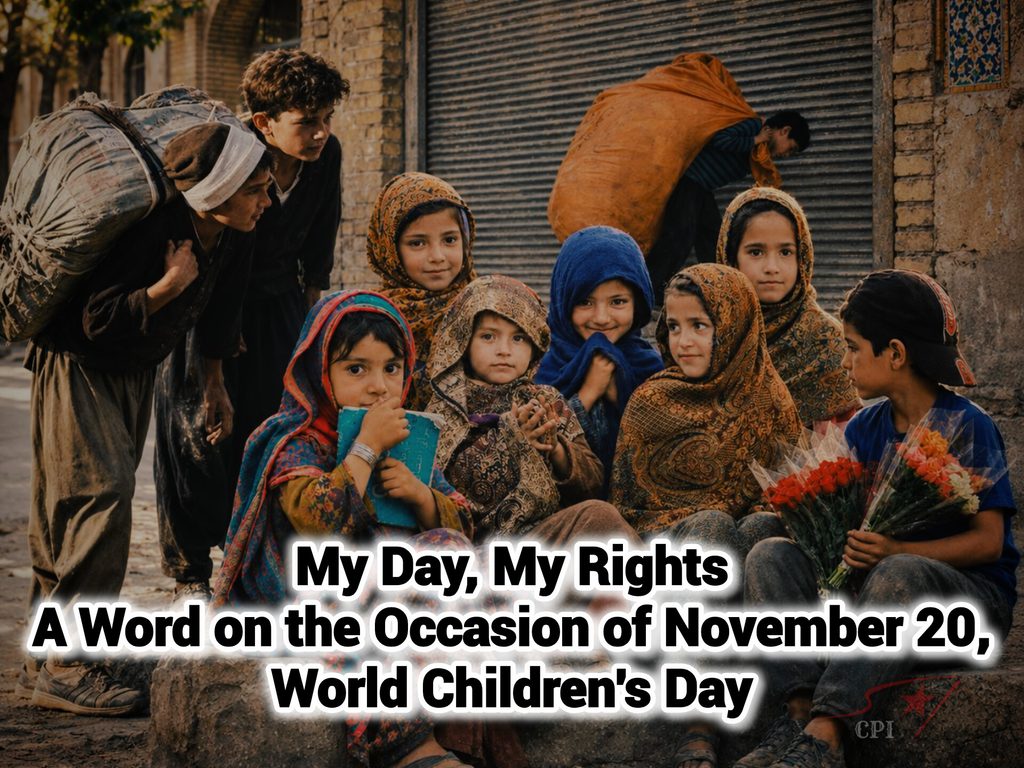
November 20, is World Children’s Day; a day that commemorates two milestones in the history of children’s rights: the adoption of the Declaration of the Rights of the Child by the United Nations General Assembly in 1959, and the adoption of the Convention on the Rights of the Child on the same day in 1989. UNICEF calls this day a day of action “for children and by children,” and this year marks it under the slogan “My Day, My Rights.” The message of this day is simple and clear. It is time to listen to children; to understand what their lives are like and where their rights are present in their daily lives, where they are absent, and where we must fight for them.
This day is observed on different dates in different countries; in some, on June 1, and in others, on November 20. But regardless of differences in calendars, the message is the same. Children are the builders of humanity’s future and must enjoy all their human rights.
In a humane society, childhood should be a period of discovery, play, imagination, and personality development; a time when children learn that the world can be a safe and wonderful place. Yet, for millions of children, everyday reality is nothing but war, poverty, discrimination, exploitation, and repression; forces that destroy childhood at its roots and send a wounded generation into adulthood.
The past year once again demonstrated that children are the first and most defenseless victims of war. On the morning of February 28, 2026, the first day of the US and Israeli attack on Iran, the “Shajareh Tayyebeh” girls’ elementary school in Minab was targeted in a missile attack. More than 150 people were killed, most of them girls between the ages of seven and twelve who were sitting at their classroom desks. The Minab tragedy was one of the deadliest attacks on a school in recent years. Across the borders, Lebanese and Israeli children were also wounded or killed under missile fire.
In Gaza, two years of war killed or injured tens of thousands of children and deprived tens of thousands more of one or both parents. Even the ceasefire declared in October 2025 did not put an end to the killings. According to UNICEF, at least 300 children were killed in the 300 days following that ceasefire; an average of one child every day. This catastrophe unfolded before the eyes of the world, with the direct or implicit indifference of the US government and its allies. In such a world, speaking of “children’s rights” without seriously criticizing structures of power is more akin to hypocrisy than genuine human concern.
For a child who survives, war means constant fear, sleepless nights, a school that no longer exists, and a home that has been destroyed. One of the deepest wounds of war is engraved in children’s minds; a wound that does not appear in official statistics but stays with them for years. Children in Tehran, Tel Aviv, Beirut, and Gaza may have nightmares, fear loud noises, become isolated or aggressive. War targets a child’s psyche even when no bullet is fired at their body. And the bitterest part is that violence becomes “normal” for these children; a generation raised in fear and hatred will reproduce that same fear and hatred in social relations, culture, and politics.
Under the rule of the Islamic Republic in Iran, the situation of children represents a dark chapter in the country’s human rights record. According to human rights organizations, Iran is the only country that has executed people every year over the past decade for crimes they committed during childhood; and this practice has continued this year as well. Prisons are filled with teenagers incarcerated because of poverty, their parents’ addiction, petty crimes, street fights, or political protests. Corporal punishment remains widespread in many schools, and millions of children from working-class and low income families are deprived of education and forced into hard and degrading work, ranging from waste picking and street vending to working in underground workshops.
During the “Woman, Life, Freedom” movement, dozens of children and adolescents under the age of 18 lost their lives. At the same time, hundreds of girls’ schools were targeted with toxic gases, poisoning thousands of students; an incident that plunged the younger generation and society as a whole into an atmosphere of fear.
These policies have a long history. During the eight-year Iran-Iraq war, sending teenagers to minefields and glorifying “child martyrdom” were part of official policy. Today, the use of children in the Basij, government rallies, bloody mourning rituals involving knives and chains, and even street repression continues the same logic of instrumentalizing children’s bodies and minds for political and ideological purposes.
Schools should be safe spaces for learning, friendship, creativity, and questioning. But in many schools in Iran, childhood is confiscated from the very entrance. Children are separated from one another based on gender from their earliest years.
Little girls are required to wear headscarves from their first day of school and are taught that playing with boys is wrong. Instead of being part of their human identity, their bodies become subjects of control and surveillance. Boys are raised with a sense of domination and patriarchy, while girls are taught submission and obedience.
Textbooks are filled with religious and ideological teachings. Clerics, seminary students, and Basij forces are sent to schools, spreading a culture of informing on one another and mutual surveillance among children. “Taklif ceremonies” are held for nine years old girls, encouraging them to accept traditional roles at an early age, including early marriage. In this way, children are denied the opportunity to learn free from imposed beliefs and to consciously choose their own paths in life in the future.
A child who grows up in an environment filled with fear, humiliation, gender discrimination, and superstition has neither the opportunity to live happily nor the freedom to develop. The consequences of this repression, ranging from chronic anxiety and diminished self confidence to difficulties in forming healthy relationships with themselves and others, will remain with them throughout their lives.
If World Children’s Day is limited to celebrations, television programs, and school decorations, while failing to address the structures that kill, exploit, and break children, it will become an empty spectacle. Truly commemorating childhood means striving for transformation. To achieve this transformation, specific goals must be placed at the center of social struggle:
- Prohibition of child labor and guaranteeing free, high-quality, universal education, regardless of class, nationality, gender, or religion;
- A complete ban on corporal punishment at home, in schools, and in all educational and upbringing institutions;
- Abolition of the death penalty, particularly for children and adolescents, and reform of criminal laws based on human dignity;
- An absolute ban on arming children and using them in paramilitary forces, government rallies, and political conflicts;
- Removal of religion and official ideology from the education system and their replacement with scientific and critical education;
- Support for independent organizations defending children’s rights instead of suppressing them and subjecting their activities to securitization;
- Full implementation of the Convention on the Rights of the Child and making it the standard for evaluating educational, judicial, and social policies.
What is happening today to children in Iran, Gaza, and other lands affected by war and repression is not their inevitable destiny; this situation can and must change. On this day, let us amplify the voices of children and stand up for the rights of every child, everywhere in the world. Defending children is defending the future; and a society that sacrifices its children has destroyed its future with its own hands.