Lessons of the “Woman, Life, Freedom” Revolution
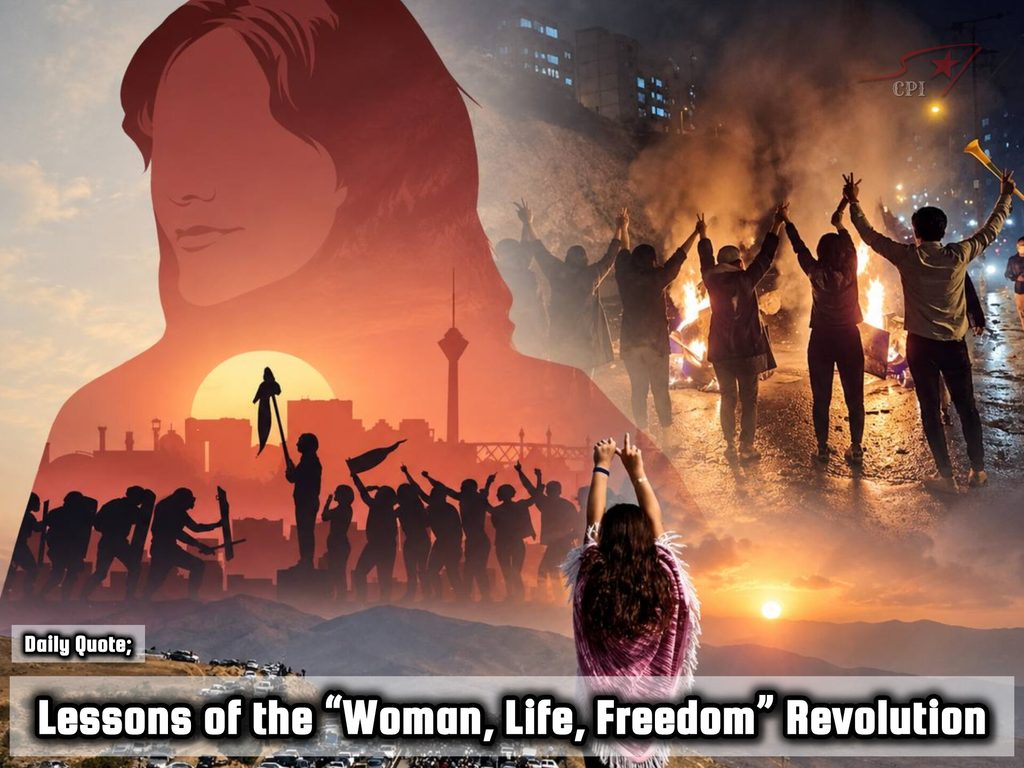
Four years ago, the state killing of Jina Amini sparked an uprising that became one of the largest and most influential protest movements in Iran’s contemporary history. Jina, a young Kurdish woman from Saqqez, died after being arrested by the morality police in Tehran; but her name quickly went beyond the boundaries of an individual tragedy and became a symbol of the accumulated anger of millions of people against repression, humiliation, discrimination, poverty, and the denial of rights. Her funeral ceremony in Saqqez, with the slogan “Woman, Life, Freedom,” marked the beginning of a movement that swept across Iran and whose echoes reached the world.
The “Woman, Life, Freedom” uprising was not merely a protest against the compulsory hijab, although the issue of the hijab was one of the most important arenas of confrontation between women and the Islamic Republic. The movement quickly demonstrated that the control of women’s bodies was part of a broader system of domination; a system based on political repression, gender discrimination, national oppression, economic exploitation, and the elimination of civil liberties. For this reason, the slogan “Woman, Life, Freedom” was able to bring women, young people, students, workers, marginalized people, and oppressed nationalities closer together around a common horizon.
Now, four years later, despite bloody repression, imprisonment, executions, threats against families seeking justice, and the government’s efforts to impose forgetting, the effects of this social revolution remain alive and tangible. Most importantly, this movement has left behind major lessons for the struggles of the people of Iran today and in the future.
The first and most fundamental lesson of Jina’s Revolution was breaking the wall of fear that the Islamic Republic had built over decades through executions, imprisonment, torture, dismissals, threats, and the constant control of society. In the autumn of 2022, millions of people saw that standing up against repressive power was possible. Women and young girls stood at the forefront of the protests; they removed their headscarves, chanted slogans in the streets, confronted the forces of repression, and gave new meaning to courage.
This courage did not manifest itself only in street demonstrations. After the visible protests subsided, it continued in universities, schools, workplaces, neighborhoods, and in everyday choices. Women’s disobedience against the compulsory hijab, their free presence in public spaces, and their resistance to humiliation and control are forms of struggle that erode the ideological foundations of the regime every day.
Society realized that fear is not an unchangeable destiny. Fear breaks when an individual does not see themselves as alone and experiences collective power. This collective experience is one of the most enduring political and psychological reserves of the “Woman, Life, Freedom” Revolution. A society that has once seen its power in the streets, universities, schools, or workplaces does not easily return to its previous condition.
The second major lesson of this movement was the transformation of political language in Iran. The slogan “Woman, Life, Freedom” was not merely a beautiful and inspiring slogan; it created a new vocabulary for understanding politics and freedom. This slogan brought “woman” from the margins to the center of politics; placed “life” against the culture of death, repression, and austerity imposed by the regime; and transformed “freedom” from an abstract concept into a daily and tangible right.
Freedom in this movement meant the right to choose one’s clothing, the right to ownership over one’s body, the right to love, the right to joy, the right to equal participation in society, the right to organize, strike, express oneself, and assemble. Life, too, did not simply mean being alive; it encompassed the right to food, work, housing, education, healthcare, a healthy environment, and human dignity.
This connection between individual freedoms and social justice was of decisive importance. Jina’s Revolution demonstrated that one cannot speak of freedom while remaining indifferent to poverty, unemployment, exploitation, and the deprivation of the majority of society. Likewise, one cannot speak of economic justice while postponing women’s freedom, freedom of expression, and the rights of oppressed nationalities to some indefinite future. The struggle for liberation is an integrated struggle.
Another important lesson of this uprising was the decisive role of the younger generation, particularly those born in the 1990s and 2000s. Before Jina’s Revolution, pessimistic analyses about this generation were widespread: a generation portrayed as individualistic, apolitical, immersed in social media, and indifferent to the fate of society. But the radical and courageous presence of teenagers and young people in the streets, schools, and universities disproved these analyses.
School students and university students rebelled against the atmosphere of repression and humiliation in many cities. They demonstrated that the younger generation not only wants change, but has also brought with it a new language, new methods of communication, new forms of organization, and a new political imagination. A generation that has spent its childhood and adolescence amid economic crisis, corruption, lack of prospects, sanctions, discrimination, and cultural control has many objective reasons to protest.
This movement was a practical school of politics for the new generation.
Many teenagers and young people learned, within a short period, lessons that might otherwise have taken years to learn under normal circumstances: the meaning of solidarity, the importance of collective action, the necessity of organization, ways of confronting government propaganda, caring for one another, maintaining security under conditions of repression, and the necessity of thinking about an alternative to the existing situation. They also learned that struggle has ups and downs and that temporary defeats do not mean the end of the road.
The widespread repression of the streets did not eliminate the movement; rather, it changed its forms. One of the important lessons of Jina’s Revolution was that social resistance exists not only in major moments and million-person demonstrations. Resistance can continue through small networks of friendship, student groups, workplaces, cultural activities, art, music, literature, support for prisoners, and support for the families of those who lost their lives.
These networks played an important role in maintaining morale, transmitting experience, caring for those affected, and keeping collective memory alive. Under conditions in which the government seeks to keep individuals isolated, scattered, and afraid, small but enduring social connections become especially important. At the right moment, these connections can develop into broader networks of protest and organization.
The experience of Jina’s Revolution also demonstrated that sustained struggle requires a combination of different forms of action: street protest, strikes, civil disobedience, cultural activity, organization in workplaces and communities, justice-seeking, and the creation of independent media. No single method is sufficient on its own. Flexibility in tactics, together with a clear vision for fundamental change, is a condition for the continuation and expansion of the struggle.
One of the prominent features of the “Woman, Life, Freedom” movement was the role of citizen journalism and storytelling. Thousands of people recorded scenes of protest, repression, courage, and solidarity with their mobile phones. Social media became platforms for transmitting news, exposing government crimes, and constructing narratives fundamentally different from the official narrative of the Islamic Republic.
The government has always sought to deny reality, blame victims, and justify repression. But during Jina’s Revolution, the government’s media monopoly was challenged with unprecedented force. Every citizen could become a witness, reporter, and keeper of the memory of an event. The images and accounts documenting those who lost their lives, arrests, women’s resistance, and protests in different cities became a living archive of the struggle of the people of Iran.
Jina’s Revolution began in Kurdistan, but from its earliest days it demonstrated that it was not a local movement. The Kurdish slogan “Woman, Life, Freedom” echoed in Tehran, Balochistan, Khuzestan, Azerbaijan, Gilan, Isfahan, Shiraz, and other cities. This solidarity was a clear response to the Islamic Republic’s longstanding policy of sowing division among the people and nationalities living in Iran.
This movement demonstrated that gender oppression, national oppression, and class oppression are interconnected. The Kurdish woman who stands against the compulsory hijab and national discrimination, the worker who struggles for wages and the right to organize, the student who demands freedom at the university, and the family seeking justice for their deceased child are all confronting a common structure of domination.
However, spontaneous solidarity is not enough. One of the movement’s decisive lessons is that the links among the women’s movement, labor movement, teachers, retirees, students, the justice movement, and the struggles of oppressed peoples must become more conscious and more organized. The power of workers and working people, particularly through nationwide strikes, can seriously shift the balance of forces against the Islamic Republic.
The “Woman, Life, Freedom” Revolution profoundly undermined the legitimacy of the Islamic Republic. It brought the issue of women to the center of Iranian politics and produced significant changes in social culture and behavior. The regime’s failure to fully impose the compulsory hijab is one of the clearest manifestations of this transformation. But the experience of these years also shows that moving from protest to fundamental change requires sustained organization.
Anger, courage, and street presence are enormous sources of power, but without independent and deeply rooted organizations, councils, local committees, workers’ and student networks, and nationwide connections, the regime has the opportunity to contain the movement through repression, attrition, and fragmentation. Organization means replacing top-down decision-making with the will of the people; it means enabling people to make decisions about their own future, their workplace, neighborhood, university, and society.
The main lesson of Jina’s Revolution is that the struggle for freedom and equality is not a short-term event, but a historical process. This process did not begin with women’s resistance and will not end with a period of repression. The seeds of this revolution have been planted in the awareness, courage, language, memory, and way of life of the people.
“Woman, Life, Freedom” is the name of a real horizon for a society in which no one is humiliated or repressed because of their gender, nationality, class, beliefs, or way of life. Realizing this horizon depends on preserving the movement’s achievements, expanding solidarity, and organizing the immense popular force that four years ago declared in the streets of Iran: a free and equal life is our right.