Statement by the Central Committee of the Communist Party of Iran on the Occasion of the Fourth Anniversary of the “Woman, Life, Freedom” Revolution
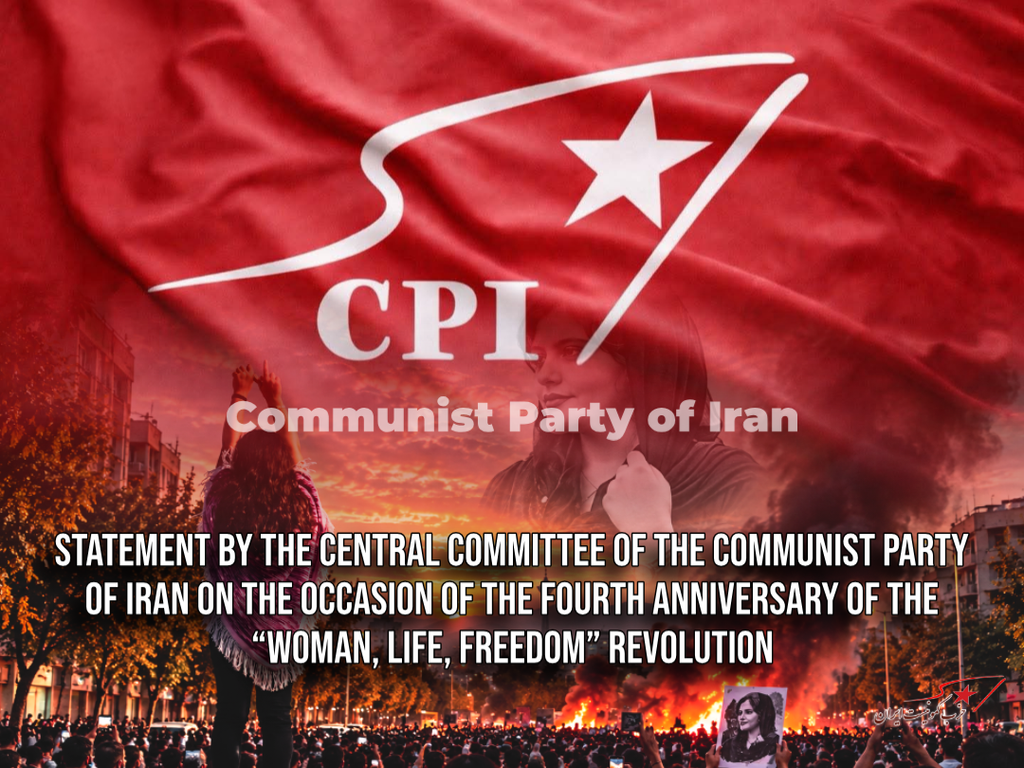
Four years have passed since the day when the name Jina Amini became a symbol of the struggle for freedom, equality, and liberation from oppression. On September 14, 2022, Jina, a 22-year-old young woman from Saqqez, was arrested in Tehran for what the morality police officers called “improper hijab” and died as a result of being beaten. On September 16, news of her death sparked a wave of anger and grief throughout Iran. One day later, tens of thousands of people from Kurdistan gathered at the Aichi Cemetery in Saqqez for Jina’s funeral and chanted the historic slogan “Woman, Life, Freedom”; a slogan that quickly spread from Kurdistan throughout Iran and from Iran to the world.
The state killing of Jina sparked an uprising whose foundations had been shaped over decades of resistance by women, workers, young people, students, teachers, retirees, the oppressed people of Kurdistan, and other oppressed nationalities. Jina’s Revolution was not a sudden event separate from previous struggles; it was the eruption of the accumulated anger of a society that has experienced nearly half a century of political repression, gender apartheid, class exploitation, poverty, discrimination, and humiliation.
The revolutionary “Woman, Life, Freedom” uprising transformed the political and social face of Iran. This uprising took the struggle against the control of women’s bodies and lives beyond opposition to the compulsory hijab and connected it with the struggle for political freedoms, social equality, welfare, economic security, and liberation from all forms of oppression and discrimination. In Kurdistan, the birthplace of this uprising, the movement quickly took on mass dimensions, and general strikes, street gatherings, and social solidarity became effective weapons of the people against the apparatus of repression.
For months, the streets of more than 150 cities across Iran became the scene of confrontation between young women and men seeking freedom and the repressive forces of the Islamic Republic. The Islamic regime mobilized all its power against a movement that had challenged its ideological and political foundations. Hundreds of people were killed, thousands were arrested and imprisoned, many were injured or disabled, and the government executed a number of young protesters in order to create fear. Nevertheless, the people demonstrated through unprecedented resistance that the era of obedience and silence had come to an end.
Although the widespread and continuous presence in the streets subsided after several months, Jina’s Revolution did not end. The movement continued its life by adapting its forms of struggle in workplaces, universities, schools, neighborhoods, prisons, the fields of art and culture, solidarity networks, and in the everyday resistance of women. The widespread disobedience of women against the compulsory hijab, the steadfastness of grieving families seeking justice, workers’ and retirees’ protests, the struggles of teachers and students, and the resistance of political prisoners are all manifestations of the continuation of the same movement.
Over these four years, the Islamic Republic has attempted to eliminate the effects of Jina’s Revolution through arrests, dismissals, summonses, threats, fabrication of cases, executions, pressure on the families of those killed, and the intensification of the security environment. On the eve of each anniversary, by deploying repressive forces, blocking roads leading to cemeteries, and preventing memorial ceremonies from being held, the government has revealed its fear of the collective memory of the people.
Families seeking justice and grieving mothers have kept the memory of this movement alive through their perseverance and courage. Memorial ceremonies for those killed have become part of the culture of resistance and protest; ceremonies that bring people together, challenge government lies, and emphasize the demands for justice, the freedom of political prisoners, and an end to impunity for those who ordered and carried out the repression. The Islamic Republic has not been able, and will not be able, to silence the voice demanding justice through threats and repression.
Jina’s Revolution has left lasting achievements. This movement increased public awareness of women’s rights and gender equality, broke many deep-rooted taboos within families and society, and introduced women to the world not as victims, but as pioneers of social change. Women’s resistance confronted the compulsory hijab, as one of the most important ideological foundations of the Islamic Republic, with a deep crisis and demonstrated that no repressive law or structure is immune to widespread and conscious civil disobedience.
This movement also strengthened solidarity between the people of Kurdistan and other regions of Iran and challenged the divisive policies of the Islamic Republic as well as chauvinist and reactionary currents within the opposition. Slogans that arose from Saqqez and Sanandaj echoed in Tehran, Balochistan, Khuzestan, Azerbaijan, and throughout Iran. Jina’s Revolution demonstrated that the struggle to eliminate national oppression, gender equality, political freedom, and social justice are not separate demands, but components of a common struggle for liberation.
The slogan “Woman, Life, Freedom” succeeded in connecting civic freedom with the pursuit of social and class justice. The deeper meaning of this slogan is not limited to freedom of dress; it also encompasses the right to a human life, the right to work and a livelihood, the right to organize and strike, the right to freedom of expression and assembly, the right to make decisions over one’s own body, full equality between women and men, the elimination of national oppression, and an end to poverty, corruption, and exploitation. Jina’s Revolution linked the struggle against gender apartheid with the struggle for bread, freedom, and the council-based administration of society.
The experience of the past four years has once again demonstrated that the Islamic Republic, despite its deep economic, political, social, and environmental crises, will not be removed from power simply through its own exhaustion and inability. The revolutionary overthrow of this regime and the achievement of freedom and equality require the expansion of a conscious, organized, mass, and nationwide struggle. The continuation of the struggle, while at the same time preserving the movement’s forces and reducing human costs, requires political wisdom, sustainable organization, and flexibility in tactics within the framework of a clear strategy.
In this process, the working class and working people have a decisive role. The real power of society is not manifested only in the streets; this power is also present in factories, production and service centers, schools, universities, and neighborhoods. A general and nationwide strike, particularly when accompanied by mass protests and local organization, can bring the machinery of repression to a standstill and deprive the government of its economic and social foundations. The experience of general strikes in Kurdistan has shown that the united and organized will of the people is capable of forcing the regime to retreat.
One of the essential necessities of the current stage is to strengthen solidarity among the women’s movement, the labor movement, the struggles of students and teachers, retirees’ protests, the justice movement, environmental movements, and the struggles of oppressed peoples. None of these movements can achieve all of its goals on its own. Victory depends on these struggles being connected to one another around common demands, grassroots organization, and a liberatory and socialist horizontal framework.
Global solidarity with the struggles of the people of Iran has also been one of the important achievements of Jina’s Revolution. The slogan “Woman, Life, Freedom” crossed geographical and linguistic borders and became an international symbol of opposition to oppression and discrimination. At the same time, efforts by hegemonic governments and reactionary forces to appropriate this movement must be resisted. The people of Iran are not struggling to replace one form of despotism, discrimination, and exploitation with another. Iran’s future must be built by the people themselves through their independent, organized, and conscious struggle.
Four years after the beginning of Jina’s Revolution, the Islamic Republic remains in power and many of the demands of this movement have yet to be realized; but Iranian society is no longer the society it was before September 2022. Women, young people, and oppressed peoples have recognized their own power. The regime may temporarily suppress protests, but it cannot eliminate their material and social foundations.
The Central Committee of the Communist Party of Iran, while commemorating the memory of Jina Amini and all those who lost their lives on the path to freedom and equality, emphasizes the unconditional freedom of political prisoners, the abolition of the death penalty, an end to the repression of women, the recognition of the freedom of association, strike, assembly, and expression, and the public trial of all those who ordered and carried out the killings and repression.
We call on workers, women, young people, students, teachers, retirees, families seeking justice, and all freedom and equality-seeking forces to commemorate the fourth anniversary of Jina’s Revolution through diverse, united initiatives appropriate to the conditions of each city and each workplace and living environment; to keep the memory of those who lost their lives alive, support families seeking justice and political prisoners, and work toward expanding organization, solidarity, and joint struggle.
The “Woman, Life, Freedom” Revolution is not a concluded event; it marks the beginning of a new chapter in the struggle of the people of Iran for liberation. The seeds planted in September 2022 remain alive in the everyday resistance of women, workers’ strikes, student protests, the perseverance of families seeking justice, and the desire for a better life shared by millions of people. This struggle will continue until the Islamic Republic is dismantled and a free, equal, socialist society free from all forms of oppression and exploitation is realized.
Long live the memory of Jina Amini and all those who lost their lives on the path to freedom!
Long live the fighting solidarity of the people of Iran!
Central Committee of the Communist Party of Iran
September 2026