The Ninth World Congress Against the Death Penalty: The Voice of Humanity’s Conscience Against the Machinery of Death
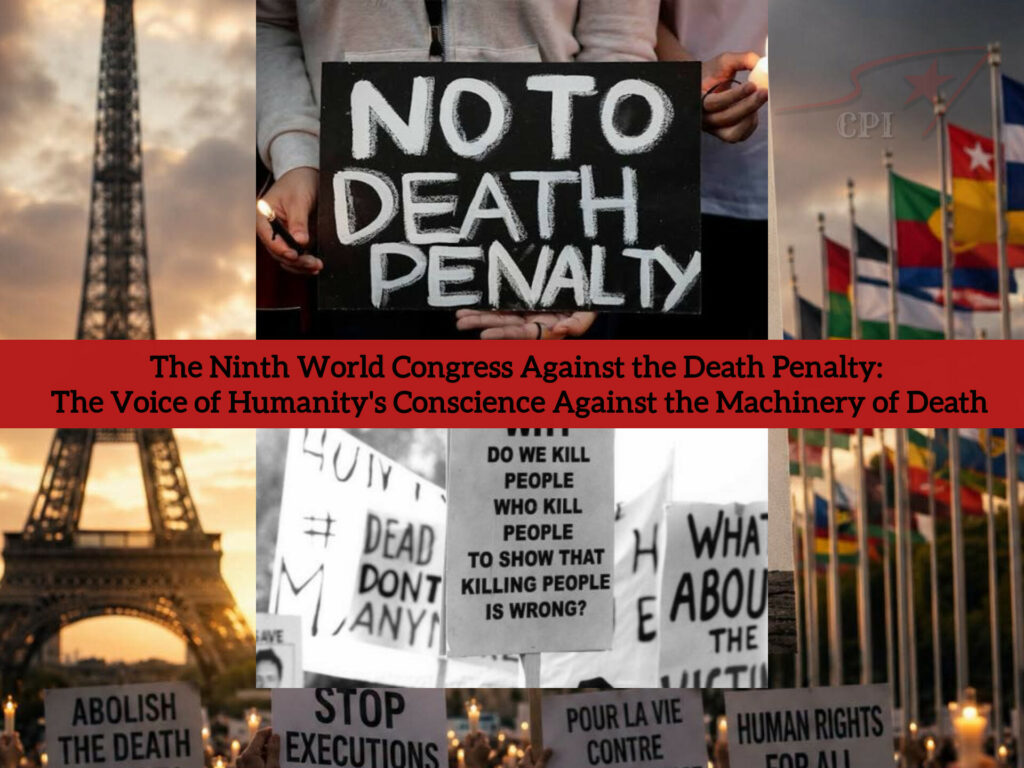
Paris once again hosted the world’s largest gathering of opponents of capital punishment, an event that became far more than a legal conference. It served as a moral tribunal against one of the most brutal remnants of modern criminal justice systems. Bringing together human rights defenders, legal experts, and relatives of victims from around the world, the Ninth World Congress Against the Death Penalty once again highlighted a painful reality: the death penalty is not an instrument of justice, but a weapon that falls most heavily upon the poorest, the most voiceless, and the most marginalized members of society.
Perhaps the congress’s most significant intellectual achievement was exposing the undeniable fact that executions are never a “blind” or equal form of punishment. Roya Boroumand, co-founder of the Abdorrahman Boroumand Center, stated plainly that capital punishment disproportionately affects those who lack financial resources and access to effective legal representation. From drug-related executions in Iran to death sentences imposed on Palestinian prisoners and the extrajudicial executions of sexual minorities in Afghanistan, the same pattern emerges: the victims of this machinery of death are almost always drawn from society’s most vulnerable and defenceless groups.
Speakers from South Korea, India, Kenya, Benin, and Taiwan likewise emphasized that death sentences are consistently intertwined with social, economic, religious, and educational deprivation. Research presented on defendants in South Korea showed that offenders generally do not consider the possibility of execution at the time they commit a crime; a finding that once again challenges the myth of the death penalty’s deterrent effect, a myth repeatedly invoked by governments to justify this form of violence.
The discussion of the United States revealed an even deeper contradiction. Robin Maher, Executive Director of the Death Penalty Information Center, presented statistics showing that American public opinion “particularly among younger generations” is increasingly turning away from this legacy of violence. The decline in new death sentences from around 300 to just 23 in a single year indicates that judges are increasingly choosing life over death. At the same time, however, a president who, according to Maher, has repeatedly encouraged states to carry out more executions demonstrates that political power remains willing to stand against the growing will of society. This divide itself illustrates that the death penalty is no longer an expression of the public conscience but rather a political instrument used to project state authority.
Among all the presentations, perhaps none was more alarming than that of Mahmood Amiry-Moghaddam, Director of Iran Human Rights. His figures (showing that half of all executions in Iran are carried out for drug-related offences and that, on average, two people are executed every day on such charges) paint the picture of a systematic killing machine that continues to operate largely in the shadow of global media silence. His warning was particularly significant: a government seeking to carry out political executions without provoking international outrage must first desensitize society to the executions of “others” people with drug-related convictions, the poor, and the forgotten. This is precisely why the struggle against capital punishment cannot be selective. Abolishing the death penalty for drug offences is itself a frontline in exposing the criminal nature of political executions. In this context, the “No to Executions Tuesdays” campaign inside Iran’s prisons has become a vital front in the global movement against capital punishment.
The presentation by Artemis Akbari of the organization ALO added another deeply troubling dimension. Whereas the Taliban previously carried out extrajudicial executions and enforced disappearances of sexual minorities in secret, it is now moving to formally legalize these crimes through a new penal code. This shift (from hidden violence to legally sanctioned violence) demonstrates how the absence of international scrutiny can normalize death as an instrument of governance.
Omar Rahhal of the Palestinian organization SHAMS perhaps offered the clearest illustration of the inherent injustice of the death penalty. A legal framework that allows only 90 days between sentencing and execution, while permitting only a single appeal, effectively eliminates any meaningful opportunity for a fair trial. Holding prisoners in complete solitary confinement from the moment a death sentence is imposed transforms the legal process from a system of justice into an instrument of political retaliation and collective repression.
Ultimately, the most fundamental argument against capital punishment to emerge from the congress echoed Roya Boroumand’s words: no judicial system in the world can ever be absolutely certain that every verdict is just. Faced with this unavoidable uncertainty, death is the only punishment that is irreversible. A wrongful prison sentence can be corrected; a wrongful execution never can.
Yet the congress was not solely a story of darkness. Burkina Faso’s abolition of the death penalty in 2018 and the complete abolition of capital punishment by 25 African countries demonstrate that change is possible. The drafting of a new African Charter for the Abolition of the Death Penalty, scheduled to be presented to the African Union in Dakar later this year, shows that although the movement advances gradually, it continues to move forward.
The Ninth World Congress Against the Death Penalty once again demonstrated that opposition to capital punishment transcends geographical, cultural, and political boundaries. It brought together activists from Iran, Afghanistan, Palestine, the United States, and across Africa around a shared commitment to recognising the inalienable dignity of every human life even the lives of those accused of the gravest crimes or regarded as society’s most despised individuals. Until this cruel and irreversible punishment is abolished from the world’s legal systems, the voice of gatherings such as this must continue to grow louder than ever.