Women Are Fired as Easily as Drinking Water: The Catastrophe of Job Insecurity for Women Workers and Female Heads of Household
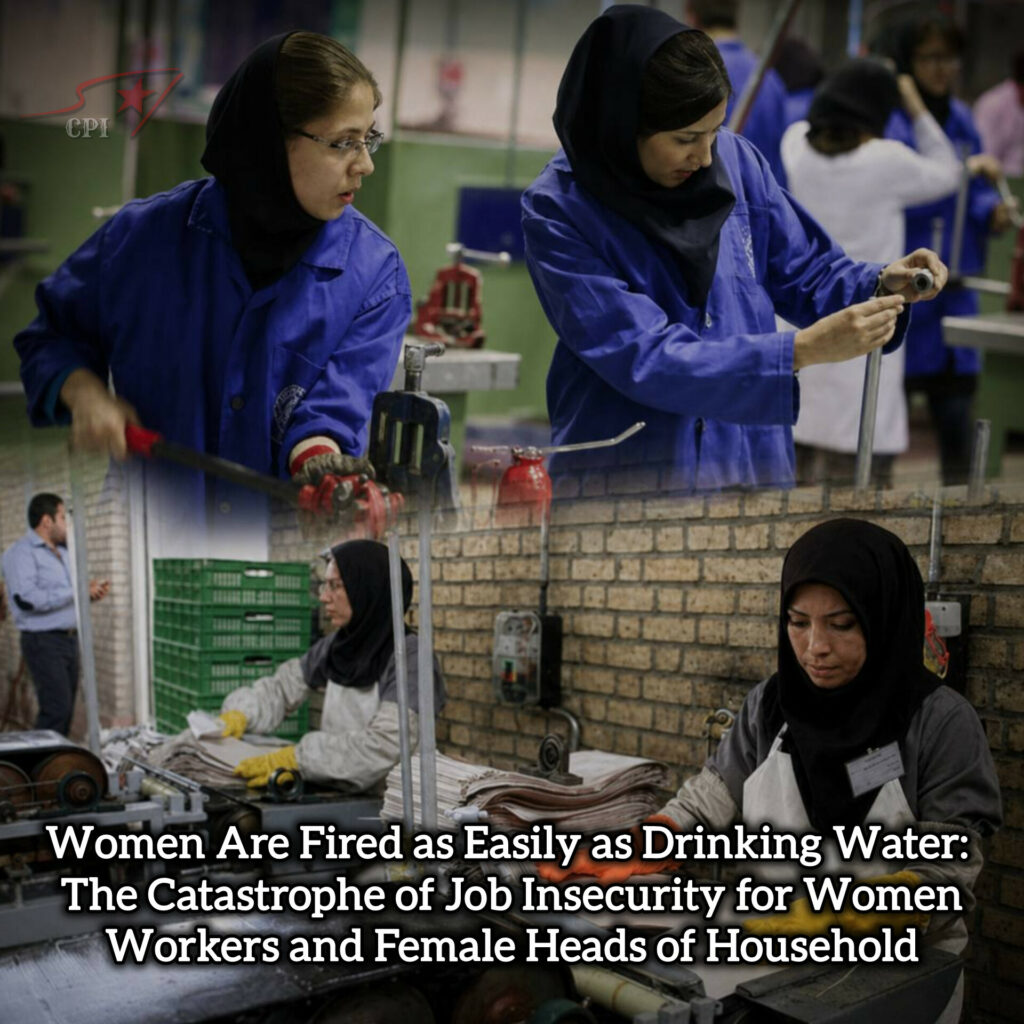
The widespread use of temporary and short-term contracts in jobs that are inherently permanent has pushed the job security and livelihoods of women workers in Iran (especially women who are the sole or primary breadwinners of their families) to a catastrophic level. What is unfolding in Iran’s labour market today is nothing less than the systematic stripping of job security from millions of working women who support their households.
In a report titled “Women Are Fired as Easily as Drinking Water,” the state-run news agency ILNA examined the dismissal of women workers, particularly female heads of household.
The report openly states that the Ministry of Cooperatives, Labour and Social Welfare “which, according to its official mandate, is responsible for protecting workers against employers’ abuses” has in practice remained passive and has continuously retreated in the face of employers’ attacks on workers’ rights. Its silence regarding one-month, three-month and blank-signed contracts in jobs of a clearly permanent nature amounts to open complicity with employers.
Simin Yaghoubian, a labour activist working with women workers, points to the root of the crisis of job insecurity. She explains that every morning, thousands of female heads of household worry less about arriving at work on time than about whether they will still have a job the next day. According to her, many of these women are the only breadwinners in their families, and even the slightest interruption in employment directly affects their livelihoods, their children’s education, their mental health, and even their human dignity. Yaghoubian stresses that today there are workers with more than ten or even twenty years of service who are still forced to sign short-term contracts and live each month in fear of whether those contracts will be renewed.
The wheels of Iran’s production and economy turn on the shoulders of workers who receive the smallest share of job security and economic well-being. Within this unequal system, women workers, and particularly female heads of household are the most vulnerable and least protected. A system built on profit accumulation has consistently viewed women as a source of cheap, flexible and compliant labour: a workforce that can be employed for the lowest possible wages and dismissed without cost or consequence whenever economic conditions change.
Under these conditions, the “temporary contract” has become a permanent threat hanging over the working class, while the concept of “job security” has been reduced to a bitter irony and an unattainable aspiration in Iran’s labour market. Gender discrimination in society and employment, patriarchal family laws, legal inequality between women and men, and discriminatory workplace regulations weigh most heavily on women workers. The regime’s anti-worker and misogynistic policies “including the dismissal of permanent workers, the expansion of temporary and blank-signed contracts, workforce reductions in factories and workshops, and the closure of production lines” have deepened poverty and further reduced workers’ living standards. Yet among all workers, the situation of women workers remains the most painful and catastrophic.
According to statistics published by the Statistical Centre of Iran, 58 percent of employed women in the country work under temporary contracts, blank-signed contracts, or without any written contract at all. Of Iran’s 4.32 million employed women, only 1.6 million hold formal jobs, while the remaining 2.739 million work in the informal sector, without pension insurance, without health insurance, and without employment contracts registered with the Ministry of Labour.
The most vulnerable women workers in Iran are those living in the lowest income brackets. They make up a large proportion of the workforce in the pharmaceutical, garment, carpet-weaving and brick kiln industries. Housewives are not even classified as unemployed workers and therefore receive no unemployment benefits. Amid the country’s deepening economic crisis, many are pushed into precarious informal work such as street vending in metro stations and on pavements, where they spend their days trying to earn a living while living in constant fear of police harassment and the confiscation of their goods.
Job insecurity is not limited to service workers, hairdressers, or women employed in workshops and cafés. Half of Iran’s nursing workforce (more than 80 percent of whom are women) are employed under temporary agency contracts or 89-day contracts. These healthcare workers, who stand at the heart of the country’s medical system, continue to provide essential care while being denied even the most basic employment stability.
The experiences of women workers across Iran paint the picture of a system that treats job security not as a fundamental right but as an unattainable privilege for the overwhelming majority of employed women. For female heads of household, this insecurity is far more than an economic problem; it is a crisis that threatens their mental health, human dignity, their children’s educational future, and the very survival of their families. As long as temporary and blank-signed contracts remain in place, and state institutions themselves continue to reinforce these conditions, the situation of women workers in Iran will remain catastrophic. Defending women’s right to secure, stable and dignified employment has become, now more than ever, both a class demand and a fundamental human imperative.