War, Social Classes and Peace
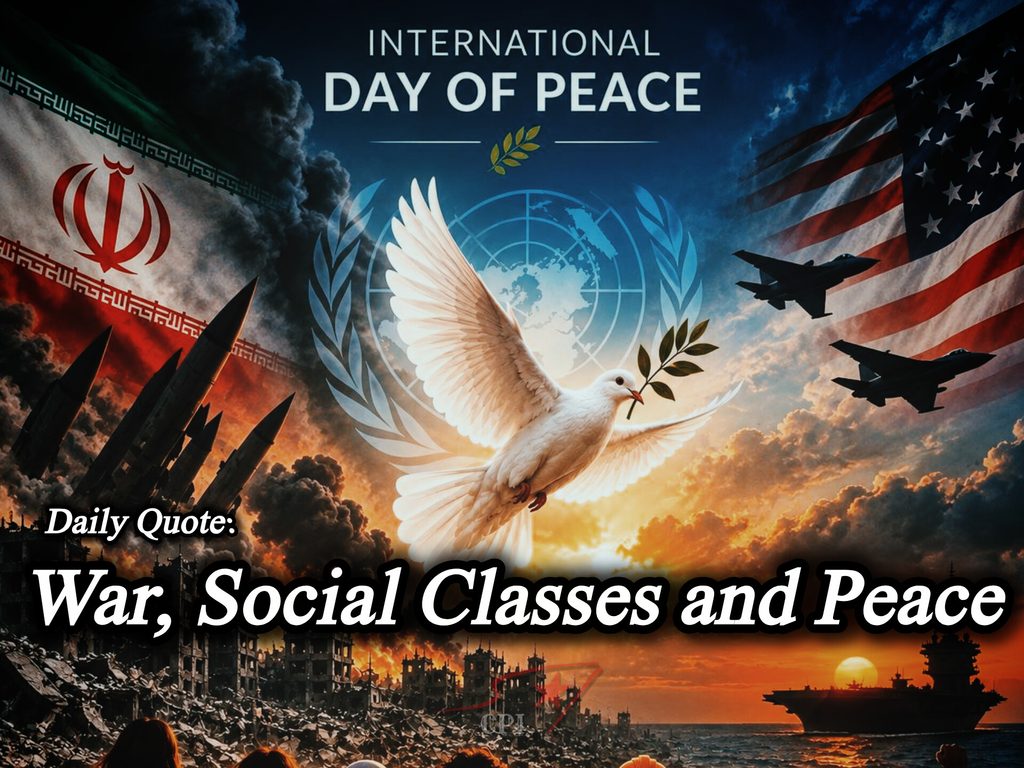
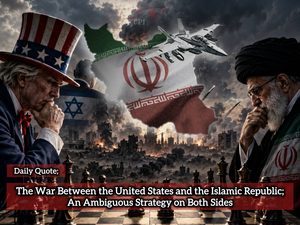
Monday, September 21, is the International Day of Peace; a day that this year arrives in the shadow of fresh wounds that have been inflicted on Iranian society since February 28, 2026, with the beginning of the war between the Islamic Republic on one side and the United States, Israel, and several regional states hosting U.S. military bases on the other. In the streets of Iranian cities, the sound of sirens and the sight of partially destroyed buildings have still become part of people’s daily lives. But a scientific examination of this war, and of war in general, cannot stop at merely describing suffering at this level; we must ask where this war came from, who benefits from it, and why the silence of the artillery is not peace in itself.
The first step is to reject the common assumption that wars are the product of clashes between “nations” or “civilizations.” If we look at the past four decades (from Rwanda and the Balkans to Afghanistan, Iraq, Ukraine, and Gaza) none of these wars emerged from the wishes of ordinary people. The people of Rwanda did not want genocide; the people of Iraq did not want wars and sectarian and religious killings; the people of Ukraine and Russia do not want to kill one another. What all these cases have in common is competition among states and major military and energy interests over control of resources, territories, and spheres of influence. A war in which the lower classes on both sides of the front lose their lives and futures for interests from which they will never benefit.
The war between Iran and the United States is of the same nature. Neither the people of Iran nor the people of the United States wanted it; yet two power blocs “one imperialist, in the form of the United States and its regional allies, and the other a dictatorial and repressive bloc in the form of the Islamic Republic” became involved in a competition whose costs were paid by ordinary people: thousands killed and wounded, destroyed infrastructure, a severely weakened economy, and a society trapped between fear of bombardment and mounting economic hardship. Wars between states almost always benefit the ruling classes and harm the lower classes. Governments create crises through war and rebuild their lost legitimacy in the atmosphere of “defending the homeland” or “confronting the enemy”; military interests, reconstruction contractors, and rent-seeking networks on both sides of the front profit from war; but workers, women, young people, and disadvantaged groups bear its heavy burden alone.
Therefore, our position toward such a war cannot be a choice between two hostile camps. Supporting the Islamic Republic in the name of “resistance against imperialism” is just as misleading as supporting U.S. and Israeli military intervention in the name of “the liberation of the Iranian people.” Both blocs pursue the interests of their own ruling classes, not the interests of the people of Iran. For four decades, the Islamic Republic has waged a continuous war against the disadvantaged sections of its own society through domestic repression, gender and national discrimination, and the plundering of the country’s resources; and the Western powers, from Iraq to Libya and Afghanistan, have repeatedly shown that “humanitarian intervention” or “regime change” from outside leads not to democracy but to destruction, fragmentation, and greater poverty.
This is precisely where we must free the concept of peace from its superficial and official definition. In its message this year, the United Nations speaks of “everyday peacebuilders” (teachers, women, young people, and civil society activists) but in Iran, peace has a far more tangible and radical meaning. Peace means that an Iranian child does not wake up to the sound of explosions; peace means that an Iranian mother does not worry about the life of her child; peace means that a worker does not tremble over whether there will be bread tomorrow; peace means that a teacher is not imprisoned for defending their labor rights; peace means that a woman is not threatened for choosing her own clothing; peace means that a student is not expelled from university for thinking; and peace means that no human being is considered a second-class citizen because of their nationality, language, gender, or beliefs. In this understanding, peace is not merely the end of foreign war; peace is also the end of domestic repression. This is what distinguishes our analysis from a liberal or merely diplomatic analysis of peace: liberal peace is often limited to the cessation of gunfire and the signing of an agreement, whereas “social peace” also requires the elimination of structural violence, namely poverty, discrimination, political repression, and inequality. The people of Iran should not be forced to choose between “foreign war” and “domestic authoritarianism”; both are two sides of the same coin.
But the more practical question is: how can such peace be achieved? Real peace is built neither from above, nor through mediation by great powers, nor through the goodwill of governments, but from below and from the organized power of working people.
Workers who have their own independent organizations, women who have formed independent civil networks, students who have organized themselves in their own free councils, teachers who have established independent trade unions, and the various nations living in Iran who enjoy equal and recognized rights, these are the real pillars of peace, not diplomatic statements.
Iran is a society made up of Persians, Kurds, Baloch, Arabs, Turks, and other national and linguistic groups. Lasting internal peace can only emerge when no nation feels that it must confront another nation in order to preserve its identity and rights; and this feeling itself is the product of structural discrimination that the central government has fueled for decades, from the Kurdish regions to Balochistan and Arab-populated Khuzestan. Legal equality, the elimination of national and linguistic discrimination, the right to equal political participation, and recognition of cultural and linguistic diversity are the foundations of internal peace. Unity imposed through force and repression is not unity; real unity is the unity of equal human beings. The right of nations to self-determination and the common class struggle of workers from all nationalities are not in conflict but complement one another: only a society in which no nation is dominant or subjugated can also establish lasting class unity against capital and the state.
Another dimension of peace is its economic and social dimension, which is often overlooked in the official discourse on peace. If millions of people live in poverty, if wages continually fall behind the real cost of living, if young people see no future prospects for themselves, and if housing, healthcare, and education become inaccessible commodities for the majority of society, then that society remains in a real state of “neither war nor peace” even in the absence of foreign war. This is what the United Nations also points to, albeit in more cautious language: health, education, nutrition, and social protection are pillars of lasting peace. In Iran, bread, work, freedom, justice, equality, and human dignity are inseparable components of a single peace project; a project that cannot be reduced to the temporary cessation of gunfire.
The conclusion of this analysis is neither passivity nor waiting for great powers or international institutions, but an emphasis on the role of the people themselves. A peace in which people have no role in its creation is, at best, a temporary ceasefire between two ruling classes that may return to war at any moment. But a peace in which workers, teachers, women, young people, students, retirees, and the various nationalities of Iran play an active role in its creation through independent trade organizations, civil networks, and transnational class solidarity can become a social and lasting peace. This peace cannot simply be demanded from governments, whether the Islamic Republic or Western governments; it must be built within society, in the workplace, at the university, in neighborhoods, and in the streets.
From this perspective, the International Day of Peace is not merely a day for recalling an abstract ideal, but an opportunity to repeat this simple truth: the war between Iran and the United States, like every other war in the capitalist world, has been a war of the ruling classes, not a war of the people. Real peace is neither a gift given to the people nor an agreement signed behind the closed doors of diplomacy; lasting peace is something that people, through class consciousness, international solidarity, and their independent organization, build and protect. Only along such a path can peace move beyond a temporary agreement on paper and become the true way of life for the people of Iran.