Beginning of the New School Year Under the Shadow of Poverty; A Beginning That Is Not the Same for Everyone
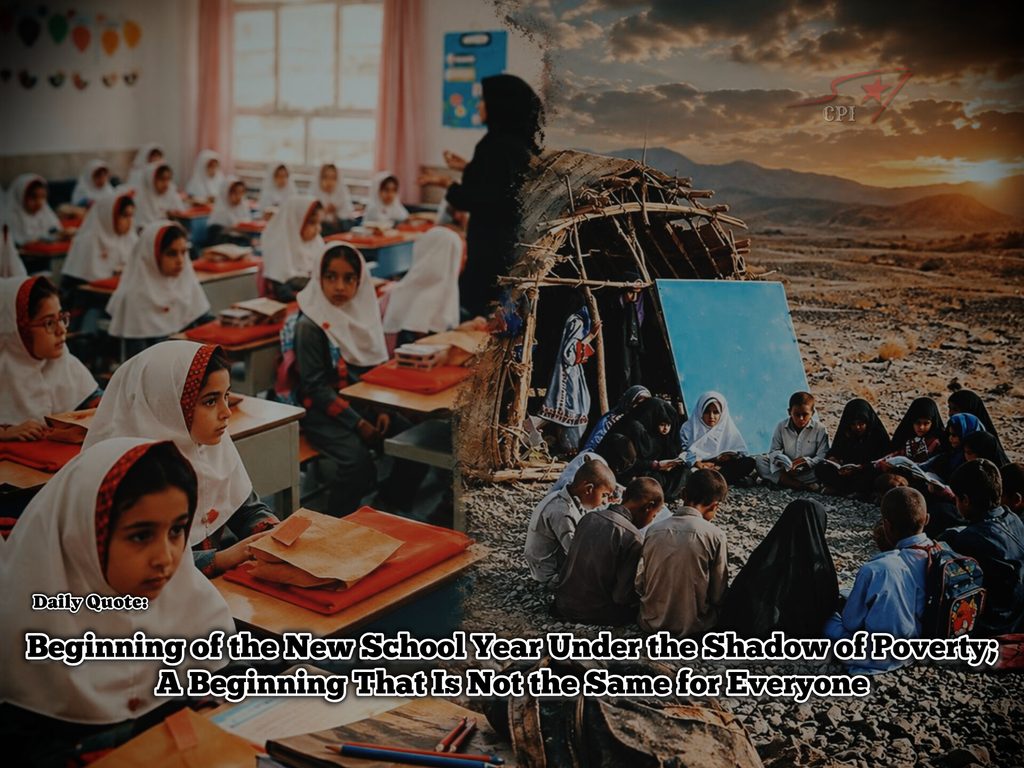
On Wednesday, September 23, the 2026–2027 academic year officially begins, and around 16 million students at different educational levels will return to classrooms; more than 9 million of them are enrolled in primary education. But behind these large figures lies a bitter reality “returning to school” does not have the same meaning for all children in Iran. For some, the first day of the school year is a day to see their friends again and begin a new adventure, for others it is the day when their families, after doing some quick calculations, have concluded that they cannot afford the costs.
On Monday, September 21, the “Blossoms” ceremony for first-grade pupils was held in schools across the country. The ceremony was originally designed with a clear purpose, to reduce the anxiety of a child who is leaving home for the first time, familiarize them with the school environment, and establish their first emotional bonds with teachers and classmates. An educational and psychological function that also holds a special place in many education systems around the world.
But in recent years, the Blossoms ceremony has become more of a media event than a celebration for children. Images released from the ceremony show children in segregated girls’ and boys’ schools, wearing uniforms and compulsory coverings, standing in a completely arranged setting facing the cameras. What was supposed to be a children’s day has become a day for producing an official image of a “happy and vibrant school”; an image that is far removed from the everyday experience of many families.
According to statistics from the Ministry of Education, around 1,154,000 children entered first grade this year. Last year, this figure was more than 1.23 million, and the trend over the past several years also shows that the number of first-grade pupils is shrinking year by year. The decline in the number of first-graders has occurred alongside the rapid increase in education costs and the growing pressure on household budgets. In other words, alongside economic data, these figures are an indication of families who have either postponed enrolling their children or have been unable to do so at all.
The heaviest shadow over the beginning of the school year is the shadow of poverty. Estimates indicate that preparing a student to enter school this year has reached around 15 million tomans. This figure covers only the cost of notebooks, pencils, a schoolbag, and basic supplies, and does not yet include uniforms, shoes, school transportation, supplementary educational books, or tuition fees at non-governmental schools.
To understand the scale of this figure, it is enough to compare it with the minimum wage for workers in 2026 — around 16.625 million tomans. A child’s school-supply basket is approximately equivalent to an entire month’s wages for a worker. A family with two or three school-aged children must, on the eve of the new school year, set aside the equivalent of two to three months of income just to equip them; all while that same income must also cover rent, food, and medical expenses.
The main factor behind this situation is the surge in stationery prices over the past year, estimated at between 50 and 100 percent. The cost of school transportation in Tehran and major cities has also increased by around 50 percent. This means that what families pay in the early days of the school year is only the first installment of expenses that must be covered month by month until the end of June.
Economic pressure on families quickly spreads into the education system and creates a series of interconnected consequences: dropping out of school, particularly in deprived areas and on the outskirts of cities; the expansion of child labor; a child who has been deprived of schooling often becomes part of the household labor force, and returning to education becomes more difficult each year. A decline in the quality of education for those who remain in school but are deprived of supplementary educational books, tutoring classes, and learning tools. Deepening class inequality; the gap between a student studying at a well-equipped non-governmental school and their peer in an overcrowded classroom in a remote village grows wider every year. Independent estimates indicate that more than three million children and adolescents of school age in Iran have been deprived of schooling. This figure cannot be regarded merely as an educational indicator; three million children outside school means a generation that will face fewer employment opportunities and greater social vulnerability in the future.
Household poverty is only one side of the coin. The education system itself has been grappling with structural problems for years: a budget that does not match its needs, schools that are dilapidated and unsafe in many cases, classrooms that are sometimes run with more than forty students, and a shortage of teachers that is covered every year with temporary solutions. In such an environment, even a family that has managed to cover the costs has no guarantee of receiving a quality education.
Alongside this material deterioration, ideological policymaking has also cast its shadow. Gender segregation from the very first day, strict control over dress, interference in educational content, and restrictions on students’ individual freedoms have transformed the school from an environment for fostering creativity and questioning into a space for discipline and brainwashing. The result is a double divide: the divide between the rich and the poor, and the divide between what is officially called education and what children actually need.
Free and universal education is recognized as a fundamental right both in Iran’s Constitution and in international documents. But when providing a child with a notebook and schoolbag costs as much as an entire month’s wages, when public schools ask families for “voluntary contributions,” and when the quality of education is tied to the ability to pay tuition, this right becomes a class privilege in practice; a privilege enjoyed by only part of society.
Education is the backbone of the development of every society, but in Iran today, this backbone is bending under the simultaneous weight of household poverty, lack of resources, deteriorating infrastructure, and ideological priorities. September 23, 2026, could have been a day of hope; but today, every school bell marking the beginning of the academic year will, instead of heralding the future, be a display of deprivation and inequality.