Working Children: The Full Reflection of a System Built on the Poverty of Workers and the Toiling Masses
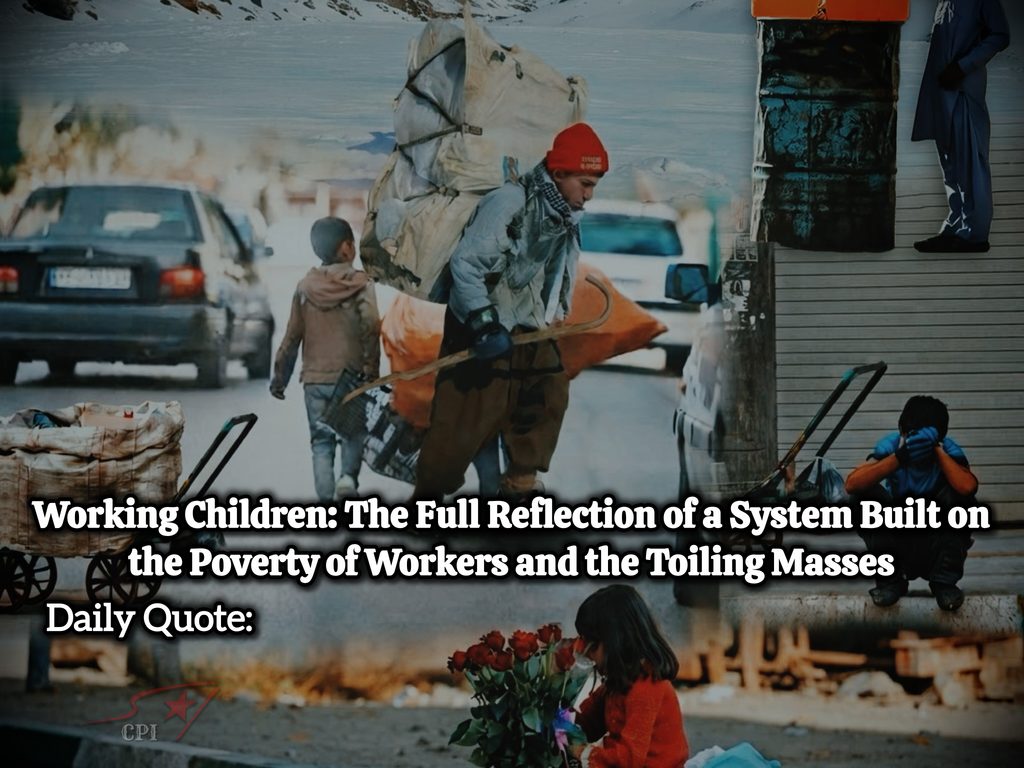
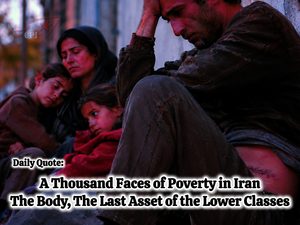
According to the government’s own statistics, more than half of Iran’s population lives in absolute poverty and is unable to meet even the most basic necessities of life. If the standard is not merely staying alive but living with human dignity, this kind of life has been denied to more than 70 percent of the Iranian people. Among them, children bear the burden of this poverty more than any other group, a poverty intertwined with unemployment, crushing inflation, homelessness, parental addiction, and street violence. The phenomenon of working children is the full reflection of a system built on the poverty of the working class and the toiling masses.
Runaway inflation, the continuous collapse in the value of the country’s currency, and the absence of any social safety net, from unemployment insurance to health insurance, push increasing numbers of children out of school every year. A family whose breadwinner’s wages are not even enough to cover the rent is forced to take its child by the hand and send them to the streets, a workshop, or a garbage bin instead of school. A child or adolescent who is prevented from continuing their education is inevitably thrown into the labor market to contribute, however little, to the family’s expenses. In this way, poverty is passed from one generation to the next, and a child who works instead of studying today will become a cheap, rightless worker tomorrow, in a market where capital needs such labor to generate profits.
Even official statistics, which are invariably accompanied by concealment, reveal the horrifying scale of this catastrophe. According to officials, including the head of the country’s Welfare Organization in 2026, the number of working and street children is estimated at around 400,000. Yet these same institutions have announced another estimate stating that, among children aged 10 to 14 alone, approximately 380,000 work on a regular basis and around 370,000 work seasonally. In other words, more than 750,000 children in total within this age group alone. The gap between these two figures speaks for itself: whenever definitions and counting are involved, the government prefers to portray reality as smaller than it actually is. The actual number is considerably higher when children working in underground workshops, farms, and homes, who are absent from all statistics, are taken into account.
The majority of these children are of school age, between 7 and 15. Some struggle to remain in school, but a significant number have already been deprived of education or are at risk of dropping out every day. Street vending at intersections and in the metro, working in small informal workshops, and scavenging through garbage are the most common occupations that consume their childhood.
According to previous statistics and reports by the Welfare Organization, around 60 percent of working children are Iranian, while approximately 40 percent are foreign nationals, primarily Afghan migrants. Afghan children occupy the lowest rung of this pyramid. Many are denied enrollment in school because they lack residency documents, receive no healthcare or social support, and are completely defenseless against employers, contractors, and officials.
Garbage scavenging, one of the most dangerous and degrading forms of work, falls largely on the shoulders of these same children. They work among the city’s waste for recycling contractors and mafias, earning meager wages without even the most basic safety measures. In addition, successive waves of mass deportations of Afghan migrants and the anti Afghan climate fueled by the government have placed these children in an even more precarious situation: on the one hand, ruthless exploitation at work, and on the other, the threat of arrest, separation from their families, and deportation. The suffering of an Afghan working child is the suffering of an Iranian working child; both are victims of the same system, and the liberation of one is impossible without the other.
Research shows that a high percentage of working children face various forms of psychological, emotional, and physical harm in their workplaces. Long working hours, exposure to contaminated and hazardous materials, malnutrition, abuse and sexual exploitation, addiction, and violence by the police and municipal authorities are all part of these children’s daily lives. In recent months, working children have also faced escalating violence, while their already meager earnings have fallen to the lowest possible level in an economy that grows smaller and poorer by the day. So-called “collection” and “organization” schemes, rather than eliminating the root causes, merely hide children from public view and leave them to face detention, deportation, or a return to the streets.
In a country where human life has no value, it is clear that working children will be deprived of all human rights. A government that killed more than 60 children in just 100 days during the 2022 revolutionary uprising, keeps many children on death row, has wounded children in the streets, and tortured them in prison cannot and does not want to protect children.
The Islamic Republic’s record regarding children has been shameful from the very beginning. Sending children into minefields during the Iran-Iraq War, deploying child soldiers, using children in mourning ceremonies and bloodying their bodies with knives and chains, and recruiting Basij teenagers to suppress the population, these are unforgettable crimes that fall within the concept of crimes against humanity.
A government that has forced hundreds of thousands of children to work and has the blood of children on its hands should have no place in any international body that claims to defend children’s rights. Just as the Islamic Republic was expelled from the United Nations Commission on the Status of Women because of its widespread human rights violations, it must also be removed from all institutions and bodies concerned with children’s rights.
Children’s welfare and safety are the primary indicators by which any government and political system should be judged, and since coming to power, the Islamic Republic has pursued the most inhumane policies toward children. The phenomenon of child labor cannot be eliminated through a few charity initiatives and theatrical “organization” schemes; its roots lie in the poverty that this political and economic system has imposed on the majority of society. Free and compulsory education for all children, regardless of nationality or residency documents; ensuring families’ livelihoods, unemployment insurance and universal healthcare and a genuine ban on child labor are the bare minimums that every humane society must guarantee.