The Whip on the Worker’s Body, the Volcano of Tomorrow’s Rage
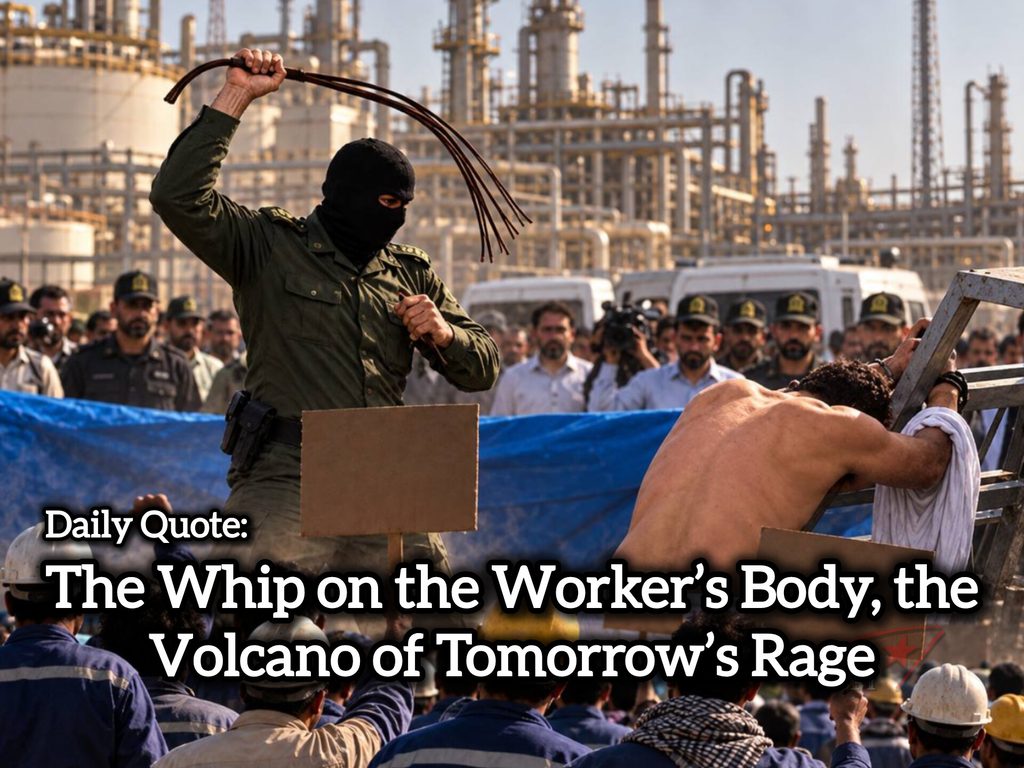
Once again, the whip has come down on a worker’s body. This time, it was the turn of the dismissed workers of Petropars in Hoveyzeh: more than ten workers who spent years toiling in the deadly heat of Khuzestan, in the heart of the massive projects at the South Azadegan oil field, only to be discarded like worn-out tools once the project phases were completed. Their contracts were not renewed, the bread was taken from their tables, and when they raised their voices in protest, the response came from Branch 101 of the Hoveyzeh Criminal Court Two. Seventy-four lashes and a fine of 20 million tomans for each worker.
This ruling must not be viewed as a mere “judicial case.” It must be called by its real name: class revenge. A worker who has been deprived of his job and is not even allowed to protest this very injustice must endure the blows of the whip across his back so that others will learn their lesson. This is the naked face of labor-capital relations in the Islamic Republic.
But Petropars is not an isolated incident. In June 2026, the Arak Criminal Court sentenced 42 workers of the Azarab company to one year in prison, 74 lashes, and one month of forced labor. Forced labor! In the twenty-first century, a worker who has raised his voice over unpaid wages and job security is sentenced to forced labor. In previous years, workers in Kurdistan, Yazd, and other regions have also been flogged for participating in May Day celebrations or protesting their dismissal.
And the most disgraceful example of all is the case of the 17 workers at the Agh Dareh gold mine, whose flogging sentences were carried out in public. Relatives of these workers have said that the judiciary had moved beyond imprisonment and monetary fines, but insisted on one thing: flogging, and in front of the eyes of other workers. The goal was clear: to stage a spectacle of humiliation, a “lesson” for anyone who dared to hold their head high.
Flogging political prisoners in the prisons of the Islamic Republic has been an everyday occurrence; countless dignified human beings have lost their lives under relentless blows of the whip. But dragging a protesting worker under the whip in front of his colleagues and family carries a particular message. Here, class hatred comes onto the stage without a veil.
But what was the result? The workers of Agh Dareh returned proudly to their families and fellow workers, the scars of the whip still on their bodies, and exposed the disgrace of this sentence throughout Iran and beyond its borders. What was meant to symbolize humiliation became a badge of honor.
In February 2009, after Sosan Razani, Shiva Kheirabadi, and their fellow activists were flogged for participating in May Day celebrations, their fellow workers were not intimidated. Instead, they stood waiting for them outside Sanandaj Prison and placed garlands of flowers around their necks. Those garlands of flowers were a spiritual flogging of the conscience of the judge who had issued such a sentence. The whip sought to create shame; the working class turned it into pride.
And today, the same story is being repeated in Hoveyzeh. Following the implementation of their sentences, Petropars workers still gather in protest outside the company every week. Why? Because hunger cannot be satisfied by a court ruling. Because the need for work and bread does not disappear with the crack of a whip. The whip did not silence the protest; it turned it into a symbol of resistance.
At that same South Azadegan oil field, the Central Processing Facility, with a capacity of 320,000 barrels per day, is loudly presented as a “national achievement.” But on whose shoulders was this achievement built? On the shoulders of those very workers who sweated in temperatures exceeding 50 degrees Celsius under the harshest operating conditions. And what was their share of this “achievement”? Temporary contracts, dismissal, and finally, the whip.
This is the logic of capital: as long as a worker’s labor power generates profit, the worker is “human capital”; the moment they demand their rights, they become a “defendant.” Oil keeps flowing, profits keep flowing, embezzlement continues unabated; only the worker is expected to remain silent. And if the worker refuses to stay silent, the whip awaits.
Let us speak plainly: the whip on a worker’s body is not a sign of strength; it is an admission of fear. Fear of a class that turns the wheels of society’s production and whose withdrawal of labor would bring everything to a halt. If the whip could intimidate workers, the flames of protest should have been extinguished the very day after the Islamic Republic came to power, when whips and far worse were brought down on the bodies of activists in prisons. But the history of the past 47 years has proven otherwise: every wave of repression has sparked a new wave of resistance.
A worker who supports their family on a wage that is four times below the poverty line; a worker whose fear of unemployment pushes them to the brink of suicide; a worker who sees billion-toman embezzlements by government officials and institutions go unanswered, while the only person treated as a criminal in this country is the one asking for bread. Such a worker is no longer afraid of the whip. A worker who stands firm on May Day, puts their own body on the line, and amplifies the voices of their fellow workers has nothing to fear from the lashes of the injustice and oppression inflicted by capitalists and their regime.
The whip is the last weapon of a system that has lost its tools of persuasion, legitimacy, and governance. When a government resorts to the whip in response to a demand for the “right to work,” it means it has nothing left to say. These inhumane rulings will not intimidate workers; they will intensify class hatred toward a system that protects the interests of capitalists. Every lash is etched into the collective memory of the working class. Society will not forget these acts of repression.
The scars of the whip on the bodies of the workers of Agh Dareh, Petropars, Azarab, and Sanandaj are not merely today’s pain; they are the volcano of tomorrow’s working-class rage. Those who issue and enforce these sentences against the most honorable human beings in this society will not escape the consequences of their inhumane and anti-worker actions. Even today, they live with the nightmare that one day these rulings will be laid before them as evidence of their crimes.
This struggle is unequal today. But the balance of forces is shifting every day in favor of the millions of people who have endured every kind of oppression for 47 years. Workers’ strikes, protests by teachers, women, students, retirees, and those seeking justice are strands of a rope being woven more tightly with each passing day. The issue is no longer just the fate of a handful of dismissed workers. The issue is a system in which a worker can be deprived of their job and then flogged for protesting that very deprivation. Such a system cannot be reformed; it must be confronted. Solidarity with the workers of Petropars, Azarab, and Agh Dareh is the duty of every worker and every free human being. Let us not abandon the weekly gatherings of the Hoveyzeh workers. Let us carry their voices to every factory, every mine, and every workplace. Capital’s whip on the worker’s body is the volcano of tomorrow’s rage; sooner or later, this volcano will shatter the worn-out order built on repression and humiliation.