The Classification of Education in Iran
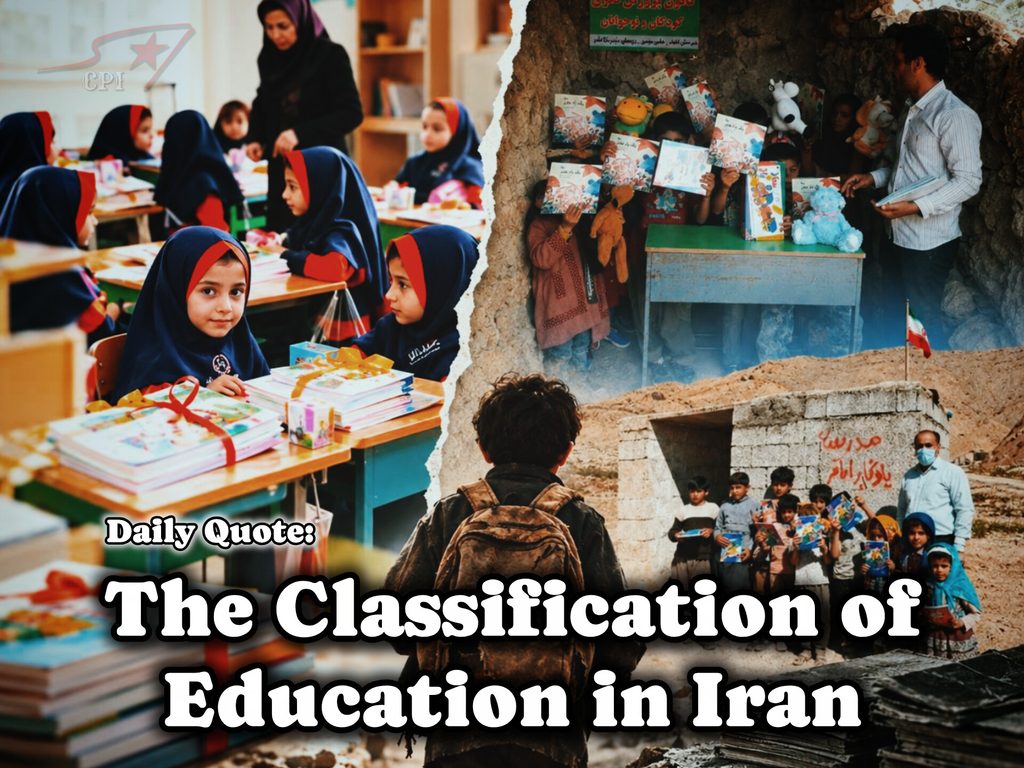
Public education in Iran was built on the promise that children, regardless of their social class or geographic location, would have an equal opportunity to learn. Today, this foundation has clearly begun to crack. What has happened in recent years is not a gradual decline in quality, but the formation of two parallel education systems: one for those who can afford to buy education, and another, increasingly collapsing system for the majority who cannot.
Perhaps the clearest sign of this divide is the results of the university entrance exams in 2024 and 2025. Among the top 40 ranks in the three main fields of the university entrance exam, not a single person came from ordinary public schools. The top-ranked students came almost entirely from private schools; private schools, government model schools, and NODET schools, meaning the very schools that have greater educational resources, more specialized teachers, smaller classes, and extensive supplementary programs.
This statistic must be read alongside another: the average final grade of 12th-grade students in ordinary public schools in 2024 was only 8.96, while the same indicator in NODET schools reached 16.14. The nearly twofold gap between these two figures provides a condensed picture of a system that, every year, excludes a larger share of its students from a competition that was supposed to be “equal.”
For many middle-class families, private school is no longer a preference but a necessity. Families that for years enrolled their children in public schools are now facing a noticeable decline in teaching quality, overcrowded classrooms, frequent class cancellations due to the lack of specialized teachers, and institutional indifference toward their children’s educational future. The result is that these same families, despite bearing heavy costs, transfer their children to private schools simply to reach a minimum acceptable level of education.
These costs are not insignificant. Private-school tuition has increased sharply in recent years, and families may sometimes have to pay tens of millions of tomans for the final three years of high school. Thus, something that should legally be free has effectively become a commodity accessible only through money; a commodity whose price, amid severe inflation in the cost of living, places additional pressure on working-class and lower-middle-class families.
On the other side of this divide, public schools are struggling with a structural crisis. The role of the school principal has changed from “being responsible for education” to “securing money and resources.” Many of these schools are housed in old and unsuitable buildings, and government funding does not even cover basic expenses. Principals are forced to collect money from parents to repair buildings, purchase supplies, provide educational equipment, and even pay the salary of the school custodian; meaning that the financial burden that should logically be borne by the government is unofficially transferred onto families, without those families receiving the benefits of private schooling.
Overcrowded classrooms are one of the most tangible signs of this crisis. In many urban schools, class sizes reach 35 to 45 students, and more than 60 percent of classes in densely populated areas have more than 30 students; in some areas, the student-to-teacher ratio has reportedly reached 57 to 1. In such classrooms, there is neither adequate ventilation nor enough opportunity for teachers to give attention to each individual student, and there is essentially no possibility of in-depth education. The shortage of physical education teachers, health staff, and academic counselors has also been added to this list, precisely at a time when social problems and psychological pressures on students are increasing.
If the debate in major cities is about declining quality, in the country’s more deprived regions the crisis has gone beyond quality and reached the basic absence of education. There are reports of schools where one grade level has been left without a teacher for an entire academic year.
The consequence of such a situation is that school dropout and the early entry of children into the labor market, particularly in deprived areas, have been increasing. The school itself, or the absence of its real function, has become part of a cycle that pushes them toward exclusion from education and premature entry into work; a harm whose effects can remain in these children’s lives for years.
Behind all these signs lies one determining factor: the budget. The share of the Ministry of Education in the country’s public budget has steadily declined over the past decade, falling from figures above 15 percent to below 10 percent. This reduction in funding has been directly transferred to schools and from there to families; the same families who must both cover their daily living expenses under conditions of severe inflation and pay more for something that should legally be free.
Under this model, the government is gradually withdrawing from its responsibility to provide a public good and transferring the burden to the market and to families’ wallets. Education, which was supposed to be a tool for equalizing opportunities among social classes, has, in the absence of sufficient funding, itself become one of the arenas for reproducing class inequality.
Comparing private and public schools in Iran today reveals two entirely different paths: one that, with sufficient money, leads to top university entrance-exam rankings, high grades, and a secure future, and another that, for the majority of the country’s students, passes through overcrowded classrooms, teacher shortages and, at worst, dropping out of school and entering the labor market. As long as this trend (the government’s budgetary withdrawal from public education and its gradual transfer to the market) continues, the gap between the two educational Irans will deepen with every new generation of students.